


The question hides a decision about order
When a player asks how many ways there are to be dealt 21 in blackjack, they are usually standing at the edge of a probability question without knowing which version of it they mean. A natural blackjack is an ace plus a ten-value card in the first two cards. But the word "ways" can mean ordered ways, where ace-then-ten and ten-then-ace count separately, or unordered ways, where they count as the same hand. Both answers are correct for different questions, and the distinction matters because it changes how you think about the deal itself.
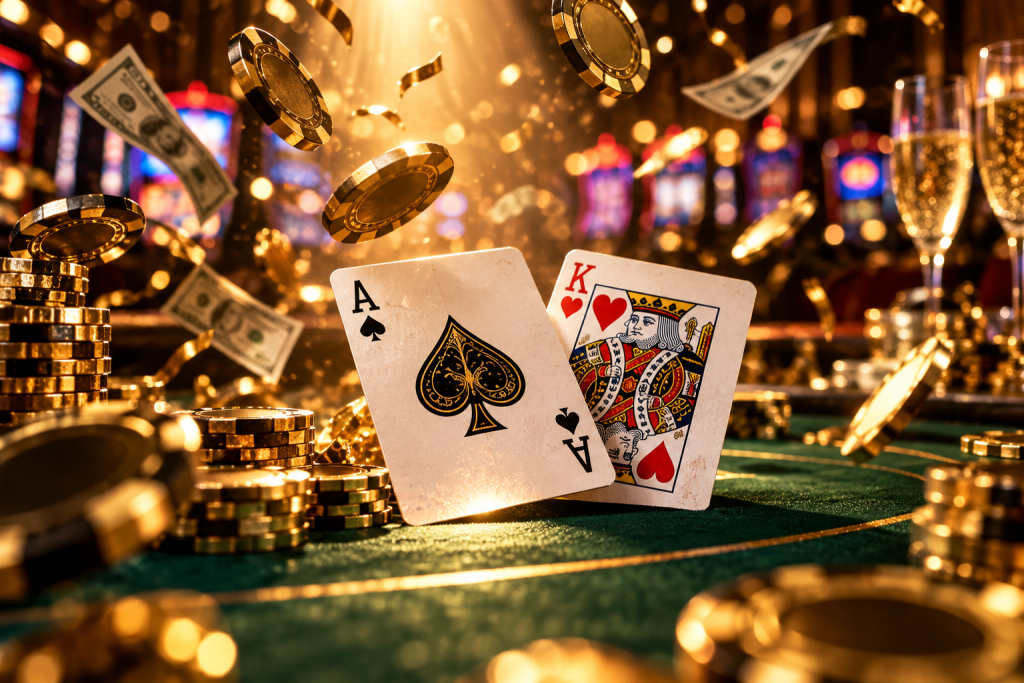
The cleanest starting point is a single 52-card deck. Four aces exist. Sixteen ten-value cards exist: four tens, four jacks, four queens, and four kings. A natural blackjack requires exactly one card from each group in the first two cards dealt. Nothing else qualifies. A pair of aces is not 21. Two ten-value cards are 20. The hand must cross the two groups.
Ordered ways: ace first, then ten, and the reverse
If the order in which the cards arrive matters, the arithmetic is direct. The first card is an ace in 4 ways out of 52, and the second card is a ten-value card in 16 ways out of the remaining 51. That gives 4 multiplied by 16, which is 64 ordered sequences. The first card is a ten-value card in 16 ways out of 52, and the second card is an ace in 4 ways out of the remaining 51. That gives another 64 ordered sequences. The total is 128 ordered two-card sequences that produce a natural blackjack from one fresh deck.
This is the number most people mean when they ask how many ways exist, because the deal itself is an ordered process. The dealer gives the first card, then the second. The two sequences feel different at the table even though the final hand is identical. A player who sees an ace first and then a ten experiences a different moment than a player who sees a ten first and then an ace. The arithmetic respects that difference by counting both.
Unordered ways: the hand is the hand
If the order does not matter, the count collapses. An ace and a ten-value card is one hand regardless of which card arrived first. There are 4 aces and 16 ten-value cards, so the number of unordered ace-ten combinations is 4 multiplied by 16, which is 64. This is exactly half of 128, and the halving is not a coincidence. Every unordered hand corresponds to two ordered sequences, one for each possible arrival order.
Neither number is wrong. The ordered count describes the dealing process. The unordered count describes the resulting hand. A probability calculation can use either one as long as the denominator matches. The total number of ordered two-card sequences from one deck is 52 multiplied by 51, which is 2,652. The total number of unordered two-card hands is half of that, or 1,326. Dividing 128 by 2,652 gives the same probability as dividing 64 by 1,326. Both reduce to the same fraction.
What the probability is
The probability of being dealt a natural blackjack from a single fresh deck is 128 divided by 2,652. That reduces to 32 divided by 663. As a decimal it is approximately 0.0483, which is about 4.83 percent, or roughly one hand in every 20.7 deals. This is the figure that matters at the table, not the raw count of ways, because the count alone tells a player nothing about how often the event occurs. A rare event can have many ways to happen if the total space of possibilities is enormous. A common event can have few ways if the space is small.
The probability changes when the deck composition changes. A single deck has 4 aces among 52 cards. A six-deck shoe has 24 aces among 312 cards. The ratio of aces to total cards stays the same, but the conditional probability after the first card shifts slightly because removing one card from a larger shoe changes the remaining proportions less than removing one card from a single deck. The difference is small but real, and it is one reason published blackjack strategy charts specify the number of decks in play.
Where the house edge enters the same hand
A natural blackjack is the best starting hand in the game, but it does not escape the house edge. The edge in blackjack comes from the rule that the player acts first. When both the player and the dealer bust, the player loses. The dealer's natural blackjack also beats the player's ordinary 21, and the payout on a player's natural blackjack is typically 3 to 2 rather than even money. Some tables pay 6 to 5 instead, which changes the value of the hand materially without changing how often it is dealt.
The probability of being dealt 21 is the same for the dealer as for the player under identical dealing conditions. The asymmetry is not in the frequency of the hand but in what happens after it appears. A player who is dealt a natural blackjack receives a premium payout. A dealer who is dealt one collects the player's wager unless the player also has a natural, in which case the hand pushes. The edge is built into the rules that govern outcomes, not into the probability of the cards themselves.
Decisions per hour change exposure, not the deal
The number of ways to be dealt 21 does not change with how quickly a player plays. What changes is how many opportunities the player has to see the event. At a full table, a player might see 60 to 80 hands per hour. At a heads-up table or an online game with fast dealing, the count can be several times higher. Each hand is an independent draw from the same deck composition, so the probability per hand stays fixed. The total number of natural blackjacks a player expects to see in a session is the probability per hand multiplied by the number of hands played.
This is where expected value becomes concrete. Suppose a player wagers one unit per hand and plays 100 hands in a session. The expected number of natural blackjacks is about 4.83, because 100 multiplied by 0.0483 is 4.83. The actual number in any given session will be an integer, often 3 or 4 or 6, and occasionally 0 or 9. The variance around the expectation is large over short sessions. Over 10,000 hands the expected count is about 483, and the observed count will usually be much closer to that figure. The long-run average is stable. The short-run experience is noisy.
Why progression systems do not touch this number
A player who increases their wager after a loss or after a win is not changing the probability of being dealt a natural blackjack. The cards do not know the bet size. A progression system changes the amount at risk on each hand, which changes the distribution of session outcomes, but it does not change the expected loss per unit wagered. The house edge applies to the total amount wagered, not to the number of hands played or the pattern of bet sizes.
Here is the arithmetic. Suppose a game has a house edge of 0.5 percent under a specific rule set. A player who wagers one unit on each of 100 hands has a total exposure of 100 units and an expected loss of 0.5 units. A player who doubles the wager after every loss and returns to one unit after every win has a different total exposure depending on the sequence of outcomes, but the expected loss remains 0.5 percent of whatever total amount was wagered. The progression redistributes when losses occur. It does not remove the edge. A natural blackjack pays the same 3 to 2 whether the wager is one unit or ten, and the probability of receiving it is unchanged.
What the count of ways cannot tell you
The number 128 is a fact about a single deck under standard composition. It says nothing about whether the game is fair, whether the operator is solvent, or whether the player will win. It is a counting exercise, not a prediction. A player who knows that a natural blackjack occurs about once every 20.7 hands has learned something real about the rhythm of the game, but that knowledge does not change the expected loss on the hands where no natural appears. Most hands are not natural blackjacks, and the house edge operates on all of them.
The useful version of this question is not the raw count but the relationship between the count and the total space of possibilities. That relationship is what produces the probability, and the probability is what feeds into expected value. A player who understands that a natural blackjack is a rare but regular event, that its frequency is independent of bet size, and that the house edge is built into the rules rather than the deal has understood the money question underneath the counting question. The rest is arithmetic.
FAQ
Does the number of decks change how many ways there are to be dealt 21?
Yes, the raw count changes because the deck composition changes. A six-deck shoe has 24 aces and 96 ten-value cards among 312 total cards, so the number of ordered ace-ten sequences is 24 multiplied by 96, which is 2,304, and the reverse order adds another 2,304 for a total of 4,608 ordered sequences. The total ordered two-card sequences from a six-deck shoe is 312 multiplied by 311, which is 97,032. The probability is 4,608 divided by 97,032, which is approximately 0.0475, or about 4.75 percent. The probability is slightly lower than the single-deck figure of about 4.83 percent because removing one card from a larger shoe changes the remaining proportions less.
Is being dealt 21 the same as winning the hand?
No. A natural blackjack is a starting hand of an ace and a ten-value card. It wins immediately unless the dealer also has a natural, in which case the hand pushes. An ordinary 21 made from three or more cards does not carry the premium payout and can lose to a dealer's natural blackjack. The probability of being dealt 21 as the first two cards is a specific event. The probability of winning the hand after being dealt 21 depends on the dealer's upcard and the rules for the dealer's play, which are separate calculations.
Why does the payout on a natural blackjack matter more than the probability of getting one?
The payout determines how much value the hand contributes to the player's expected return. A 3 to 2 payout on a natural blackjack returns 1.5 units of profit per unit wagered. A 6 to 5 payout returns 1.2 units. The probability of the hand is the same in both cases, but the contribution to the player's overall return drops when the payout is reduced. The difference in house edge between a 3 to 2 table and a 6 to 5 table is larger than many other rule variations, which is why the payout is printed on the table layout and should be read before sitting down.
Play responsibly
Gambling should be treated as paid entertainment, never as a way to earn income or recover losses. 1-800-MY-RESET (1-800-697-3738)
18+ or 21+ depending on where you are; follow the minimum age that applies to you.
This article is general information about how these mechanics work. It is not legal advice and not a recommendation to gamble or to use any particular operator. Availability and legality differ by jurisdiction — check the rules that apply where you are.