


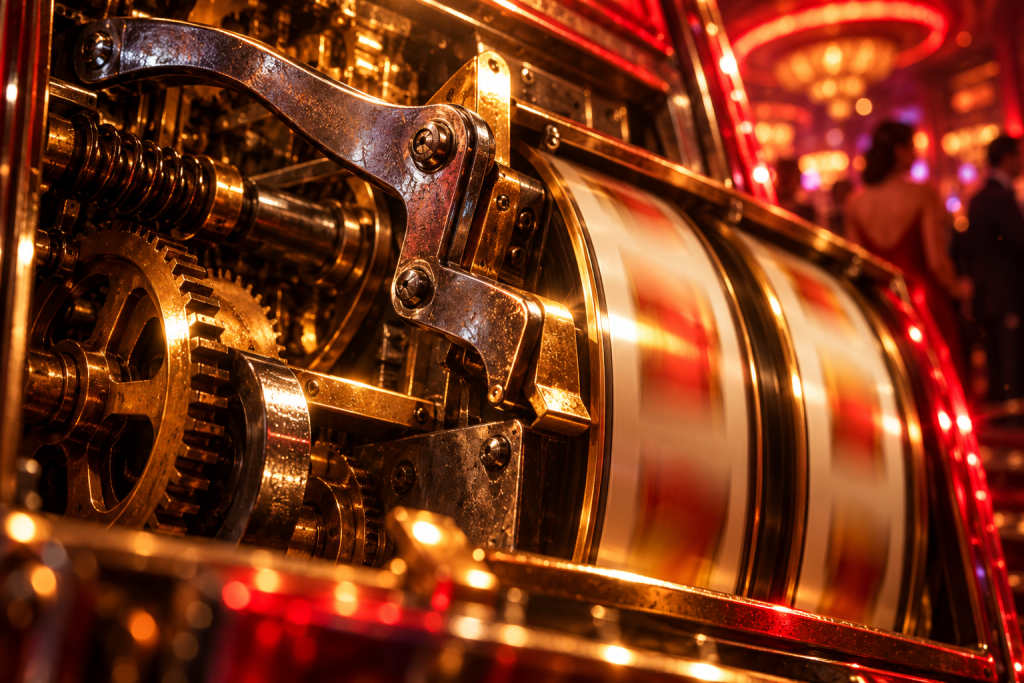
The machine the reader is asking about has no single universal design
A mechanical slot machine is a physical device that indexes reels through a timed sequence of a kicker and a stopper. The exact geometry, spring tension and timing differ between manufacturers and between models from different decades, so any description here covers the shared mechanical principle rather than one specific cabinet. What stays constant is the job of the two parts named in the query: the kicker drives the reel into motion, and the stopper arrests that motion at a defined position.
This article can explain the mechanism in structural terms, but it cannot give a parts list, a service interval, a reel weight or a spring specification for any named machine. Those figures live in the manufacturer's service documentation for a specific model, and a reader who needs them should obtain that document rather than rely on a general description.
Why the kicker and stopper exist at all
A mechanical slot reel is a disc or drum carrying symbols around its circumference. The reel needs two things to function: an impulse that starts it turning, and a means of stopping it so that a symbol lands in the pay window. The kicker provides the impulse; the stopper provides the arrest.
Without a stopper, a spinning reel would coast to a halt under friction and stop at an uncontrolled position. The stopper converts a free-spinning reel into an indexed reel, meaning the reel can only come to rest at one of a fixed set of positions. That indexing is what makes a symbol align with the payline in a repeatable way.
The kicker: what it does and what governs it
The kicker is the component that transfers a burst of mechanical energy into the reel assembly. In a classic electrically assisted mechanical machine, the kicker is typically a solenoid-driven lever or a cam that strikes a star wheel or a pin on the reel hub. In an older fully mechanical machine, the kicker may be part of the handle linkage that winds a spring and releases it into the reel train.
What the kicker does not do is choose the outcome. The outcome is determined by where the reel is when the stopper engages, and that in turn depends on the timing of the handle pull, the state of the timing bar, and the geometry of the stop mechanism. The kicker only supplies the starting impulse; it has no knowledge of symbols and no role in selecting one.
The stopper: how a reel lands on a symbol
The stopper is the component that engages the reel and brings it to a halt at an indexed position. In most mechanical designs the stopper is a flat metal blade or finger that drops into a notch on a star wheel attached to the reel hub. When the stopper drops into the notch, the reel is locked at that position and cannot rotate further until the next cycle releases it.
The number of notches on the star wheel equals the number of stop positions on the reel, which equals the number of symbols on the reel strip. A twenty-symbol reel has twenty stop positions and a star wheel with twenty notches. The stopper blade is retracted by the timing mechanism at the start of each spin and released at the moment the machine is designed to stop that reel.
The sequence in a single spin
A mechanical slot spin follows a fixed mechanical sequence. The player pulls the handle or presses the spin button, which releases the timing bar and retracts the stoppers. The kicker then strikes the reel hub, setting the reel in motion. After a designed delay, the timing mechanism releases the stopper for the first reel, which drops into the next passing notch and locks that reel. The second and third reels follow in sequence, each stopped by its own stopper.
The order in which the reels stop is a design choice, not a rule of physics. Some machines stop the left reel first, others stop the right reel first, and some stop all three nearly simultaneously. The sequence affects the rhythm of play and the perceived suspense, but it does not change the underlying indexing principle.
What varies between machines
Mechanical slot machines differ in several structural dimensions, and a reader examining a specific machine should look for these differences rather than assume a standard design.
| Dimension | What changes | Why it matters for the mechanism |
|---|---|---|
| Reel diameter | Larger or smaller reels hold different numbers of symbols | Changes the star wheel notch count and the stopping resolution |
| Kicker type | Solenoid, spring-loaded lever, or cam-driven arm | Changes the impulse profile and the wear pattern on the reel hub |
| Stopper type | Blade into star wheel, pin into hole, or friction brake | Changes how precisely the reel locks and how much drift occurs |
| Timing source | Mechanical timing bar or electrical timer | Changes how consistently the stopper release is spaced |
| Number of reels | Three, four, or five | Changes the number of kicker and stopper assemblies and the stop sequence |
None of these variations makes one machine more or less fair than another. They are engineering choices within the same indexing principle, and the outcome on any given spin remains a function of where each reel is when its stopper engages.
What the kicker and stopper do not do
A common misreading is that the kicker or stopper somehow selects a winning or losing symbol. Neither part has that role. The kicker is a source of starting impulse, and the stopper is a position lock. The symbol that lands in the window is the one that happens to be at the indexed position when the stopper drops, and that position is the product of the reel's angular momentum, the timing of the stopper release, and the fixed spacing of the notches.
On an electrically assisted mechanical machine, a random number generator may determine when the stopper is released, but the stopper itself is still a dumb mechanical blade. The randomness lives in the timing decision, not in the metal parts that execute it.
Why the physical design constrains the symbol count
A mechanical reel can only carry as many symbols as physically fit around its circumference at a readable size. Each symbol corresponds to one stop notch on the star wheel, so the reel's diameter and the symbol's printed size together set an upper bound on the number of stops. A larger reel can carry more symbols, but it also has more rotational inertia, which changes how hard the kicker must strike and how firmly the stopper must lock.
This is a physical constraint that does not apply to video slots, where the reel strip is a rendered image and the stop count is a software parameter. The mechanical machine is bound by the geometry of its parts, and that geometry is exactly what the kicker and stopper are built to serve.
What to confirm before you go
If the reader wants to examine a mechanical slot machine in person, several details are worth confirming with the venue before travelling. The venue's own guest services desk or museum floor staff can confirm whether a given machine is on display, whether it is operational or static, and whether it is an original mechanical cabinet or a later electromechanical model.
- Whether the machine is operational or displayed as a static exhibit.
- Whether it is a fully mechanical machine or an electrically assisted machine with mechanical reels.
- Whether the cabinet has been modified, which can change the kicker and stopper assembly from its original configuration.
- Whether the venue permits close inspection of the mechanism or keeps the cabinet sealed.
The authoritative source for a specific machine's mechanism is the manufacturer's service manual for that model, not a general description. A reader who owns or maintains a machine should obtain that manual from the manufacturer or a licensed service provider.
FAQ
Does the kicker choose the winning symbol?
No. The kicker supplies the starting impulse that sets the reel in motion. The symbol that lands in the pay window is determined by where the reel is when the stopper engages, which depends on the reel's angular position at that moment and the fixed spacing of the stop notches. The kicker has no role in selecting an outcome and no knowledge of the symbols printed on the reel.
How does the stopper know where to stop the reel?
The stopper does not know anything. It is a mechanical blade or finger that drops into one of the notches on a star wheel attached to the reel hub. The number of notches equals the number of stop positions, so the reel can only lock at one of those fixed positions. The timing mechanism decides when the stopper is released, but the stopper itself simply engages the next passing notch.
Are all mechanical slot machines built the same way?
No. Kicker type, stopper type, reel diameter, notch count and timing source all vary between manufacturers and between models from different decades. A fully mechanical machine from the early twentieth century uses a different impulse and stop design than an electrically assisted mechanical machine from the 1970s. The shared principle is indexed stopping, but the parts that implement it differ widely.
Play responsibly
Gambling should be treated as paid entertainment, never as a way to earn income or recover losses. 1-800-MY-RESET (1-800-697-3738)
18+ or 21+ depending on where you are; follow the minimum age that applies to you.
This article is general information about how these mechanics work. It is not legal advice and not a recommendation to gamble or to use any particular operator. Availability and legality differ by jurisdiction — check the rules that apply where you are.