


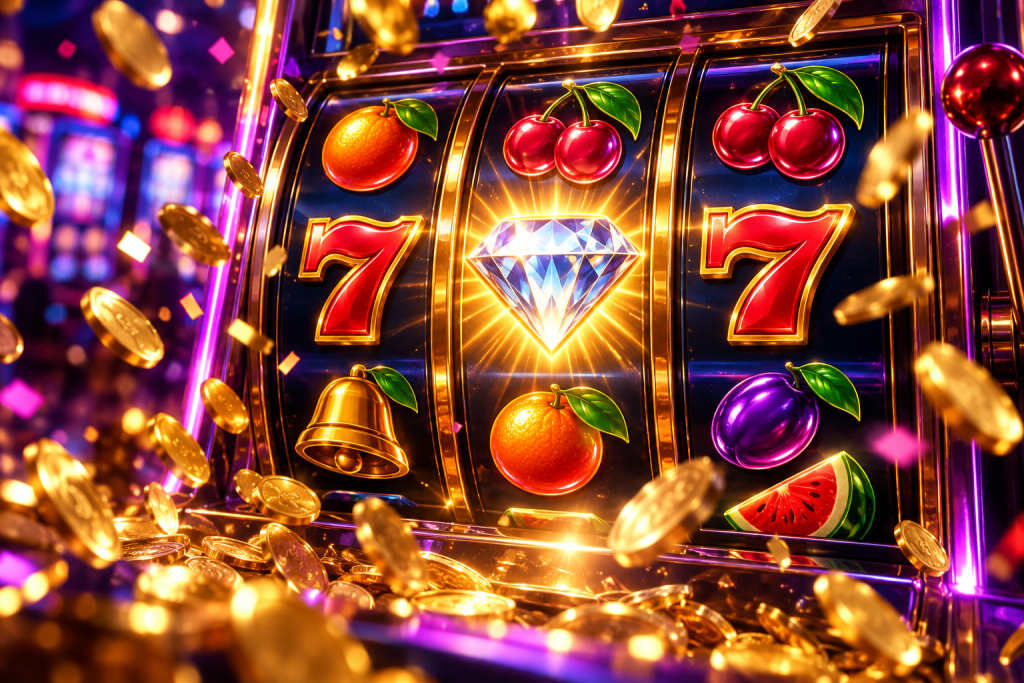
The question behind the unicow
When a player asks how often a particular symbol appears on a slot machine, they are usually trying to work out whether the game is close to paying, or whether a specific icon is deliberately scarce. The honest answer is that no symbol appears on a fixed schedule, and no symbol's recent absence makes it more likely to appear next. What the player is really observing is the interaction between a random number generator, the way a game's reels are mapped, and the weighting the game designer assigned to each symbol.
A slot does not spin physical reels in the old mechanical sense. Each spin produces a random number, and that number is converted into a reel position. The symbols the player sees are the result of that conversion. How often any one symbol lands is therefore a statistical property of the game's design, not a countdown the machine is running.
What the RNG does
The random number generator is the algorithm that determines game outcomes. It runs continuously, producing numbers even when no one is playing. When a player presses spin, the game takes the next number from that stream and uses it to select a stopping position for each reel. The important point is that the RNG has no memory. A spin that lands three scatter symbols does not make the next spin more or less likely to land anything else. Each spin is an independent event.
Independent testing laboratories are commonly used to certify RNG behaviour. That certification covers game mechanics, not an operator's financial conduct. For a player, the practical meaning is that the game's outcome distribution is fixed in its design, and no sequence of past spins changes it.
Reel mapping and symbol weighting
The visual reel a player sees is a display, not the full set of possible outcomes. Behind it sits a virtual reel or a weighted table that maps each random number to a symbol. A game designer can place a high-paying symbol on the visible reel strip only once while placing a low-paying symbol many times. That means the unicow, or any other premium symbol, may be genuinely rarer than the card-rank symbols around it, but its rarity is a design choice expressed as a probability, not a timer.
Two games can show identical-looking reels and still have completely different symbol frequencies, because the weighting happens in the mapping layer the player never sees. The only place the player can learn how a symbol pays is the paytable, and the paytable does not usually state the symbol's probability. It states the prize for a winning combination.
| What the player sees | What it tells them |
|---|---|
| A symbol appearing often | The symbol is weighted to appear frequently, usually because it pays little or forms part of many near-miss combinations |
| A symbol appearing rarely | The symbol is weighted to appear less often, usually because it pays more or triggers a feature |
| A symbol not appearing for many spins | Nothing predictive; each spin is independent and the symbol's probability has not changed |
| A symbol appearing several times in a row | A run of independent outcomes; the next spin's probability is unchanged |
Paylines versus ways-to-win
How a symbol appears also depends on the game's pay structure. Fixed-payline games require betting all lines, and a symbol must land on one of those lines in the right positions to count. Ways-to-win formats pay on adjacent-symbol combinations instead of fixed lines, which changes how often a given symbol contributes to a win without changing the symbol's underlying frequency on the reels.
A player trying to judge how often the unicow appears should first check which format the game uses. On a fixed-payline game, the same symbol can appear on the screen but miss every active line and pay nothing. On a ways-to-win game, position matters less and adjacency matters more. The paytable and the game's information panel state which format applies.
Volatility changes the pattern, not the rate of return
Volatility, also called variance, describes how payouts are distributed over time. High volatility means rarer but larger payouts; low volatility means more frequent but smaller ones. Volatility does not change a game's RTP. A high-volatility game may hold back its big symbol combinations for long stretches, while a low-volatility game doles out small wins constantly. A player who feels the unicow never appears may simply be playing a high-volatility game where the premium symbol is part of a rare, large payout event.
Return to Player is a theoretical percentage of total wagered money a game returns to players over a very large number of spins or hands. It is a long-run statistical average, not a per-session guarantee. House edge and RTP are complements: they sum to 100% for the same game. Neither figure tells a player when a particular symbol will appear next.
Fixed and progressive jackpots
If the unicow is tied to a jackpot, the jackpot type matters. Fixed jackpots pay a set amount. Progressive jackpots grow from a share of qualifying wagers and reset after a win. Progressive contributions are typically taken out of the game's return, and some progressives require a maximum-stake bet to qualify. A symbol that triggers a progressive may be weighted differently from one that merely pays a line win, because the game designer must fund the jackpot pool from the base game's return.
A player checking how often a jackpot symbol appears should look at the game's rules screen, which usually states whether the jackpot requires a specific bet level and whether the symbol must land on a particular reel or line. The paytable will not state the symbol's probability, but the rules screen often clarifies the qualifying conditions.
How to read the information panel and paytable
Every regulated slot carries an information panel, usually opened with a button marked with an "i" or a question mark. That panel contains the game's rules, the paytable, and often the theoretical return. The paytable lists every symbol and what it pays for two, three, four, or five of a kind, and it distinguishes between regular symbols, scatters, wilds, and bonus triggers. The rules page states the number of paylines or the ways-to-win count, the bet range, and any feature rules.
What the paytable does not typically state is the probability of any single symbol. A player who wants to know how often the unicow appears will not find a percentage printed on the screen. They will find the symbol's payout values and, from the game's volatility and the symbol's position in the paytable, can infer that a high-paying symbol appears less often than a low-paying one. The exact frequency is embedded in the game's maths, which is not usually published at symbol level.
What a player can and cannot control
Stake size changes the amount wagered per spin and therefore the amount a winning combination pays, but it does not change the probability of any symbol appearing. A maximum bet does not make the unicow more likely to land unless the game's rules state that a feature or jackpot requires a specific bet level. In that case, the qualifying condition is a rule of the game, not a change in the RNG.
No play pattern alters the programmed return. Stopping the reels early, changing bet size between spins, or switching games after a win does not change the underlying probabilities. A player can choose a game with lower volatility if they prefer more frequent small wins, or a game with a higher stated RTP if they want a slower expected rate of loss, but neither choice makes a particular symbol appear on a schedule.
FAQ
Does a slot symbol become more likely after a long absence?
No. Each spin is independent, and the RNG has no memory. A symbol that has not appeared for many spins has exactly the same probability of appearing on the next spin as it did on the previous one. The feeling that a symbol is "due" comes from watching short runs of independent events, not from any change in the game's maths.
Can I find the exact probability of a specific symbol anywhere?
Usually not. The paytable states what each symbol pays, and the information panel may state the game's overall theoretical return and volatility, but symbol-level probabilities are part of the game's internal design and are not normally published. A player can infer relative rarity from the paytable and the game's volatility, but not an exact percentage.
Does betting more make a premium symbol appear more often?
No, unless the game's rules state that a feature or jackpot requires a specific bet level to qualify. In that case the symbol's probability is unchanged, but a lower bet may not be eligible for the feature the symbol triggers. The qualifying condition is a rule of the game, not a change in the random number generator.
Gambling can be addictive. Play responsibly. If you or someone you know is struggling with gambling addiction, call the National Problem Gambling Helpline at the helpline printed in the footer below or text the helpline printed in the footer below. Help is available 24/7. Must be 18 or older to gamble. Void where prohibited. Please play responsibly.
Play responsibly
Gambling should be treated as paid entertainment, never as a way to earn income or recover losses. 1-800-MY-RESET (1-800-697-3738)
18+ or 21+ depending on where you are; follow the minimum age that applies to you.
This article is general information about how these mechanics work. It is not legal advice and not a recommendation to gamble or to use any particular operator. Availability and legality differ by jurisdiction — check the rules that apply where you are.