
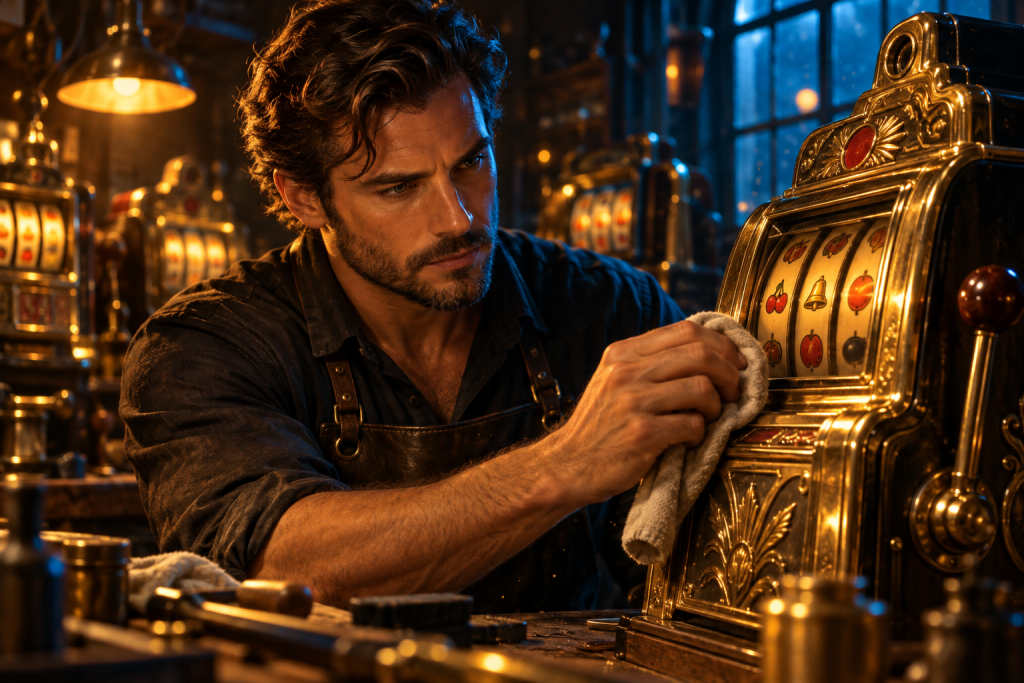
The repair question is about a physical object, not a casino game
A reader asking how to repair an antique slot machine is usually standing in front of a cast-iron or early electromechanical cabinet that has not worked properly in decades. The question has nothing to do with playing odds, payouts, or casino policy. It is a question about mechanical restoration: diagnosing a machine that will not cycle, will not pay, or will not hold its timing.
This article can explain the general shape of that work, the skill sets it draws on, and the categories of information a restorer needs. It cannot give a step-by-step repair sequence for a specific machine, because no specific machine, model, or documented fault is supplied here. The honest first answer is that antique slot machine repair is a craft that rewards patience, documentation, and the right reference material for the exact mechanism in front of you.
What counts as an antique slot machine
The term covers a wide range of machines built across roughly a century, and the repair approach differs sharply between them. Early machines are purely mechanical: a handle pull winds a spring, a clockwork governor controls reel spin, and levers, cams, and pawls stop each reel in sequence. Later machines add electric motors, relays, and eventually solid-state components, which changes the nature of the failure and the tools required.
Before any repair begins, the single most useful step is identifying the maker, model, and approximate production period. That identification determines which manuals, parts diagrams, and community resources apply. A machine with no visible nameplate or serial number is a research project in itself.
| Machine type | Typical drive | Common failure points | Repair approach |
|---|---|---|---|
| Early mechanical (late 1800s to 1930s) | Handle, spring, clockwork governor | Worn pawls, broken springs, gummed lubrication, bent levers | Disassembly, cleaning, hand-fitting replacement parts |
| Electromechanical (1940s to 1970s) | Electric motor with mechanical reel stops | Relay contacts, motor brushes, dried grease, broken wiring | Electrical testing plus mechanical adjustment |
| Early solid-state (1970s to 1980s) | Circuit boards and stepper motors | Failed capacitors, cold solder joints, corroded connectors | Board-level diagnosis and component replacement |
The repair process is diagnosis first, parts second
Experienced restorers almost never begin by replacing parts. The first task is to observe the machine through a full cycle and identify exactly where it stops, slips, or fails to engage. A handle that will not pull, a reel that spins too long, a payout slide that jams, and a coin that will not register are different problems with different causes.
Diagnosis typically proceeds from the outside in: confirm power or spring tension, verify the coin path, watch the cycle, and only then open the mechanism. Many faults on purely mechanical machines are caused by old lubricant that has hardened into a varnish-like film. Cleaning and correct re-lubrication solve a meaningful share of problems without a single new part.
Skills the work draws on
Antique slot machine repair combines several distinct skill areas. None of them is exotic, but a restorer who has only one of them will hit a wall quickly.
- Mechanical reasoning: understanding how levers, cams, springs, and pawls interact, and how wear changes their timing.
- Metalwork and fabrication: making or modifying small parts when originals are no longer available.
- Electrical diagnosis: for electromechanical and early solid-state machines, tracing circuits and testing components safely.
- Finish and conservation: deciding what to clean, what to preserve, and what to leave alone, especially on machines with collector value.
- Documentation and photography: recording the position of every part before and during disassembly so the machine can be reassembled correctly.
What a restorer needs before opening the case
The most valuable resource is documentation specific to the machine in question. Original service manuals, parts lists, and exploded-view diagrams exist for many major makers, but they are not collected in any single place. Collector clubs, online archives, and specialist literature are the usual channels for finding them.
The second resource is a reliable source for parts. Some common parts are reproduced today; others must be salvaged from donor machines or made by hand. The availability of a given spring, pawl, or payout slide is entirely model-specific and changes over time as reproduction runs sell out.
The third resource is community knowledge. Forums and clubs devoted to vintage slot machines are where restorers document unusual faults, share measurements, and identify machines with missing nameplates. The quality of that knowledge varies, so it is best cross-checked against printed documentation.
Safety and legal considerations sit outside the repair itself
An antique slot machine is a heavy mechanical device under spring tension. A mainspring that releases unexpectedly can cause serious injury to hands and fingers. Restorers routinely secure or release spring tension in a controlled way before disassembling the mechanism, and they treat every unknown machine as if it is under tension until proven otherwise.
Electrical machines add the usual hazards of line voltage and aged insulation. A machine that has sat for decades should be inspected by someone competent in electrical safety before it is plugged in. The repair question is mechanical; the safety question is electrical and physical.
Separately, the legal status of owning, transporting, or displaying an antique slot machine varies by jurisdiction. Some places treat old machines as collectibles with no special restriction; others regulate possession regardless of age. The authoritative source for that question is the gaming or gambling authority in the reader's own jurisdiction, not a repair manual and not this article.
Restoration versus repair: a decision that changes the work
A machine that will be displayed in a private collection may need only to look right and cycle reliably. A machine that will be operated regularly needs a higher standard of mechanical soundness. A machine with significant collector value may be worth more with its original worn parts than with new replacements, even if it does not run perfectly.
That decision shapes every subsequent choice: whether to replate metal, whether to replace a worn pawl or build it up with weld, whether to keep original paint or refinish. A restorer who skips this decision often does work that later has to be undone.
| Decision point | Display-only approach | Regular-operation approach |
|---|---|---|
| Worn mechanical parts | Clean and preserve; leave original where possible | Replace or rebuild to restore reliable timing |
| Original finish | Conserve; avoid stripping | Refinish only where function or safety requires |
| Electrical components | May remain disconnected | Must be safe and fully functional |
| Documentation | Photo record for future owners | Photo record plus parts and adjustment notes |
Why no article can give a universal step-by-step
A repair sequence that is correct for one maker's 1930s mechanism may be meaningless for another maker's 1960s electromechanical machine. Even within one maker, designs changed across decades, and machines were sometimes modified by operators during their working lives. A restorer who follows a generic sequence without checking it against the actual mechanism in front of them can easily make a fault worse.
This is why the honest answer to the repair question begins with identification and documentation, not with a wrench. The machine itself, once identified, points to the specific manual, diagram, and community that can guide the work.
What to confirm before you go
Before spending money on parts, manuals, or a donor machine, several things are worth confirming. Each of these is changeable and specific to the reader's situation, and none can be stated as a fixed fact here.
- Exact maker, model, and serial number: confirm from the machine's own nameplate or casting marks, not from a seller's description.
- Whether a service manual or parts diagram exists for that exact model: check collector archives, clubs, and specialist literature.
- Parts availability for the specific fault: confirm with reproduction parts suppliers or donor-machine sources before disassembly.
- Legal status of possession in your jurisdiction: confirm with the gaming authority where you live, not with an online seller.
- Whether the machine is under spring tension or has live electrical components: confirm by inspection before opening the case.
FAQ
Can I repair an antique slot machine without any mechanical experience?
The work is learnable, but it is not a beginner project in the sense of a single afternoon fix. Diagnosis requires understanding how the mechanism is supposed to cycle, and disassembly requires care with springs under tension. A better first step than opening the case is obtaining the correct documentation for the specific machine and studying the mechanism before touching it.
Where do I find parts for an old slot machine?
Parts availability is entirely model-specific. Some common springs, pawls, and payout slides are reproduced today; others must be salvaged from donor machines or fabricated by hand. The reliable channels are collector clubs, specialist literature, and reproduction parts suppliers that focus on vintage machines. Confirm that a part fits your exact model before buying.
Is it legal to own and repair an antique slot machine?
This depends on the jurisdiction where the machine is kept, and the answer can change even between neighboring areas. Some places treat old machines as collectibles; others regulate possession regardless of age. The authoritative source is the gaming or gambling authority in your own jurisdiction. This article does not state the legal status of owning or repairing any machine anywhere.
Play responsibly
Gambling should be treated as paid entertainment, never as a way to earn income or recover losses. 1-800-MY-RESET (1-800-697-3738)
18+ or 21+ depending on where you are; follow the minimum age that applies to you.
This article is general information about how these mechanics work. It is not legal advice and not a recommendation to gamble or to use any particular operator. Availability and legality differ by jurisdiction — check the rules that apply where you are.