


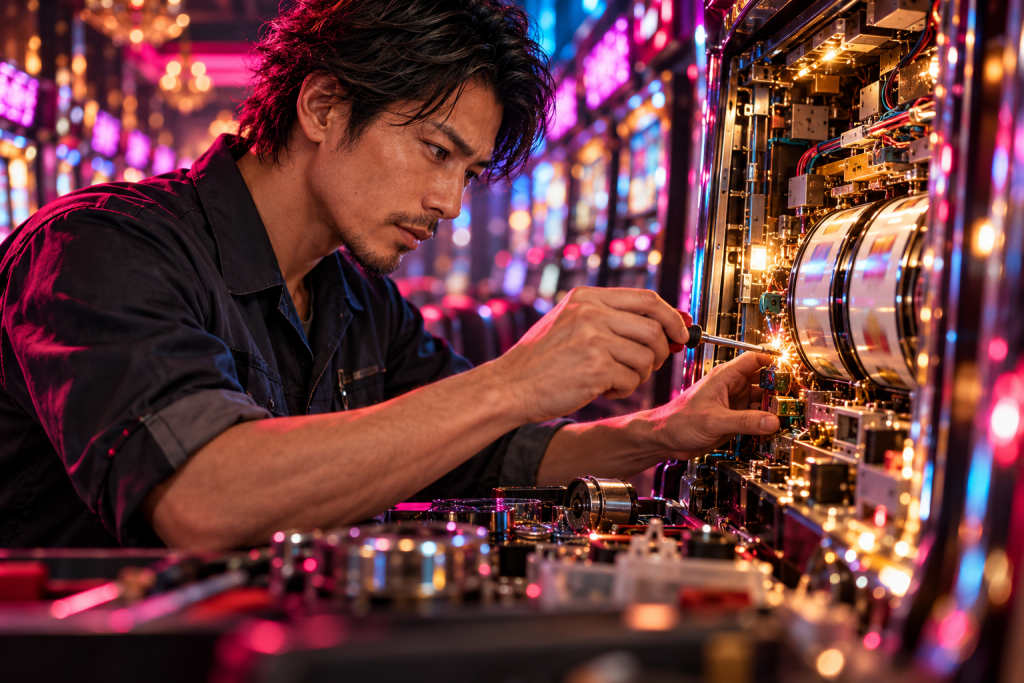
The repair question starts with the machine's design
Someone asking how to repair a Japanese slot machine is usually looking at one of two very different objects: a pachislot cabinet built for the Japanese amusement market, or a slot machine built for a casino floor that happens to be of Japanese manufacture. The two share a cabinet, a reel mechanism, and a bill or coin path, but the parts supply, the documentation, and the rules that govern who may open the cabinet differ sharply. A repair manual for one will not reliably cover the other.
Japanese slot machines are built around a layered design. A mechanical or motor-driven reel assembly sits behind a glass panel, a coin or token acceptor feeds the play cycle, and a control board runs the game logic. Most repair work is not about the game logic at all. It is about a worn belt, a dirty sensor, a stuck coin, a failed backlight, a bent reel index, or a power supply that no longer holds voltage. Those failures are mechanical and electrical, and they are the same class of failure found in any coin-operated amusement equipment.
The first useful step in any repair is identifying the machine's exact model, board revision, and market of origin. Japanese amusement machines are often exported after their service life in Japan, and an exported cabinet may have had its payout system removed, its token acceptor replaced, or its control board swapped for a generic one. The model number printed on the cabinet is not always the model number of the electronics now inside it.
What usually fails first
Most repair requests begin with a machine that powers on but does not play, or plays but does not pay, or pays but makes a grinding noise. Each symptom points to a different subsystem. A machine that does not power on points to the power supply, the main fuse, or the wiring harness. A machine that powers on but does not accept coins points to the acceptor's optical sensors, the coin rail, or the solenoid that routes the coin. A machine that accepts coins but does not spin the reels points to the start switch, the reel motor driver, or a safety interlock that is not closed.
A machine that spins but stops on the wrong symbols, or pays the wrong amount, is a different category of problem. On a mechanical machine, the reel index disc and the payout slides wear together and drift out of alignment. On an electronic machine, the issue is usually a failed optical sensor on the reel hub or a corrupted setting in the control board's memory. Neither problem is fixed by adjusting a single screw; both require the machine's timing diagram and a way to test each sensor's output.
Grinding noises are almost always mechanical: a dry bearing, a stretched drive belt, a cracked gear, or a coin jammed against the hopper wheel. These are the most approachable repairs for a careful owner, because the parts are visible once the cabinet is open and the failure is audible. The risk is not the mechanical work itself; it is opening the cabinet without first disconnecting power and discharging the capacitors in the power supply.
Who is allowed to open the cabinet
The rules that govern who may open a slot machine cabinet, and what they may do inside it, are set by the jurisdiction where the machine operates, not by the manufacturer. A machine sitting in a private collection is governed by ordinary property and electrical-safety rules. A machine sitting on a casino floor is governed by the gaming authority in that jurisdiction, which typically requires that only licensed technicians open the cabinet, that every access be logged, and that any change to the game program or the payout settings be re-verified before the machine returns to service.
Japanese amusement machines in Japan operate under a different framework. The cabinet is an amusement device, not a wagering device, and the repair channel runs through the manufacturer's service network, the distributor, or an independent amusement-equipment technician. The machine's payout behaviour is set by the manufacturer's ROM and by the mechanical payout slides, and a repair that changes either one may put the machine outside the technical standard it was certified under at the time of manufacture.
None of this means a private owner cannot repair a machine they own. It means the owner should first establish which framework applies to their machine, and then follow the documentation that matches that framework. A casino-floor machine should never be opened by someone who is not authorised by the operator and the jurisdiction. A home machine should never be opened by someone who has not read the electrical-safety section of the service manual.
Parts, tools, and documentation
Japanese slot machines are not a single parts ecosystem. A pachislot cabinet from a major Japanese manufacturer uses metric fasteners, JIS screw heads, and connectors that are common in Japanese consumer electronics. A casino slot machine built by a Japanese manufacturer for export uses the parts and connectors specified by the casino operator's procurement standards, which are often different. A repair that starts with the wrong screwdriver can strip a JIS screw head and turn a simple fix into a machine-shop job.
The minimum tool set is modest: a JIS screwdriver set, a multimeter, a non-conductive probe, a discharge resistor for the power supply capacitors, a set of metric sockets, and a good light. The documentation is harder to obtain than the tools. Service manuals for Japanese amusement machines are often printed only in Japanese, distributed only to authorised service centres, and keyed to a specific board revision. An English-language manual for an exported cabinet may describe a different board than the one installed.
For parts, the realistic channels are the manufacturer's parts desk, a distributor that handles Japanese amusement exports, a specialist parts reseller, or a donor machine of the same model and revision. Buying a donor machine is often cheaper than buying a single reel assembly, because the parts are no longer in production and the reseller prices them as collectibles. The donor route only works if the donor's board revision and mechanical assembly match the machine being repaired.
Repair sequence that matches how these machines are built
A defensible repair sequence starts with the power supply, because a machine with unstable power will produce symptoms in every other subsystem. The order that follows is: power supply and fuses, then the coin path, then the reel drive, then the reel index sensors, then the payout mechanism, then the control board. The control board is last because it is the most expensive part to replace and the most likely to be blamed for a fault that is a dirty connector or a failed sensor.
Each step has a test. The power supply is tested with a multimeter at the board connector, not at the wall. The coin path is tested by manually passing a coin through the acceptor with the power off, then with the power on. The reel drive is tested by watching the reel spin with the glass off and listening for the source of the noise. The index sensors are tested with the multimeter in continuity mode while the reel is turned by hand. The payout mechanism is tested by triggering each payout slide in sequence and confirming the coin count. Only when all of those pass does the control board become the suspect.
Document every step. A repair log that records the symptom, the test performed, the measurement taken, and the part replaced is the only thing that makes a second repair session faster than the first. It is also the only thing that lets a future owner, or a future technician, understand what was already changed.
What cannot be fixed by a home repair
Some failures are not repairable at the component level by a careful owner. A control board with a failed surface-mount chip, a reel motor with a burned winding, a power supply with a blown switching transistor, or a payout hopper with a cracked casting are all cases where the repair is a replacement, and the replacement part may not exist. The honest answer in those cases is that the machine becomes a parts donor, or it waits for a specialist with a rework station and a stock of boards from scrapped machines.
The game program itself is a separate matter. The ROM or flash memory that holds the game logic is not something a repair technician modifies. If the machine's behaviour is wrong and the mechanical path is clean, the fault is in the board, and the fix is a board swap or a board repair by someone with the right test equipment. Changing the game program to alter the payout behaviour is not a repair; it is a modification, and it changes the machine's technical character.
What to confirm before you start
Before opening any Japanese slot machine, confirm four things. First, confirm the machine's exact model, board revision, and market of origin, because every later step depends on that identification. Second, confirm which framework applies to the machine: a private collection, a casino floor, or a Japanese amusement location. Third, confirm that you have the service documentation for the board revision installed, not a similar model. Fourth, confirm that you have a way to discharge the power supply capacitors safely, because the stored charge in a slot machine power supply can persist long after the machine is unplugged.
The authoritative current answer for a specific machine lives in the manufacturer's service documentation for that model and revision, in the distributor's parts list, and in the rules published by the gaming authority or the amusement-equipment authority in the jurisdiction where the machine operates. A private owner should also check the electrical-safety requirements in their own jurisdiction before working on any mains-powered equipment.
FAQ
Can a private owner repair a Japanese slot machine without a licence?
For a machine in a private collection, the governing rules are ordinary property and electrical-safety rules, and no special licence is required. For a machine on a casino floor, the jurisdiction's gaming authority sets the rules, and those rules typically require that only authorised technicians open the cabinet. The owner's first step is to establish which framework applies to their machine and to follow the documentation that matches it.
Why does the same model number have different parts inside?
Japanese slot machines are exported after their service life, and an exported cabinet may have had its payout system removed, its token acceptor replaced, or its control board swapped. The model number on the cabinet is not always the model number of the electronics inside. A repair must be keyed to the board revision installed, not to the model number printed on the cabinet.
Where can I get a service manual for a Japanese slot machine?
Service manuals are often printed only in Japanese, distributed only to authorised service centres, and keyed to a specific board revision. The realistic channels are the manufacturer's parts desk, a distributor that handles Japanese amusement exports, a specialist parts reseller, or a donor machine of the same model and revision. An English-language manual for an exported cabinet may describe a different board than the one installed.
Play responsibly
Gambling should be treated as paid entertainment, never as a way to earn income or recover losses. 1-800-MY-RESET (1-800-697-3738)
18+ or 21+ depending on where you are; follow the minimum age that applies to you.
This article is general information about how these mechanics work. It is not legal advice and not a recommendation to gamble or to use any particular operator. Availability and legality differ by jurisdiction — check the rules that apply where you are.