


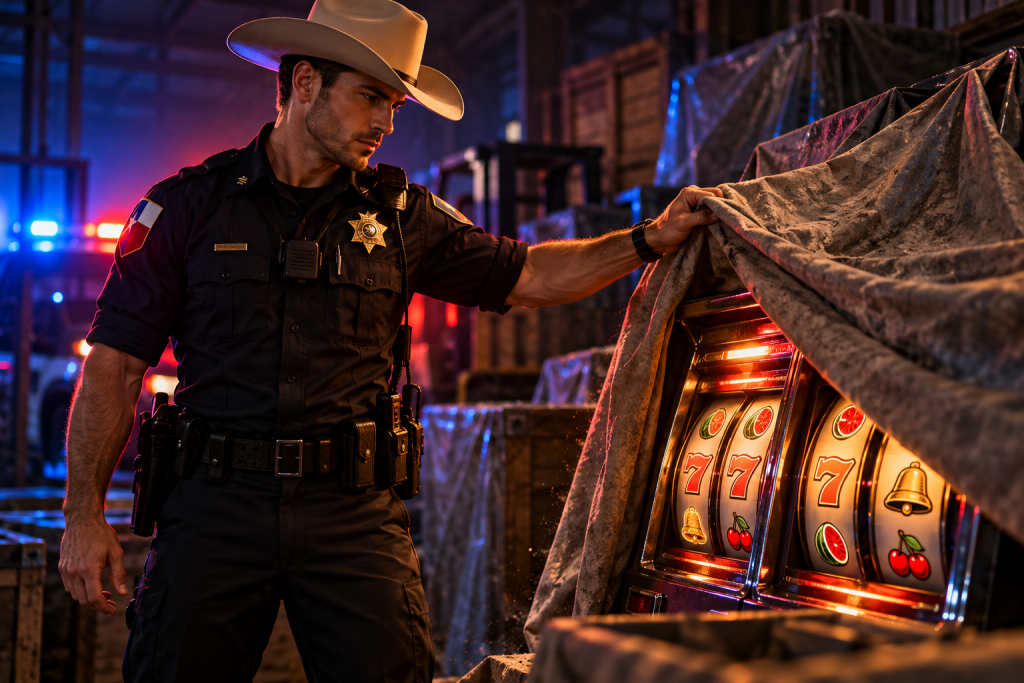
A reader searching this phrase has usually walked into a convenience store, gas station, game room, or private club and seen a row of machines that look like slots but operate outside any casino floor. Texas is a state where the legal landscape around gambling devices is unusually strict, and the first useful thing to know is that the question is not really about casinos at all. It is about how a private citizen flags a machine to the authority that can act on it.
This article explains the reporting mechanics: what to document, which categories of agencies handle complaints, what to expect after a report, and what this article deliberately does not claim. It names no agency as definitively responsible for a specific machine, because jurisdiction depends on where the machine sits and what kind of premises it is in.
The Texas Context for Slot Machines
Texas has a narrow set of legal gambling exceptions, and a machine that looks like a slot is generally not among them unless it falls into a specific carve-out. Charitable bingo, the state lottery, pari-mutuel wagering on horse and dog racing, and certain gambling conducted on federally recognized tribal land each operate under separate frameworks. A standalone slot machine in a strip-mall game room does not sit inside any of those frameworks.
Machines that pay out cash, or that award credits redeemable for cash or cash-equivalent prizes, are the ones most likely to draw enforcement attention. Machines marketed as "eight-liner" devices or as amusement machines with prizes are a long-running gray area in Texas, and local enforcement varies by county. The key point for a reporter is that the machine's appearance matters less than what it pays and how the operator runs it.
Who Handles a Report
Reporting channels in Texas are split across categories of authority rather than concentrated in a single gaming commission. The category that applies depends on the premises, the machine's function, and sometimes the county. The table below lays out the general categories a complaint might route through.
| Agency category | What they typically handle | What a reporter should bring |
|---|---|---|
| Local law enforcement | Machines inside city or county limits, game rooms, convenience stores | Address, machine count, photos, dates observed |
| County attorney or district attorney | Pattern complaints, repeat locations, organized operations | Written summary, prior report numbers, photos |
| State-level public safety or gaming enforcement body | Machines tied to broader illegal gambling activity or multi-county operations | Same documentation, plus any operator names or license plate numbers |
| Federal authorities | Machines connected to organized crime, large cash flows, or tribal-land disputes | Usually via a state or local referral, not a direct citizen tip |
This table describes categories, not named agencies. The correct office for a specific machine depends on where the machine is and which county has jurisdiction. A reader should start with the law enforcement agency for the city or county where the premises sits, because that is the office that can confirm whether it takes gambling-device complaints directly or routes them elsewhere.
What to Document Before You Report
A report that says "there are slot machines at a store on Main Street" is weaker than one that gives an officer enough to act on. The documentation list below is what most enforcement bodies need to open a file, and none of it requires confronting the operator or entering a restricted area.
- The full street address of the premises, or the nearest intersection if no address is posted.
- The name on the storefront or business sign, if any.
- The number of machines visible from the public area.
- What the machines look like: reel-style, video-screen, touchscreen, or cabinet style.
- What signage or wording appears on or near the machines, including any "amusement only" or "no cash value" language.
- Dates and times you observed the machines.
- Whether you saw any payout occur, and what form it took if you did.
- Photos or video taken from a public vantage point, never from inside a restricted area.
Photographs matter, but they must be taken lawfully. Standing on a public sidewalk and photographing a storefront through the window is different from walking behind a counter. A reporter should never trespass, never misrepresent themselves, and never attempt to operate a machine to gather evidence.
What Happens After a Report
Most reports do not produce an immediate raid. An agency that receives a machine complaint will typically assess whether the location falls within its jurisdiction, whether the description matches a known illegal-gambling pattern, and whether it has the resources to investigate. Some complaints are resolved by a letter to the property owner. Others become part of a longer investigation that a citizen never sees conclude.
A reporter should keep their own record of the report: the date, the agency contacted, the name or badge number of the person spoken to if one is given, and any case or report number assigned. If nothing changes and the machines remain, the same documentation can go to the next category of authority up the table.
What This Article Cannot Tell You
This article cannot name the specific agency that will act on a specific machine, because that depends on the machine's location and the county's enforcement posture. It cannot state a timeframe for action, because enforcement priorities and caseloads vary. It cannot tell you whether a particular machine is illegal, because that determination requires an examination of the device, its payout mechanism, and its operator's conduct — none of which a citizen report can settle on its own.
It also cannot give a phone number or address for any agency. The right channel is the one published on the official website of the city, county, or state body that has jurisdiction over the premises. A reader should search for that body's official site and use the contact method listed there.
The Published List of Texas Casino Venues
A separate and frequently confused question is how many legal casino venues Texas has. The published list this article draws from documents 3 venues in Texas, all categorized as Native American, spread across 3 cities: Eagle Pass, Livingston, and El Paso. Each city documents 1 venue on that list.
That figure is a snapshot from a publicly published reference source, not a regulator's licence count and not a complete current list. Lists are edited at different times, so a count can lag an opening or a closure. The authoritative current list sits with the gaming regulator for the jurisdiction in question.
The 3 documented venues are Kickapoo Lucky Eagle Casino, Naskila Gaming, and Speaking Rock Entertainment Center. These are the venues the list documents, not a claim about their operating status, their legal standing, or their current machine counts. No property figures are available for this article, so no machine counts, floor sizes, or room rates are stated here.
Why the Count Varies by Source
Different sources count Texas gambling venues differently because they define a casino differently. A commercial licence-holder, a tribal gaming operation, a racetrack with electronic gaming terminals, and a fraternal club with amusement machines each fall into a different category. A list that counts only tribal casinos will show a small number. A list that counts every premises with a machine that looks like a slot will show a much larger one.
That definitional gap is exactly why a citizen report matters. The machine in the convenience store is not on any published casino list, because it is not a casino venue. It is a device-level question, and device-level questions route through law enforcement, not through a casino regulator's venue directory.
What to Confirm Before You Go
Before filing a report, confirm three things. First, confirm the exact address and county of the premises, because jurisdiction turns on it. Second, confirm which agency's official website lists gambling-device complaints for that county, and read what that page asks for. Third, confirm whether the machine sits on tribal land, because tribal land changes which authorities can act and a city police report may not be the right channel there.
The channel that holds the current answer is the official website of the city, county, or state enforcement body with jurisdiction over the premises. A reader should use that site's published contact method rather than any third-party list of phone numbers.
FAQ
Can I report a slot machine anonymously in Texas?
Many law enforcement agencies accept anonymous tips, but an anonymous report carries less weight than one with a named complainant an officer can call back. The reporter should ask the agency at the time of filing whether anonymous reports are accepted for gambling-device complaints and what documentation they require. The answer varies by county and by the agency's internal policy.
What makes a slot machine illegal in Texas?
The determination turns on the device's payout mechanism and the operator's conduct, not on the machine's outward appearance. A machine that awards cash or cash-equivalent prizes outside a legal gambling framework is the one most likely to draw enforcement. A citizen report describes what was observed; the agency makes the legal determination after examining the device.
How many casinos are documented in Texas?
The published list documents 3 venues in Texas, all categorized as Native American, across Eagle Pass, Livingston, and El Paso. This is a snapshot from a publicly published reference source, not a regulator's licence count. The authoritative current list sits with the gaming regulator for the jurisdiction.
Play responsibly
Gambling should be treated as paid entertainment, never as a way to earn income or recover losses. 1-800-MY-RESET (1-800-697-3738)
18+ or 21+ depending on where you are; follow the minimum age that applies to you.
This article is general information about how these mechanics work. It is not legal advice and not a recommendation to gamble or to use any particular operator. Availability and legality differ by jurisdiction — check the rules that apply where you are.