


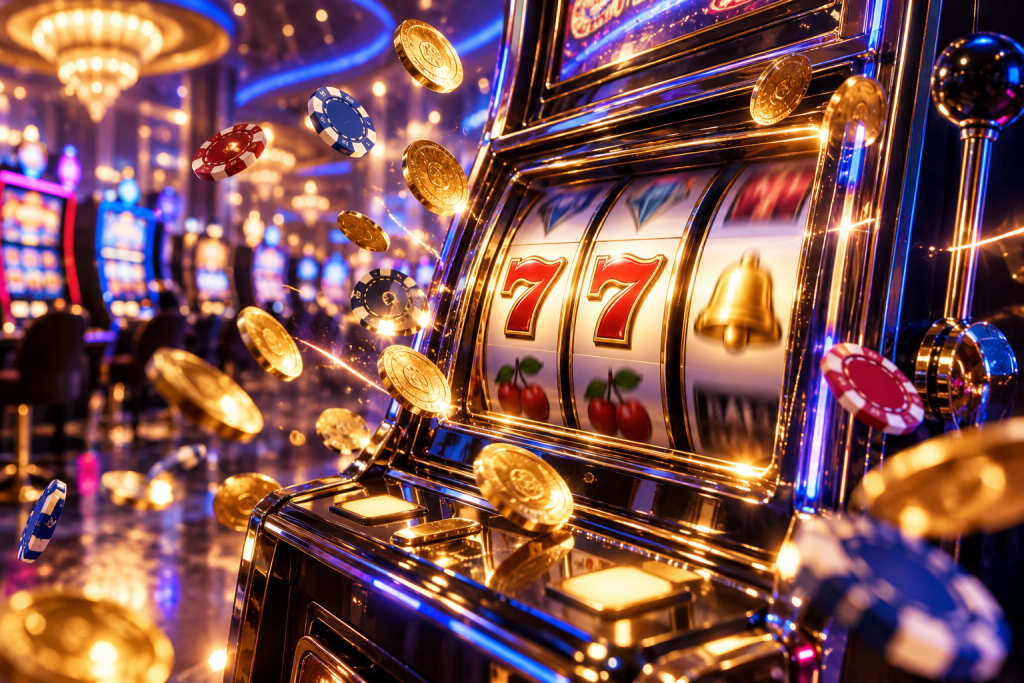
The question starts from a machine that has no memory
A slot machine such as Red Hot Tamales does not become more likely to pay because it has been cold, because a player has fed it a certain amount, or because a jackpot is overdue. Each spin is settled by an internal random process that has no connection to the previous spin, the next spin, the time of day, or the person pressing the button. The outcome is determined the moment the spin is initiated, and the reels are only a display of that result.
No method of play changes the built-in advantage that stays with the house on every spin. The machine is designed so that, over a very large number of spins, the total paid out is less than the total wagered. A player can choose how fast to spin, how much to stake per spin, and when to stop, but none of those choices alters the mathematical structure of the game.
What the game is
Red Hot Tamales is a slot machine theme. The name refers to the symbols and visual design of the game, not to a separate category of slot with different odds. Like other slot machines, it takes a stake, runs an internal random process, and returns a result that is either a loss or a payout according to a fixed pay table.
The pay table is the only document that tells a player what each combination is worth. It is printed on the machine or available on its help screen. The pay table does not tell a player the probability of each combination, and it does not tell a player the overall return percentage. Those figures are not published on the machine.
Why a strategy cannot exist for this game
A strategy is a plan that changes the expected outcome. In a game where the player makes no decision after the stake is set, there is nothing for a strategy to act on. The player does not choose which symbols appear, does not hold any reels, and does not discard anything. The only decisions are whether to spin, how much to stake, and when to leave.
Those decisions affect how long a bankroll lasts and how much is wagered in total, but they do not affect the expected loss per unit wagered. A player who stakes more per spin loses more in expectation per spin. A player who spins faster loses more in expectation per hour. A player who stops after a win has not beaten the machine; the machine has no memory of the win.
| Player decision | What it changes | What it does not change |
|---|---|---|
| Stake size per spin | Total amount wagered; size of each payout | House edge per unit wagered |
| Speed of play | Expected loss per hour | Probability of any given outcome |
| When to stop | Length of session; total loss realised | Future spins, which are independent |
| Which machine to choose | Theme and pay table displayed | The random process that settles each spin |
The venue's fixed geographic position
This article cannot name the venue where a Red Hot Tamales machine sits, because no venue fact has been supplied for this query. What can be stated is the general principle: a casino venue has a fixed physical location, described by a city, a state, and a set of coordinates. That location does not move when a player searches from a different device or a different city.
Because no venue row exists for this query, no straight-line distance can be stated. The distance matrix for this article is empty. The article therefore cannot publish any mileage figure, any road distance, or any travel time. Any number of that kind would be invented, and this article does not invent numbers.
How straight-line distance differs from the road you would drive
A straight-line distance, also called a great-circle distance, is the shortest path between two points on the surface of the Earth. It ignores every obstacle on the ground. A road trip follows a network of highways and local streets, and that network rarely runs in a straight line between two cities.
The difference between the two figures is driven by terrain, water, and the shape of the road network. Mountains force roads to climb and switch back. Rivers and lakes force bridges or ferries, and the crossing point may be far from the straight line. State boundaries do not change the geometry, but they can change where roads are built and how direct a route is. All of these factors make road distance longer than straight-line distance, sometimes by a large margin.
This article does not publish road mileage. Road distance depends on the exact starting point, the route chosen, and current conditions, and none of those are fixed facts. A reader who needs road distance should measure it from their own starting point using a mapping tool that accepts a precise origin and destination.
What the reader can do with a fixed venue position
If a reader knows the city and state where the venue sits, the reader can find its coordinates from a public mapping source. The reader can then measure the straight-line distance from their own location using the same tool. The measurement is only as good as the two points entered, so the reader should use the venue's street address or its published coordinates, not a general city name.
The reader's own location is the variable in that measurement. The venue's location is the constant. That is the correct way to think about any distance question: the venue is fixed, the reader is not.
What to confirm before you go
Before travelling to any venue, a reader should confirm the items that change and that this article cannot state. The venue's own website or guest services line is the authoritative channel for each of the following: whether the venue is currently open, its hours, whether a specific machine such as Red Hot Tamales is on the floor, and any entry or parking requirements.
The venue's published location page is the authoritative channel for its street address and coordinates. A mapping tool is the authoritative channel for road distance and travel time from the reader's own starting point. None of those figures are published here, because none of them are stable facts.
FAQ
Can a player improve their odds on Red Hot Tamales by changing bet size?
No. Changing the stake changes the amount wagered and the size of any payout, but it does not change the house edge per unit wagered. A larger stake means a larger expected loss per spin. The pay table may show different payout multiples for different stake levels, but the underlying random process and its built-in advantage remain the same.
Why does this article not give a distance to the venue?
No venue fact was supplied for this query, so no venue location exists in the article's data. Without a documented venue position, no straight-line distance can be stated, and road distance is never published here because it depends on the reader's exact starting point and route. The reader should confirm the venue's city and state from its own site, then measure from their own location.
Does a slot machine become more likely to pay after a long losing streak?
No. Each spin is independent of the previous spins. The machine has no memory of what it has paid or taken. A long losing streak does not make a jackpot more likely on the next spin, and a recent jackpot does not make another one less likely. The same fixed house advantage applies to every spin regardless of history.
Play responsibly
Gambling should be treated as paid entertainment, never as a way to earn income or recover losses. 1-800-MY-RESET (1-800-697-3738)
18+ or 21+ depending on where you are; follow the minimum age that applies to you.
This article is general information about how these mechanics work. It is not legal advice and not a recommendation to gamble or to use any particular operator. Availability and legality differ by jurisdiction — check the rules that apply where you are.