


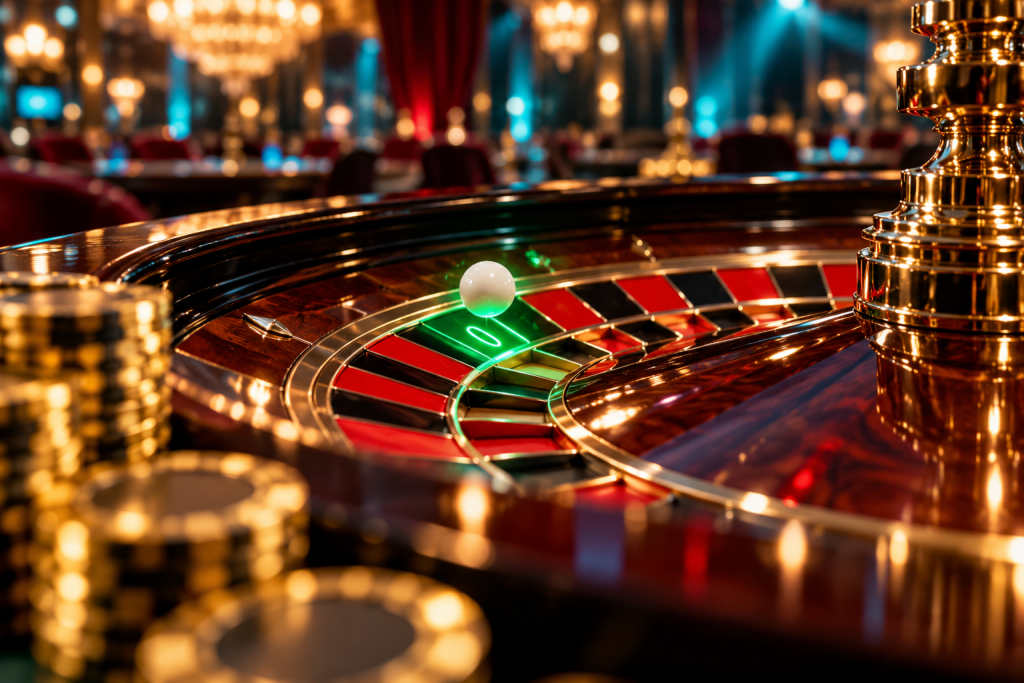
The zero pocket is the exception to every even-money bet
When the ball lands in the zero pocket, every even-money wager on the table loses. That is not because zero is an even number. It is because the zero pocket sits outside the even-money betting categories entirely. The even-money bets on a roulette layout are red or black, odd or even, and low or high. The zero pocket is none of those things: it is not red, it is not black, it is not odd, it is not even, it is not low, and it is not high. It is the pocket the layout uses to make sure the even-money bets are not even propositions.
On a European wheel, the zero is a single green pocket among 37. On an American wheel, there are two green pockets, the single zero and the double zero, among 38. Every one of those green pockets defeats every even-money bet on the table. A player who has bet on black loses when the zero appears. A player who has bet on even loses when the zero appears. The same is true for red, odd, low and high. The zero does not push, it does not return the stake, and it does not count as a half-win on a standard layout.
Some tables offer a rule that softens this. Under the rule known in French as la partage, or under the en prison rule, an even-money bet that loses to the zero may have half the stake returned, or the whole stake held in place for the next spin under certain conditions. Where these rules exist, they are printed on the table or in the game information panel. Where they do not exist, the zero simply takes the whole even-money wager.
Why the zero exists in the first place
The zero pocket is the mechanism that gives the house its mathematical advantage on the even-money bets. If a wheel had 36 pockets and no zero, a bet on red would cover 18 pockets and a bet on black would cover 18 pockets. The bet would pay even money, and over a very large number of spins the expected return would be exactly the amount wagered. The zero changes that arithmetic.
On a European wheel with 37 pockets, a bet on red still covers 18 pockets, but there are now 19 pockets that lose: the 18 black pockets plus the single green zero. The bet pays even money, so a winning spin returns one unit of profit and a losing spin costs one unit. The house edge on that bet comes from the one extra losing pocket. The same logic applies to every even-money bet on the layout. The American wheel adds a second green pocket, which gives the even-money bets one more losing pocket and a larger house edge than the European layout.
This is the structural reason the zero is never included in the even-money categories. The categories are defined by the 36 numbered pockets, and the green pockets are deliberately left outside them. The zero is not an oversight in the numbering. It is the pocket that makes the payout ratio slightly worse than the true odds of winning.
What the zero does to each even-money bet
The even-money bets all lose to the zero in the same way, but they are not identical bets. Each one covers a different set of pockets, and each one has the same house edge on the same wheel, because each one covers 18 of the 36 numbered pockets and loses on every green pocket. The table below shows what each even-money bet covers and what happens when the zero appears.
| Even-money bet | Pockets covered | Pockets that lose | Result when zero appears |
|---|---|---|---|
| Red | 18 red pockets | 18 black pockets plus green zero pockets | Loses |
| Black | 18 black pockets | 18 red pockets plus green zero pockets | Loses |
| Odd | 18 odd-numbered pockets | 18 even-numbered pockets plus green zero pockets | Loses |
| Even | 18 even-numbered pockets | 18 odd-numbered pockets plus green zero pockets | Loses |
| Low (1-18) | 18 low-numbered pockets | 18 high-numbered pockets plus green zero pockets | Loses |
| High (19-36) | 18 high-numbered pockets | 18 low-numbered pockets plus green zero pockets | Loses |
The table makes the point directly: the zero is not a losing number within the even-money categories. It is a pocket outside all six categories, and it loses for every one of them. A player who asks whether zero is included in an even bet is usually asking whether the zero counts as an even number for the purposes of the even bet. The answer is no. The zero is not even, and the even bet does not cover it.
How the zero changes the odds on a spin
The presence of the zero means an even-money bet is not a coin flip. On a European wheel, a bet on red has 18 winning pockets and 19 losing pockets. The probability of winning on any single spin is 18 out of 37. The payout is even money, so the bet returns less than the true odds would justify. The difference between the payout and the true odds is the house edge on that bet.
On an American wheel, the same bet has 18 winning pockets and 20 losing pockets, because there are two green pockets. The probability of winning is 18 out of 38. The payout is still even money, so the house edge is larger. The extra green pocket is the entire reason the American layout is less favourable to the player on the even-money bets than the European layout.
This does not mean the zero appears often in a short session. It means that over a very large number of spins, the zero appears often enough to shift the expected return. In any single session, the ball may land in the zero pocket several times, once, or not at all. The house edge is a long-run statistical average, not a per-session guarantee. A player can win on an even-money bet for a while and still be playing a bet with a built-in mathematical disadvantage.
The la partage and en prison exceptions
Some European tables reduce the cost of the zero on even-money bets. Under the la partage rule, when the zero appears and the player has an even-money bet on the table, the operator returns half the stake immediately. The player loses half the wager instead of the whole wager. Under the en prison rule, the stake is not returned and not collected. It is held in place, and the next spin decides its fate. If the next spin wins for that bet, the stake is returned. If it loses, the stake is collected.
These rules apply only to even-money bets, and only when the zero appears. They do not apply to inside bets or to the other outside bets. They also do not apply on every table. Where a table offers one of these rules, it is a meaningful difference in the cost of the zero, and a player who wants to know which rule applies should look at the table signage or the game information panel before the first spin.
Where neither rule is offered, the zero simply collects the full even-money wager. That is the standard outcome on most American layouts and on many European layouts as well. The rule set in use is part of what determines the house edge on the even-money bets, and it is printed at the table or in the game's information screen.
How to read the table before you bet
Before placing an even-money bet, a player can check three things on the table or in the game panel. The first is the wheel type: a European layout has one green zero pocket, and an American layout has two. The second is the rule set for even-money bets: whether la partage or en prison applies, or whether the zero takes the full stake. The third is the payout shown for the even-money bets, which is even money on a standard layout.
None of these change the basic answer to the question. The zero is not included in an even bet on roulette. It loses for every even-money bet on a standard layout, and the only variation is whether the table softens that loss with a partial return or a held stake. The zero is the pocket that makes the even-money bets slightly worse than even, and that is true on every wheel that has one.
FAQ
Does the zero count as an even number in roulette?
No. The zero pocket is not part of the even-numbered set. The even bet covers the even numbers from 2 to 36, and the zero is outside that set. The zero loses for the even bet just as it loses for the odd bet.
What happens to a red or black bet when the zero hits?
The bet loses on a standard layout. The zero pocket is green, so it is covered by neither the red bet nor the black bet. Some tables offer la partage or en prison, which return half the stake or hold it for the next spin, but where those rules are absent the full even-money wager is collected.
Is the zero the reason the house has an edge on even-money bets?
Yes. The zero pocket, and the double zero on an American wheel, adds one or two losing pockets to every even-money bet without adding any winning pockets. The bet still pays even money, so the extra losing pocket creates the house edge on that bet.
Play responsibly
Gambling should be treated as paid entertainment, never as a way to earn income or recover losses. 1-800-MY-RESET (1-800-697-3738)
18+ or 21+ depending on where you are; follow the minimum age that applies to you.
This article is general information about how these mechanics work. It is not legal advice and not a recommendation to gamble or to use any particular operator. Availability and legality differ by jurisdiction — check the rules that apply where you are.