


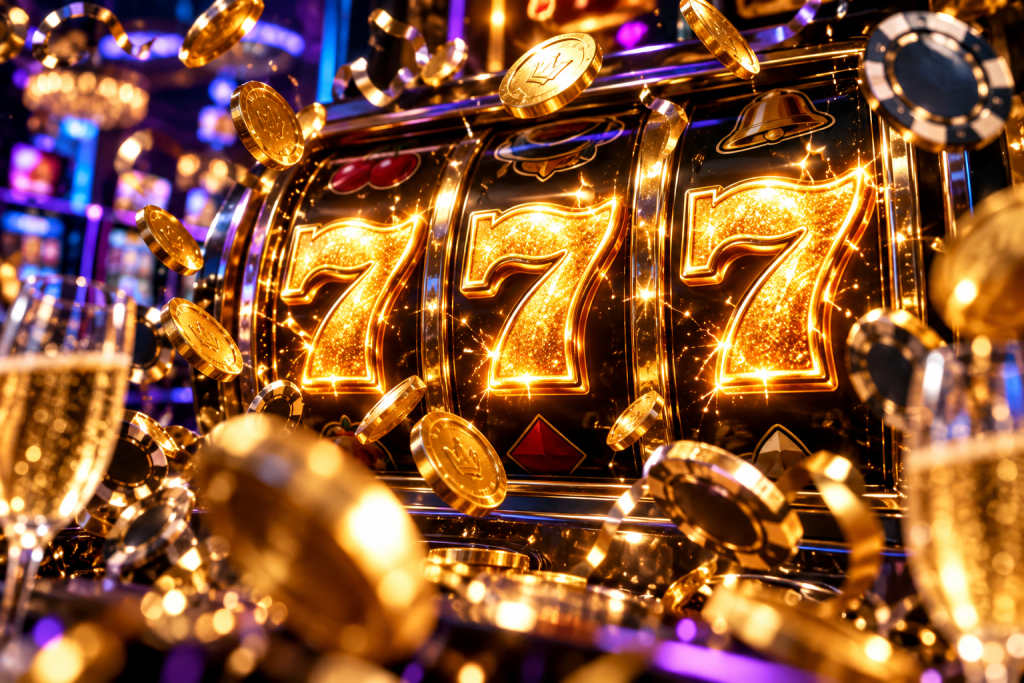
The symbol that outgrew the machine
Walk past any row of slot cabinets and the triple-seven will find you. It is on the glass, on the button deck, and in the animation that plays when a jackpot lands. The number carries so much weight that players sometimes choose a machine because of it, or hold a chair for one that has already shown two sevens on the payline. None of that changes what the machine will do next.
The question underneath the question is really about whether a symbol can be lucky in a mechanical sense. The honest answer is no, and the reason is worth understanding because it explains how every modern slot works. The 777 is a display symbol, not a cause. It appears when the machine's random number generator has already selected an outcome, and it appears no more or less often than the game's maths says it should.
What the random number generator does
A modern slot machine does not spin reels in the way a mechanical cabinet once did. Inside the software, a random number generator produces numbers continuously, even when nobody is playing. Each number maps to a position on each reel, and the game uses the next number in the stream at the exact moment the spin is triggered. The reels you see are an animation of that result, built to look like a physical spin.
The key point is that the decision happens before the reels stop, not because of them. A seven is not "close" to landing when two of them show on the payline. The outcome was already fixed by the number that was drawn. The animation is a presentation layer, and the symbols on it are chosen to match the result the generator produced. This is why a machine that has just paid a jackpot is not cold, and a machine that has not paid in an hour is not due. The generator has no memory of what it produced before.
Independent testing laboratories commonly certify that the generator behaves as intended. That certification covers the mechanics of the game, not the operator's financial conduct, and it does not make any particular outcome more likely for any particular player.
Where the 777 sits in the paytable
The paytable is the document that matters when you want to know what a symbol is worth. It is usually reachable from a button on the game screen, often labelled "info" or "paytable" or shown as a small "i". Inside it, every symbol has a value attached to a combination, and that value is expressed as a multiple of the stake or as a fixed credit amount depending on the game.
The 777 is typically a high-value symbol, but it is only one entry in a table that also includes lower-value symbols, wilds, scatters, and bonus triggers. What makes a symbol valuable is not its cultural history but where the game designer placed it in that table. A triple-seven might pay more than a triple-bar, or it might be the trigger for a fixed jackpot. The paytable states this precisely, and it is the only place where the symbol's value is defined.
Fixed jackpots versus progressive jackpots
When a 777 combination is tied to a jackpot, the type of jackpot changes what the symbol means in practice. A fixed jackpot pays a set amount that is printed in the paytable and does not change. A progressive jackpot grows from a share of qualifying wagers and resets after a win. Some progressive games require a maximum-stake bet to qualify for the top prize, and that requirement is stated in the game's own rules or on the jackpot meter.
The distinction matters because a player who sees a large progressive figure on a cabinet might assume any spin can win it. On many games that is not true unless the stake meets the qualifying level. The jackpot meter and the information panel state the rule. Reading them before playing is the difference between knowing what a spin can return and guessing.
| Feature | Fixed jackpot | Progressive jackpot |
|---|---|---|
| Prize amount | Set and printed in the paytable | Grows from qualifying wagers and resets after a win |
| Funding | Built into the game's normal return | Typically taken from a share of each qualifying wager |
| Stake requirement | Usually any qualifying spin | Some games require maximum stake to qualify |
| Where the rule appears | Paytable | Jackpot meter and game rules |
Paylines and ways-to-win
The 777 only pays when it lands in a pattern the game recognises. Older and simpler slots use fixed paylines, which are specific lines across the reels. A combination must fall on one of those lines to pay, and the player usually must bet on all of them. Newer formats use ways-to-win, where adjacent matching symbols from the leftmost reel pay regardless of their exact position. Both systems are described in the paytable, and the difference changes how a near-miss looks even though it changes nothing about the underlying odds.
A near-miss is a display event, not a probability event. When two sevens land on a payline and the third stops one position away, the player sees a moment of tension. The machine's maths already resolved that spin. The near-miss is a visual pattern that occurs with whatever frequency the reel mapping produces. It does not signal that a win is approaching.
What volatility does and does not change
Volatility describes how payouts are distributed over time. A high-volatility game pays less often but in larger amounts when it does pay. A low-volatility game pays more often but in smaller amounts. The 777 symbol often sits at the top of a high-volatility game's paytable, which is why those games can feel like they are built around a rare, large event.
What volatility does not change is the game's long-run return. Return to Player is a theoretical percentage of total wagered money a game returns over a very large number of spins. It is a statistical average, not a per-session guarantee. Volatility changes the shape of the ride, not the destination. A game that pays a large jackpot rarely will, over enough spins, return the same theoretical percentage as a game that pays small amounts often, assuming the same return is programmed. The player experiences the difference as long dry spells or frequent small wins, but neither pattern is a strategy.
Stake size also changes nothing about the programmed return. Betting more multiplies the size of every win and every loss by the same factor. It does not make the 777 land more often, and it does not make the machine more generous. The only thing stake size changes is how much money moves per spin, which is a bankroll decision, not a probability decision.
No pattern alters the programmed return
It is worth saying plainly because the question invites it: no betting pattern, stopping rule, machine choice, or superstition about the number seven changes the built-in edge of a slot. The game's return is programmed into its maths, and the random number generator ensures each spin is independent of the last. A player can choose a game with a different volatility profile, a different paytable structure, or a different jackpot type. Those choices change the experience and the expected rate of loss. They do not create a way to win.
What a player can genuinely control is which game to play, how much to stake, how long to play, and when to stop. Those are real decisions with real consequences for a bankroll. The 777 symbol is not one of them.
How to read the information panel
Every modern slot carries its own documentation, usually behind an "i" or "info" button on the main screen. That panel contains the paytable, the rules for bonus features, the jackpot qualification terms if any, and sometimes the theoretical return for the specific game configuration. The return figure shown there is the one that applies to that game as configured, and it is the only per-game figure a player should rely on. Publicly published reference sources may list typical ranges, but the game's own panel is the authoritative statement for that cabinet or online title.
When a player wants to know what a 777 combination pays, the answer is on that panel, not in folklore. The panel states whether the symbol pays as a line hit, a scatter, or a jackpot trigger. It states the stake multiple. It states the qualifying conditions. Reading it takes a minute and answers the question completely.
FAQ
Does 777 pay more than other symbols?
It depends entirely on the game. In many slots the triple-seven is the highest-paying standard symbol, but in others it is a mid-tier symbol or a jackpot trigger. The paytable states the exact payout for every combination, and that is the only place to find the answer for a specific game.
Can a machine be more likely to hit 777 after a long dry spell?
No. The random number generator produces each outcome independently of the last. A long run without a jackpot does not make the next spin more likely to produce one, and a machine that has just paid a jackpot is not less likely to pay again. The generator has no memory.
Do I need to bet maximum to win the 777 jackpot?
On some progressive games, yes. The jackpot meter or the game's information panel states whether the top prize requires a maximum-stake bet. On fixed-jackpot games, any qualifying spin at the stated stake usually qualifies. The rule is always written in the game's own documentation, and it differs between titles.
Play responsibly
Gambling should be treated as paid entertainment, never as a way to earn income or recover losses. 1-800-MY-RESET (1-800-697-3738)
18+ or 21+ depending on where you are; follow the minimum age that applies to you.
This article is general information about how these mechanics work. It is not legal advice and not a recommendation to gamble or to use any particular operator. Availability and legality differ by jurisdiction — check the rules that apply where you are.