


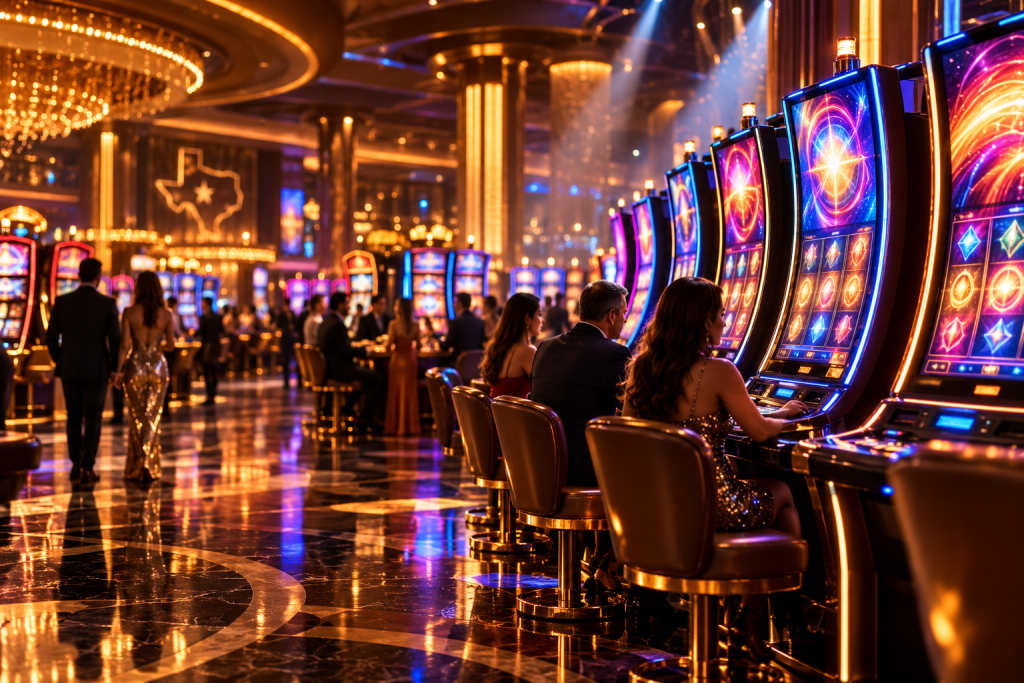
Texas law draws a hard line on slots, but three venues still run electronic games
A private person keeping a conventional slot machine in Texas faces a different legal position than a federally recognized tribe operating an electronic gaming hall on trust land. The state's penal code treats possession of a gambling device as a criminal matter, while the three Native American venues documented in the published list operate under a separate legal framework that is not a state commercial licence. A reader arriving at this question usually needs both halves of that picture.
The published list of casinos in the United States documents three venues in Texas, spread across three cities: Eagle Pass, Livingston, and El Paso. The list is a snapshot maintained by volunteer editors, not a regulator's licence roll, so it can lag an opening or a closure. The authoritative current position on any specific device or venue belongs to the state's gaming regulator and, where tribal land is involved, to the federal framework that governs Indian gaming.
What counts as a slot machine under Texas law
Texas law defines a gambling device broadly enough to catch most machines that accept money and deliver a prize based partly on chance. The definition turns on whether the machine is designed to deliver something of value on an element of chance, even if the machine also involves an element of skill. An eight-liner, a video poker cabinet, and a traditional reel slot can all fall inside the same statutory category when the prize is cash or something redeemable for cash.
The legal test is not what the machine is called, what it looks like, or whether the manufacturer labels it a game of skill. It is what the machine does: whether a player risks something of value on a chance outcome for a chance at a prize. Machines that award only free replays or non-cash prizes of nominal value can sit in a different category, and that distinction is exactly where most enforcement disputes happen.
Possession of a gambling device, promotion of gambling, and keeping a gambling place are separate offences with separate elements. A person can be exposed to one without the others. The machine itself can also be subject to seizure and forfeiture, which is why the question of private ownership is not just about a fine.
The three documented venues and where they sit
The published list documents one venue in each of three Texas cities. They are Kickapoo Lucky Eagle Casino in Eagle Pass, Naskila Gaming in Livingston, and Speaking Rock Entertainment Center in El Paso. All three are classified in the list as Native American venues, which is the key structural fact: they are not commercial casinos licensed by the state, and their legal footing is not the same as a Las Vegas or Atlantic City property.
The list does not supply machine counts, floor sizes, room counts, or opening hours for these venues, so this article does not state them. Facility figures of that kind are revised as properties expand and rebuild, and the only figures this article can responsibly give are the documented locations and the straight-line distances below.
| Venue | City | Documented type |
|---|---|---|
| Kickapoo Lucky Eagle Casino | Eagle Pass | Native American |
| Naskila Gaming | Livingston | Native American |
| Speaking Rock Entertainment Center | El Paso | Native American |
Because all three are Native American venues, the legal question is not whether Texas authorizes them. It is whether the federal Indian gaming framework applies to the specific land, the specific tribe, and the specific class of game, and whether the device qualifies as a class II game, a class III game, or something outside either class. Those are federal questions that a state penal statute does not answer on its own.
Why the legal answer depends on who owns the machine and where it sits
A slot machine in a private home, a bar, a truck stop, or a game room in Texas is not in the same legal position as a machine on tribal trust land. The state's general prohibition applies to the first category. The second category is governed by a different body of law that the state does not administer, and the state's ability to enforce its own gambling statutes there is limited in ways that have produced decades of litigation.
This is why a simple yes-or-no answer to "is it illegal to have slot machines in Texas" is misleading. The honest answer is: for most people and most places, yes, possession of a conventional slot machine is a criminal matter under state law. For the three documented tribal venues, the machines operate under a federal framework that sits outside the state's ordinary licensing system, and the legality of the specific games they offer has been contested and litigated rather than settled by a single statute.
| Situation | Governing framework | What a reader should check |
|---|---|---|
| Private possession of a conventional slot machine | Texas penal law on gambling devices | Current statutory text and local enforcement practice |
| Machine in a commercial game room or bar | Texas penal law plus local ordinances | Whether the machine awards cash or redeemable prizes |
| Electronic games at the three documented tribal venues | Federal Indian gaming framework, not a state licence | The venue's own statements and current federal litigation status |
Straight-line distances to the three documented cities
The table below gives great-circle distances between the three documented venue cities. These are straight-line figures, not road distances. Road travel is always longer, and this article does not publish road mileage or driving times. A reader planning a trip should measure from their own starting point and check road conditions separately.
| From | To | Straight-line distance (miles) | Measurement type |
|---|---|---|---|
| Eagle Pass | El Paso | 463.9 | Great-circle |
| Eagle Pass | Livingston | 336.9 | Great-circle |
| Livingston | El Paso | 641.0 | Great-circle |
The three venues are far apart. Eagle Pass sits on the Rio Grande at the state's southwestern edge, Livingston is in the Piney Woods northeast of Houston, and El Paso is at the far western tip. A person driving between any two of them crosses most of the state, and the straight-line figures above understate the actual road distance by a wide margin.
How the count of three should be read
The published list documents three venues in Texas, and three are documented here. That sentence is deliberately narrow. It is not a regulator's count, not a claim that no other venue exists, and not a statement that all three are open today. Lists of casinos are edited at different times, and a venue can open, close, or rebrand between edits. The authoritative current list belongs to the gaming regulator in the relevant jurisdiction, and a reader who needs an official count should start there rather than with any encyclopedia-style list.
More fundamentally, different sources count different things. A commercial casino licence, a tribal gaming operation, a racetrack with electronic gaming, and a cruise ship casino are four different categories, and a source that includes only one of them will produce a different number than a source that includes all four. That is why the count of three here is a documentation count, not a legal census.
What to confirm before you go
If a reader is planning to visit one of the three documented venues, the changeable items are exactly the ones this article does not state: current operating hours, whether the venue is open to the public on a given day, what games are currently offered, and what identification or membership requirements apply at the door. Those answers live on the venue's own published pages and at its guest services desk, not in a static article.
A reader should also confirm the legal status of any specific game before assuming it is the same as a Nevada-style slot. The three venues have different histories, different tribal affiliations, and different positions in ongoing federal litigation, and a machine that looks like a slot may be legally classified as a bingo-based electronic aid rather than a slot machine. The distinction matters for the venue's legal footing even if it makes no visible difference to the player.
The state's gambling statutes and the federal Indian gaming framework are both subject to legislative change and court decisions. What is true this year may not be true next year, and a reader who needs a current legal answer for their own conduct should consult a Texas-licensed attorney rather than treating this article as legal advice.
FAQ
Is it illegal for a private person to own a slot machine in Texas?
Under Texas penal law, possession of a gambling device is generally a criminal matter, and a conventional slot machine falls within the statutory definition of a gambling device. The machine can also be seized. The exact charge and penalty depend on the facts, and anyone facing a specific situation should consult a Texas-licensed attorney rather than relying on a general article.
Why do the three tribal venues have slot-like machines if Texas bans slots?
The three documented venues are Native American operations, not state-licensed commercial casinos. Their games sit under the federal Indian gaming framework, which operates separately from Texas's general gambling statutes. The specific games have been the subject of litigation, and their legal classification as bingo-based electronic aids versus slot machines is a federal question, not a state one.
How many casinos are there in Texas?
The published list documents three venues in Texas, all classified as Native American. That is a documentation count from a volunteer-edited list, not a regulator's licence roll, and it can lag openings or closures. Different sources count different categories of venue, so a reader who needs an official current count should consult the gaming regulator for the relevant jurisdiction.
Play responsibly
Gambling should be treated as paid entertainment, never as a way to earn income or recover losses. 1-800-MY-RESET (1-800-697-3738)
18+ or 21+ depending on where you are; follow the minimum age that applies to you.
This article is general information about how these mechanics work. It is not legal advice and not a recommendation to gamble or to use any particular operator. Availability and legality differ by jurisdiction — check the rules that apply where you are.