


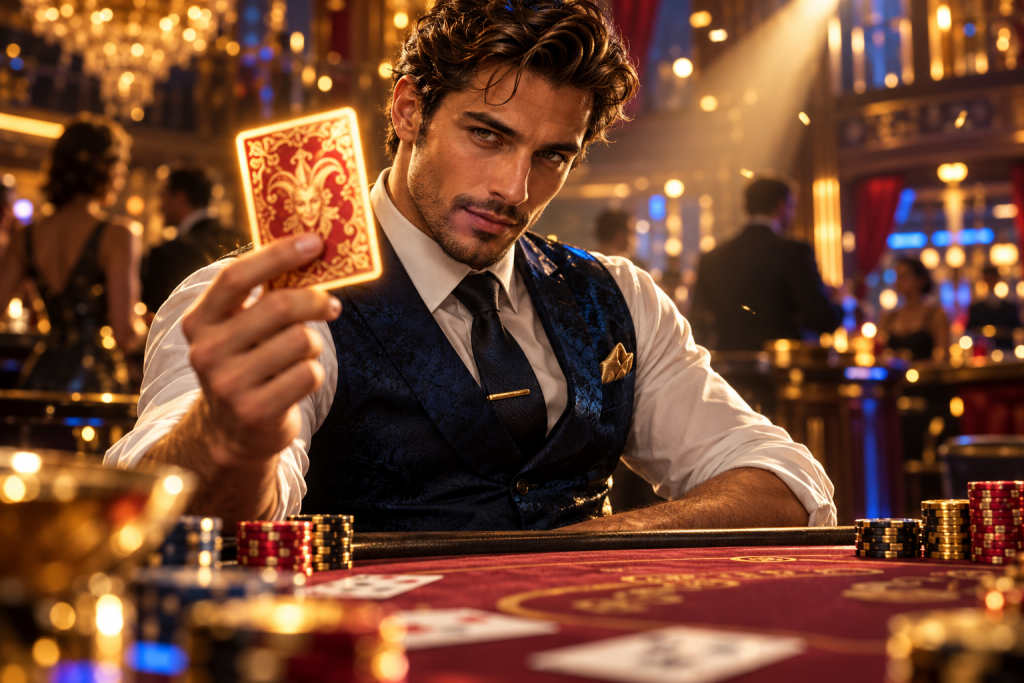
The deck at a standard blackjack table
You sit down, put your buy-in on the felt, and the dealer spreads the cards for a quick check. If you watch that spread closely, you will see only the familiar ranks from ace through king. A conventional blackjack shoe contains no jokers. The game is built around a fixed deck structure: 52 cards per deck, and the joker is not one of them. Casinos remove jokers before the cards ever reach the shoe, for the same reason they use cards of uniform size and finish: blackjack is a comparing game whose mathematics depend on a known set of possible totals, and a wild card would break that arithmetic.
This matters more than a trivia answer suggests. Blackjack strategy, the decisions to hit, stand, split or double, rests on the probability of drawing each rank from the remaining shoe. Every published basic-strategy chart derives from the specific rule set in use: deck count, dealer stand rules, doubling and splitting rules. Add a wild card and those probabilities shift in ways the standard charts do not describe. So the practical answer to whether a joker is played in blackjack is no for the game you will almost always find, but the fuller answer requires a second question: what variant are you playing?
Where jokers appear
Jokers do exist in a few blackjack-adjacent products, and they are usually attached to a side bet rather than the main hand. The most common is a progressive or fixed jackpot side wager that pays based on combinations involving the player's cards and sometimes the dealer's upcard. In some of these, a joker acts as a wild card for the side bet only. Your main hand is still played under normal blackjack rules; the joker simply changes what the side bet pays.
A smaller number of proprietary table games use a joker as a wild card inside the main game itself. These are not standard blackjack and are typically labelled with their own name on the layout and the glass. The felt will usually state the rule in plain words, such as a note that a joker may substitute for any card to form a hand. When a joker is in play, the objective shifts slightly from the classic form: the goal is still a hand total closer to 21 than the dealer's without exceeding it, but the wild card changes the optimal decisions at several points.
| Game type | Joker in the shoe | Joker's role | Effect on main-hand strategy |
|---|---|---|---|
| Standard blackjack | No | None | Standard charts apply |
| Blackjack with a joker side bet | Yes, often | Wild for the side bet only | Standard charts still apply to the main hand |
| Proprietary joker-wild variant | Yes | Wild inside the main hand | Standard charts do not apply; the table rules define decisions |
How to confirm what is in the shoe before you play
The fastest check is the table's printed rules plaque, usually fixed to the layout near the dealer or on the table sign above. It will state the deck composition and any wild-card rule. If the wording is not visible, ask the dealer directly: "Does this game use jokers, and do they affect the main hand or only the side bet?" Dealers answer this question routinely, and the answer determines whether you should use a published basic-strategy chart at all.
The game information panel on an online table does the same job. Open the rules or help screen before your first wager and look for the words "wild", "joker", or any mention of a card outside the standard 52. If the game is a standard blackjack title, the help text will describe a conventional deck or shoe with no joker. If it is a variant, the help text must describe the joker's function, because that function is a rule of the game, not a cosmetic detail.
The distinction between the main game and the side bet is the one that usually confuses new players. A joker sitting on the layout does not automatically mean your blackjack hand has changed. It may only feed a separate wager with its own pay table, its own house edge, and its own rules about which combinations qualify. Read the side bet's pay table separately from the main game's rules. The two are priced independently: the main hand carries the edge built into the standard game under that table's rule set, while the side bet carries its own, often materially higher, edge.
Why the deck composition changes the decisions
Blackjack is a game of conditional probabilities. The decision to hit a 16 against a dealer's 10 is a calculation about how often each possible drawn card appears in the remaining shoe. That calculation assumes a known deck: no wild cards, no extra ranks, and a fixed number of each rank per deck. When a joker is added as a wild card, the probability of completing any given hand increases, and the correct play at several decision points changes. A hand that should be hit under standard rules might be stood under a wild-card rule, or vice versa.
This is why strategy charts are not portable across game variants. A chart printed for a six-deck shoe with the dealer standing on soft 17 does not transfer to a single-deck game with different doubling rules, and it certainly does not transfer to a game with a wild card. The table rules in use, not the general name "blackjack", determine the chart. When you sit at a variant table, the only reliable source for correct play is the rule set printed on that table or in that game's help file.
For the standard game, the objective is stable: finish with a hand total closer to 21 than the dealer's without exceeding it. The dealer's play is fixed by the house rules, typically drawing to a stated total and standing thereafter. Your decisions are the only variable, and they are decisions about risk under a known deck, not guesses about what the next card will be.
Buy-in, round sequence and where the joker question fits
A round of standard blackjack moves through a fixed sequence. You buy in by placing cash on the layout; the dealer exchanges it for chips and announces the amount. You place a wager in the betting circle. The dealer deals two cards to each player and two to the house, one face up. You then act on your hand: stand, hit, double where the rules allow, or split pairs where the rules allow. After all players act, the dealer completes the house hand according to the fixed drawing rule. Winning bets are paid, losing bets are collected, and pushes return the stake.
Every step of that sequence assumes the standard deck. The moment a joker enters the shoe, the sequence still runs, but the meaning of your decisions changes. Before you buy in, confirm which game you are joining. The buy-in itself is the point of no return: once your cash is in chips on that table, you are playing the game that table runs, wild card or not.
Procedural mistakes new players make
The first mistake is assuming every blackjack table is the same game. A player who has memorised a basic-strategy chart for a standard shoe will sometimes apply it to a variant table with a joker side bet or a wild-card main game. The chart no longer describes the probabilities, and the player is making decisions under a rule set the chart was never built for. The fix is the table plaque or help screen, read before the first wager.
The second mistake is treating the side bet as part of the main game. A joker side bet is a separate wager with its own pay table and its own house edge. Players sometimes size the side bet as if it were a natural extension of the blackjack hand, when it is an independent bet with a different return profile. The main hand and the side bet are settled separately, and a losing side bet does not affect the main hand's outcome.
The third mistake is asking the wrong question at the table. New players sometimes ask "is this normal blackjack?" and receive a yes, because the dealer hears the question as whether the table follows standard drawing and payout rules. The precise question is whether the shoe contains jokers and whether a joker affects the main hand. That wording gets the information that determines which strategy, if any, applies.
FAQ
Do any standard casino blackjack games use jokers?
No. Standard blackjack is dealt from conventional 52-card decks with jokers removed. If a joker appears in a blackjack-style game, it is either a side-bet feature or a proprietary variant with its own name and rules.
If a joker appears on the table, does it change my blackjack hand?
Not necessarily. On many tables the joker is part of a separate side bet and has no effect on the main hand. The table plaque or game help screen states whether the joker is wild for the side bet only or for the main game.
Can I use a normal blackjack strategy chart at a joker-wild table?
Only if the joker affects just the side bet and the main hand is dealt under standard rules. If the joker is wild inside the main game, the standard chart does not describe the probabilities, and the only correct play comes from the rule set printed for that specific variant.
If you or someone you know has a gambling problem, call the helpline printed in the footer below.
Play responsibly
Gambling should be treated as paid entertainment, never as a way to earn income or recover losses. 1-800-MY-RESET (1-800-697-3738)
18+ or 21+ depending on where you are; follow the minimum age that applies to you.
This article is general information about how these mechanics work. It is not legal advice and not a recommendation to gamble or to use any particular operator. Availability and legality differ by jurisdiction — check the rules that apply where you are.