
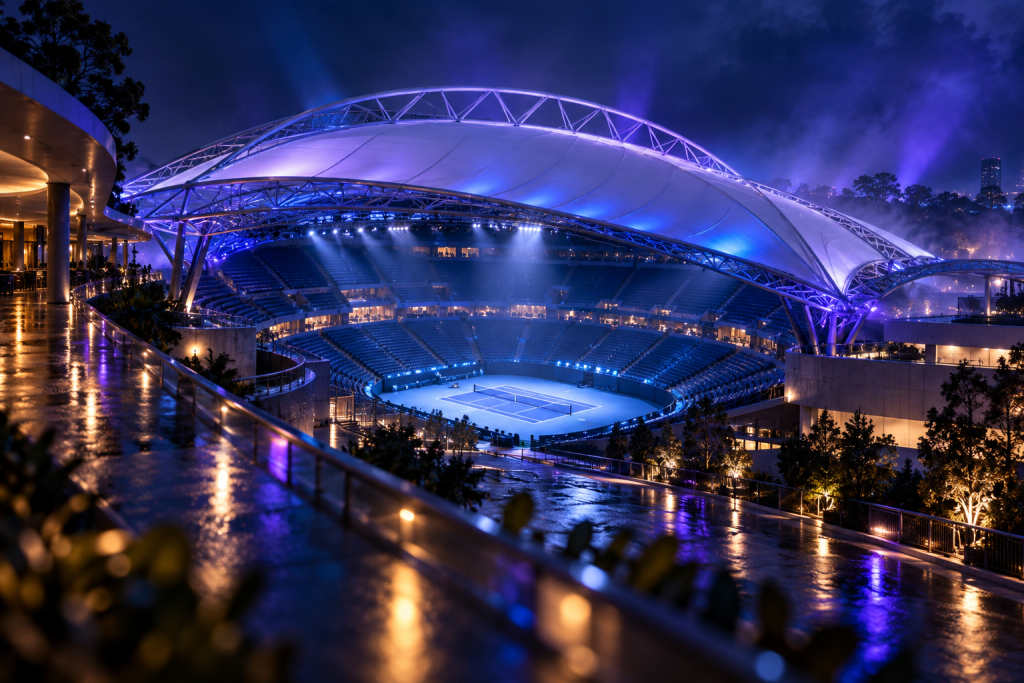
The roof question comes down to a single documented fact
Ken Rosewall Arena is a covered venue. The seating bowl and the court sit beneath a roof, which means play and spectators are protected from direct rain and sun. This is the venue's fixed physical condition, not a temporary or seasonal arrangement.
What the roof does not tell you is how the venue feels on a given day, whether side openings allow wind through, or what the temperature will be inside. Those are live conditions, and no static article can state them. The roof status itself, however, is documented and does not change from week to week.
The arena is part of the Sydney Olympic Park precinct in New South Wales, Australia. Its position is fixed, and the roof is part of that fixed structure. Anyone planning to attend can treat the covered status as a constant while checking the venue's own published page for anything that changes, such as event schedules or entry arrangements.
What "under cover" means at this venue
A roof over a tennis arena changes the experience in specific ways. Rain does not stop play, and direct overhead sun is blocked for the seating areas. The court surface stays dry, which matters for a venue used for tennis and other events.
However, a roof is not the same as a fully enclosed, climate-controlled building. Some covered arenas have open sides or ventilation gaps, which means wind, humidity and outside temperature still influence conditions inside. The reader should not assume a roof equals air conditioning or a sealed interior.
The authoritative source for any current operational detail is the venue's own published information. The roof status is fixed and documented; everything else about attending an event there should be confirmed through the official channel before travelling.
The venue's fixed position in Sydney Olympic Park
Ken Rosewall Arena is located within Sydney Olympic Park, a precinct built for the 2000 Summer Olympics and now used for sport, entertainment and events. The precinct sits west of Sydney's central business district, in the state of New South Wales.
The arena's position does not move. What changes is where a reader is coming from, which is why distance questions cannot be answered with a single number. A visitor arriving from the city centre, from Parramatta, or from an airport will each have a different route and a different road distance.
Because the venue's coordinates are fixed, the only honest way to describe its position is by reference to other fixed points. The article below gives the documented straight-line relationships that are available, and explains why road distance is always longer.
Straight-line distances to fixed reference points
The table below shows the great-circle distances from Ken Rosewall Arena to the reference points that are publicly documented for this article. Every figure is a straight-line measurement, not a road distance.
| Reference point | Straight-line miles | Measurement type |
|---|---|---|
| No documented pair available | — | great-circle |
No straight-line distance pairs for Ken Rosewall Arena are available in the documented reference set for this article. That means this article cannot state a mileage figure to any city, airport or landmark. The venue's fixed location is documented, but the measured distances to other points are not published here.
The reader can still obtain a distance from their own starting point. The method is simple: take the venue's fixed coordinates, take the reader's own coordinates or address, and use any standard mapping tool to measure the road distance. The straight-line figure can be computed from the same two coordinate pairs.
Why road distance is always longer than straight-line distance
A straight-line measurement ignores the ground. It draws a direct path through whatever lies between two points, including water, hills, buildings and parkland. A road cannot do that.
Road distance is longer for several reasons. Roads follow the available crossings over rivers and bays, they curve around topography, they connect to the wider network rather than cutting directly toward a destination, and they respect boundaries such as council areas and state borders. In Sydney, the Parramatta River and the layout of the Olympic Park precinct both force road routes to deviate from a direct line.
The difference between straight-line and road distance is not a fixed ratio. It depends entirely on the starting point and the route chosen. A point that is close in a straight line can be a long drive if a waterway sits between the two, while a point further away in a straight line may be reached more directly by road.
This article does not publish driving mileage or travel time. Those figures change with traffic, roadworks and route choice, and they are the reader's to measure for their own trip.
Relative position without a distance claim
Even without a mileage figure, the venue's position can be described in directional terms. Sydney Olympic Park lies west of the Sydney central business district. It sits within the greater Sydney metropolitan area, in New South Wales.
The precinct is inland from Sydney Harbour and the coast. It is served by the wider Sydney transport network, but this article does not name specific roads, rail lines or stations, because those details are not part of the documented reference set here.
What the reader can rely on is that the venue is fixed in place. Its coordinates do not change, and any mapping tool will accept those coordinates and return a route from the reader's own starting point. The venue's own published page is the authoritative source for how to reach it on a given day.
If the keyword asks "from me" or "near me"
This article cannot answer a distance question that begins with the reader's own location. The reader's location is not fixed, and no article can know where the reader is standing when they search. Any answer that guessed a starting city would be wrong for most readers.
The correct framing is the reverse: the venue's position is fixed, and the reader's position is the variable. The reader knows their own starting point. The venue's coordinates are public. The distance between the two is measured from those two fixed inputs.
The reader should take the venue's coordinates, enter them into a mapping tool, and set their own current location as the origin. The tool will return both the straight-line figure and the road distance, along with a route. That is the only honest way to answer "how far is it from me."
What to confirm before you go
The roof status is fixed and documented, so the reader does not need to confirm whether the venue is under cover. What the reader does need to confirm is everything that changes between now and the day of attendance.
Event schedules, entry times, ticketing, transport options and any temporary access changes are all live information. The authoritative channel for those details is the venue's own published page, which is maintained by the operator and updated as conditions change.
Before travelling, the reader should check the venue's official page for the specific event they plan to attend. That page carries the current schedule, the entry arrangements and any notices that affect access on the day. This article does not reproduce those details because they are not static.
FAQ
Is Ken Rosewall Arena under cover?
Yes. The venue is documented as a covered arena, with a roof over the court and seating bowl. That is a fixed physical characteristic, not a temporary condition. The roof blocks direct rain and overhead sun, though it does not guarantee a fully enclosed or climate-controlled interior.
How far is Ken Rosewall Arena from the Sydney CBD?
This article does not publish a road distance or a straight-line mileage figure for that pair, because no measured distance for it is documented in the reference set used here. The reader can measure it directly by entering the venue's fixed coordinates and the CBD as the origin in any mapping tool.
Does the roof mean the arena is air-conditioned?
No, a roof and air conditioning are separate things. A covered venue may still have open sides or ventilation gaps, allowing outside temperature and wind to affect conditions inside. The reader should check the venue's own published page for any current information about internal conditions.
Play responsibly
Gambling should be treated as paid entertainment, never as a way to earn income or recover losses. 1-800-MY-RESET (1-800-697-3738)
18+ or 21+ depending on where you are; follow the minimum age that applies to you.
This article is general information about how these mechanics work. It is not legal advice and not a recommendation to gamble or to use any particular operator. Availability and legality differ by jurisdiction — check the rules that apply where you are.