
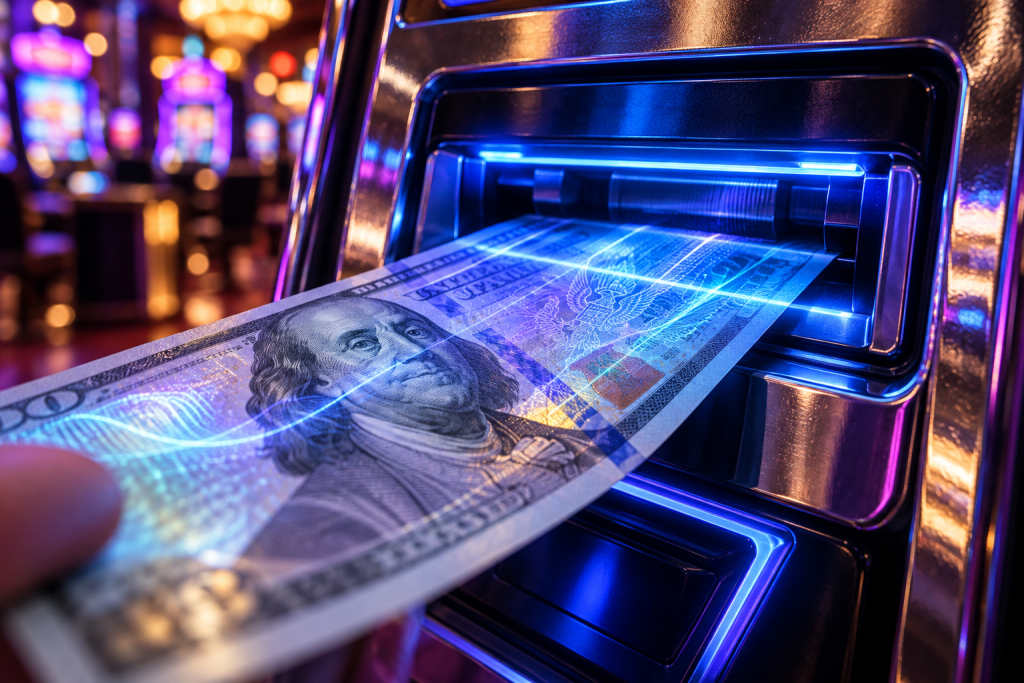
The moment a bill meets the machine
A player pushes a banknote into the acceptor slot, and the machine has a fraction of a second to decide whether to credit the play balance or push the note back out. That decision is not made by the reels, the screen, or the game software in the way most players imagine. It is made by a dedicated bill validator unit mounted inside the cabinet, built around optical and magnetic sensors that read physical features of the note as it passes through a narrow transport path.
The validator is a separate hardware module from the game controller. It has its own firmware, its own sensor array, and its own list of acceptable note designs. When the machine accepts a bill, the validator has matched what it saw against that stored list. When it rejects a bill, the validator has failed to match the note to any entry on the list, or has matched it to a known-bad pattern.
This article explains what the validator checks, what it cannot check, and what happens at each stage of the process. It does not describe any specific venue's equipment, because the hardware inside a given cabinet is not published in a way that can be verified here.
What the validator is looking at
A modern bill validator does not "look" at a note the way a human cashier does. It takes a series of measurements as the note moves through the transport, then compares those measurements against stored templates for each denomination and series the unit is programmed to accept.
The sensor set typically includes optical sensors that measure how much light passes through the note at specific wavelengths, and magnetic sensors that detect the presence and pattern of magnetic material in the ink or embedded security thread. Some units add ultraviolet sensors, infrared sensors, or thickness and density measurements. The exact combination varies by manufacturer and model, and casino operators do not publish the sensor configuration for a given cabinet.
Each genuine note design has features that are difficult to reproduce with ordinary printing equipment: the precise placement of the portrait, the pattern of the fine-line engraving, the response of the paper or polymer substrate to transmitted light, and the magnetic signature of the ink. The validator measures these features and checks whether they fall within the tolerances stored for that denomination.
Acceptance is a match, not a guarantee
The validator's decision is best understood as a matching operation against a stored reference set. If the measured features fall within the programmed tolerance for a known denomination, the unit sends an acceptance signal to the game controller, which credits the corresponding amount. If they do not, the unit reverses the transport and returns the note.
That means the machine is not making a legal judgment about whether a bill is genuine. It is making an engineering judgment about whether the physical measurements match a template. A note can be rejected for reasons that have nothing to do with counterfeiting: it may be worn, wrinkled, folded, wet, torn, taped, or simply a series the validator has not been programmed to recognise.
The same logic runs in reverse. A counterfeit that reproduces the measured features closely enough to fall inside the tolerance bands can be accepted. No validator catches every counterfeit, and manufacturers do not publish the miss rate for obvious reasons. The machine's acceptance is a strong signal, not a forensic conclusion.
Where the counterfeit check ends
Once a validator accepts a bill, the note sits in a locked cashbox inside the machine. The casino's count team removes the cash on a schedule the property controls, and that is where a second, human-level check happens. Staff count the notes, reconcile the totals against the machine's recorded credits, and examine anything that looks suspect.
If a counterfeit is found in the cashbox, the acceptance decision is traced back to the validator's serial number and the time of the transaction. The validator's firmware logs each acceptance and rejection, so a property can identify which unit accepted a bad note and when. That log is an operational record, not something a player can see.
The point for a player is that the machine is the first filter, not the last one. The authoritative judgment on whether a bill is counterfeit belongs to the currency-issuing authority and the financial institutions that process the cash, not to a slot machine.
What changes what the machine accepts
Several variables determine whether a given bill passes a given validator, and they are worth separating because players often attribute a rejection to the wrong cause.
| Variable | What it changes | Who controls it |
|---|---|---|
| Programmed note list | Which denominations and series the unit will try to match | Casino or route operator, through validator configuration |
| Firmware version | The stored templates and tolerances the unit applies | Validator manufacturer, updated by the operator |
| Note condition | Whether the physical measurements fall inside tolerance | The player, before inserting the bill |
| Sensor calibration | How tightly the unit measures against its templates | Service technician, during maintenance |
| Currency design | Which security features exist for the validator to read | The currency-issuing authority |
None of these variables is published for a specific cabinet. A player who wants to know which note series a given machine accepts can ask the property's slot operations staff, but the answer may be general rather than machine-specific.
Why a genuine bill can be rejected
A rejection at the validator is not evidence that a bill is fake. The most common causes are physical condition and series coverage. A note that has been through enough hands may have softened edges, a crease through the security thread, or a stain that changes its optical response. The validator's tolerances are set tightly enough to catch counterfeits, which means they also catch some genuine notes in poor condition.
Series coverage matters because a validator can only match notes it has been programmed to recognise. When a currency-issuing authority introduces a new design, validator manufacturers release firmware updates with the new templates. Until an operator installs that update, the machine will reject the new series even though the note is perfectly genuine.
The practical response to a rejection is to flatten the note, try a different orientation, or use a different note. If the same bill is rejected at multiple machines, the note may be damaged or may be a series the property's validators do not yet accept. The property's cage or cash desk can usually exchange a damaged genuine note, but that is an operational matter for the venue to handle.
What the machine cannot tell
A bill validator cannot determine the legal status of a note. It cannot tell whether a bill was reported stolen, whether it is the proceeds of a crime, or whether it is genuine but altered in a way the sensors do not measure. It also cannot tell whether a note is a high-quality counterfeit that reproduces the measured features within tolerance.
The validator's job is narrower than the phrase "tell if a bill is fake" suggests. It checks a specific set of physical features against a stored reference, and it returns a binary result: accept or return. The binary result is a useful first filter, but it is not a counterfeit detection system in the forensic sense.
For a player, the practical takeaway is that the machine's acceptance is not a promise about the note's authenticity, and its rejection is not an accusation. Both outcomes are engineering decisions made by a sensor array against a template list.
What to confirm before you go
If a reader wants to know what a specific venue's machines accept, the authoritative channel is the property itself. The slot operations desk or guest services can explain which note series the validators on the floor are configured to accept, and the cash desk can handle a damaged genuine note that the machines keep returning.
The currency-issuing authority's public materials describe the security features of each note series, which is the reference a validator's templates are built from. A player who wants to understand why a note was rejected can compare the note's condition against those published features, but the authority's materials are about the note, not about any machine's configuration.
What changes between visits is the validator firmware and the programmed note list. What stays fixed is the general mechanism: optical and magnetic measurement against stored templates, with acceptance as a match and rejection as a non-match.
FAQ
Does a slot machine know a bill is counterfeit?
No. The validator measures physical features and compares them against stored templates for note designs it is programmed to accept. A match produces an acceptance signal; a non-match returns the note. That is an engineering comparison, not a legal or forensic determination of authenticity.
Why did a machine reject my genuine bill?
The most common reasons are note condition and series coverage. Worn, creased, or stained notes can fall outside the validator's tolerance bands, and a new note series may not be in the unit's programmed list until a firmware update is installed. A rejection is not evidence that the bill is fake.
What happens if a machine accepts a fake bill?
The note goes into the locked cashbox, and the acceptance is recorded in the validator's log. The property's count team examines the cash later, and any suspect note is traced back to the unit and time of the transaction. The machine is the first filter, not the final authority.
Play responsibly
Gambling should be treated as paid entertainment, never as a way to earn income or recover losses. 1-800-MY-RESET (1-800-697-3738)
18+ or 21+ depending on where you are; follow the minimum age that applies to you.
This article is general information about how these mechanics work. It is not legal advice and not a recommendation to gamble or to use any particular operator. Availability and legality differ by jurisdiction — check the rules that apply where you are.