


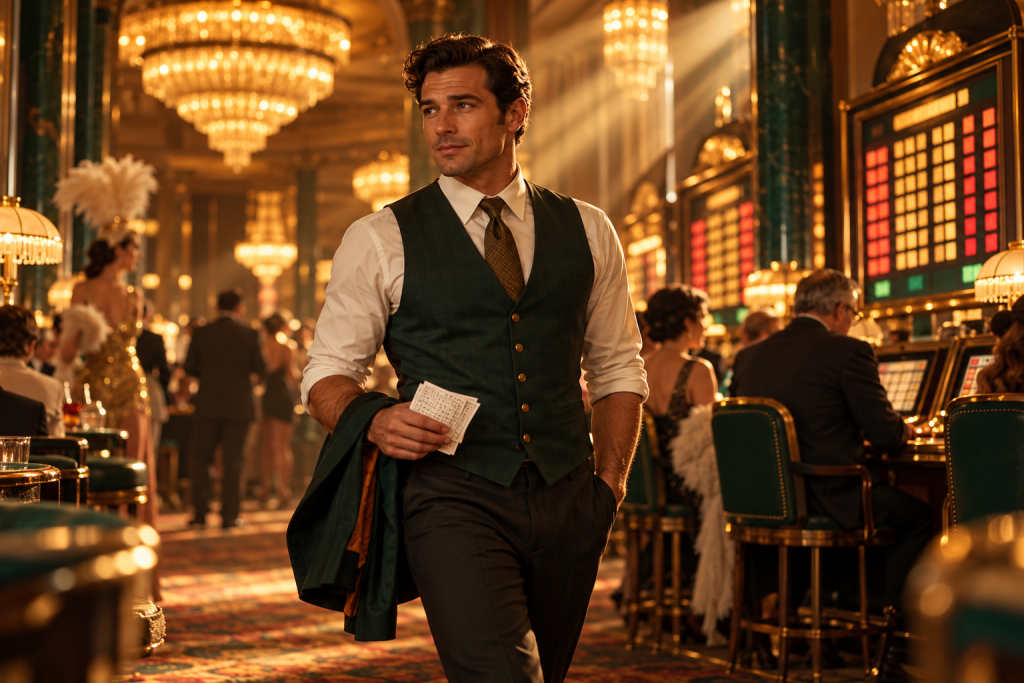
The Job That Disappeared From the Casino Floor
A visitor walking through a Las Vegas casino today will see keno lounges, keno boards, and keno tickets, but the employee who once moved between the player and the game is largely gone. The keno runner was a casino floor worker who carried a player's marked keno ticket to the keno counter, then returned with the receipt. That specific job has been absorbed by other systems and other roles, and the change happened for reasons that are structural rather than sudden.
This article explains why the role faded, what replaced the function it served, and where a reader can find current information about keno in Las Vegas today. It does not provide operating hours, current staffing levels, or any venue's present keno schedule. Those details change constantly and belong to the venues themselves.
What a Keno Runner Did
Keno is a lottery-style game in which a player selects numbers from a fixed field, typically 1 through 80, and the casino draws a set of winning numbers. The player marks choices on a paper ticket. In the era when keno runners were common, the player handed that ticket and payment to the runner, who walked it to the keno writer at the keno counter. The runner then brought back the official receipt, which was the only valid claim document if the ticket won.
The runner's value was mobility. A player seated at a restaurant, a bar, or a slot machine could stay put and still play keno, because the runner bridged the distance between the player and the keno operation. The job was part of a larger floor-service economy that included change runners, drink servers, and other staff who moved between guests and fixed service points.
The Structural Forces That Removed the Role
The keno runner did not vanish because of a single event. Several long-term changes in casino operations made the role redundant, and they worked together over decades.
First, electronic keno systems changed how tickets are issued. A player at a machine or a bar-top unit can now select numbers, pay, and receive a validated ticket without any human intermediary. The machine prints the receipt on the spot. The function the runner performed - carrying a paper slip to a central writer - is built into the terminal itself.
Second, casino floor layouts and staffing models shifted. Properties consolidated service functions and reduced the number of employees whose only task was moving paper between two fixed points. The cost of a dedicated runner became harder to justify when the same transaction could be completed electronically at the point of play.
Third, player behaviour changed. The rise of machine-based keno and multi-game terminals meant that many players who once used runners began playing at screens directly. The runner's market - the player who wanted keno without leaving a restaurant table - was increasingly served by the same electronic systems.
None of these changes happened on a documented single date. They unfolded across the industry over years, and the pace differed by property. Some venues retained runner-style service longer than others, but the role as a standard casino floor position has largely disappeared from the Las Vegas landscape.
What Replaced the Runner
The tasks a runner once performed did not disappear; they moved to other channels. The comparison below shows where each function now lives.
| Function the runner performed | Where that function now sits | What changed |
|---|---|---|
| Carrying a marked ticket to the keno writer | Electronic keno terminal at the player's seat or machine | No human transport needed; the terminal validates and prints the receipt |
| Returning the official receipt to the player | Terminal-printed ticket, issued instantly at the point of play | The receipt is generated where the player sits |
| Collecting payment from the player | Bill acceptor or card reader on the terminal | Payment is handled by the machine, not a floor employee |
| Bringing winnings back to the player | Player redeems at the keno counter or a cashier | Redemption still requires a trip or a service interaction, but the runner's delivery step is gone |
The keno writer and the keno counter still exist in many Las Vegas properties. What disappeared is the intermediary who walked between the player and that counter. The game itself has not gone away.
Why the Change Is Hard to Date Precisely
Casino staffing is not a matter of public record in the way that a building opening or a change of ownership is. A property does not file a document with a regulator stating that it eliminated keno runners. The role declined through attrition, retraining, and the gradual replacement of paper-based workflows with electronic ones.
This is different from a venue closure or a rebranding, which leaves a trace in public records. A job category can disappear without a single announcement, and that is what happened with keno runners. Any article that claims a specific year or a specific property as the moment the role ended is likely inventing a precision the record does not support.
What can be documented are the surrounding facts: the venues where keno has historically operated, the ownership structures that changed over time, and the physical locations where keno lounges sit. Those are the stable reference points.
Keno in the Documented Downtown Las Vegas Properties
The reference sources available for this article document several downtown Las Vegas casino properties, and downtown has historically been a centre of keno play. The table below lists the documented venues nearest to the Las Vegas city reference point, with their straight-line distances. These figures come from publicly published reference sources and reflect a documented point in time, not today's operations.
| Venue | Straight-line distance from Las Vegas city reference point | Measurement type |
|---|---|---|
| The D Las Vegas | 0.1 miles | Great-circle (straight-line) |
| Four Queens | 0.2 miles | Great-circle (straight-line) |
| Horseshoe | 0.3 miles | Great-circle (straight-line) |
| Golden Nugget Las Vegas | 0.3 miles | Great-circle (straight-line) |
| Binion's | 0.3 miles | Great-circle (straight-line) |
| Golden Gate | 0.4 miles | Great-circle (straight-line) |
| Main Street | 0.4 miles | Great-circle (straight-line) |
| Main Street Station | 0.4 miles | Great-circle (straight-line) |
Road distance is always longer than straight-line distance, and this article does not publish road mileage. A visitor measuring from their own position should use a mapping tool for driving distance, not the figures above.
The documented venue set contains 318 venues measured to the Las Vegas city reference point. That is not a complete list of casinos in Las Vegas or any other jurisdiction. The state gaming regulator maintains the authoritative current list of licensed properties.
What Public Records Do and Do Not Show
Public records are good at capturing ownership changes, openings, and physical addresses. They are not good at capturing the day-to-day staffing mix on a casino floor. A reader who wants to know whether a specific Las Vegas property still employs keno runners will not find that answer in a property deed or a licensing record.
The documented ownership histories in the reference sources illustrate the point. The D Las Vegas is owned and operated by Derek and Greg Stevens. Four Queens was owned by Elsinore Corporation from 1973 to 2003. Binion's is owned by TLC Casino Enterprises. Golden Nugget Las Vegas is owned by Landry's, which is based in Houston, Texas. These ownership facts are stable and documented. They say nothing about whether any of those properties currently staffs a keno runner position.
Ownership and branding of casino properties change through sales and rebrands, and facility figures are revised as properties are rebuilt and expanded. Any current staffing question must be answered by the property itself, not by historical records.
Where Current Keno Information Lives
The honest answer to "what happened to keno runners" has two parts. The structural part - the decline of the role and the reasons for it - is stable and can be explained. The current part - whether any given property still has keno, where its keno lounge sits, and what hours it operates - is perishable and belongs to the venue.
For a reader planning a trip, the useful channels are:
- The property's own website, specifically any page describing its keno lounge or gaming floor
- The property's guest services line, which can confirm current keno operations and whether any runner-style service remains
- The keno counter itself once on site, where the current rules, schedules, and staffing are posted
- The Nevada Gaming Control Board's public resources for questions about licensed gaming operations in the state
Third-party articles, forum posts, and older travel guides are the least reliable sources for current keno staffing. A post from even a year ago may describe a keno operation that has since moved, closed, or changed its service model.
What to Confirm Before You Go
If keno is part of a planned Las Vegas visit, the changeable items below should be confirmed directly with the property before travel. None of them are stable enough to publish here, and none should be assumed from an older article.
- Whether the property currently operates a keno lounge or keno terminals at all
- Where the keno operation sits within the property
- What hours the keno operation runs, and whether those hours differ from the casino floor as a whole
- Whether paper tickets are still accepted, or whether keno is now machine-only at that property
- Whether any runner-style service remains, or whether all keno play is self-service at terminals
- What the current keno paytable and minimum ticket price are, since these change and are not published in this article
The property's own keno page and guest services line are the authoritative channels for every item on this list. No third-party source can substitute for them.
FAQ
Did keno runners disappear from all Las Vegas casinos at once?
No. The role declined gradually as electronic keno terminals spread and casino floor staffing models changed. There is no documented single date or property-level announcement that marks the end of the position. The change happened through attrition and workflow redesign over years, and the pace differed by property.
Can I still play keno in Las Vegas without a runner?
Yes. Keno remains available at many Las Vegas properties, but the ticket is now typically issued by an electronic terminal at the point of play. The player selects numbers, pays, and receives a validated receipt without an intermediary. The keno writer and keno counter still exist at many venues, but the runner's transport function has been absorbed by the machines.
How do I find out if a specific Las Vegas casino still has keno?
Contact the property directly through its own website or guest services line. The venue's keno page, if it has one, will state current hours, location, and whether play is machine-based or includes any counter service. Third-party articles and older forum posts are not reliable for current keno operations because staffing and layouts change frequently.
Play responsibly
Gambling should be treated as paid entertainment, never as a way to earn income or recover losses. 1-800-MY-RESET (1-800-697-3738)
18+ or 21+ depending on where you are; follow the minimum age that applies to you.
This article is general information about how these mechanics work. It is not legal advice and not a recommendation to gamble or to use any particular operator. Availability and legality differ by jurisdiction — check the rules that apply where you are.