


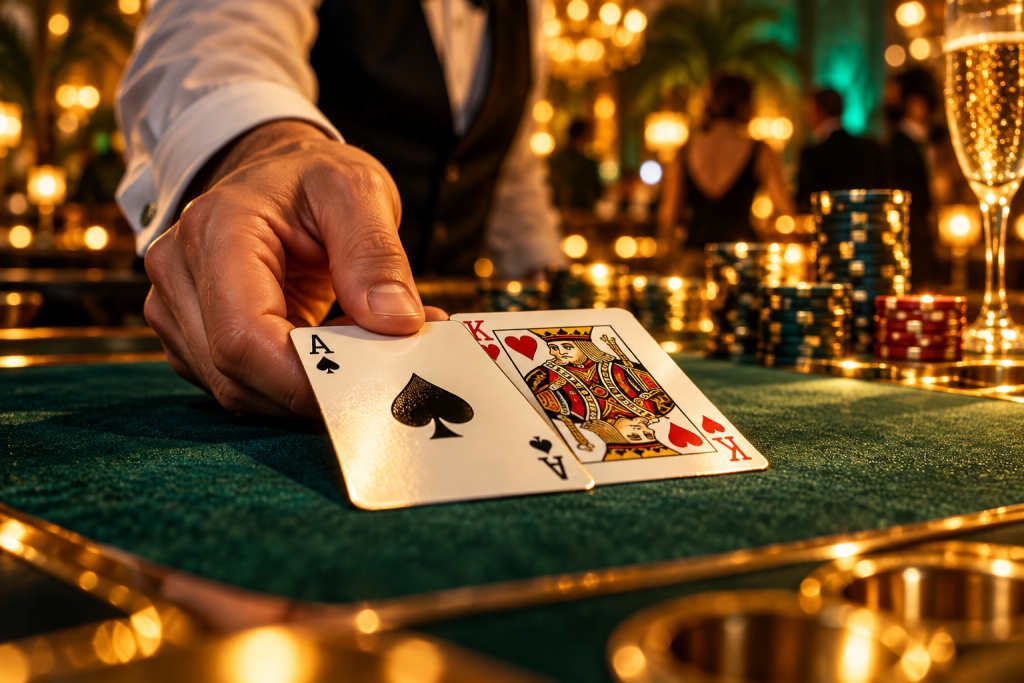
The Highest Possible Starting Hand Is 21
A blackjack hand begins with two cards, and no two-card hand can exceed 21. The arithmetic is simple: the highest card value is 11 for an ace, and the next highest is 10 for any ten, jack, queen or king. Add them together and you get 21, not 22 or more. A player who receives an ace and a ten-value card as their first two cards holds a natural blackjack, which is the strongest starting hand in the game and settles immediately in most rule sets.
This is not a quirk of casino policy or a special exemption. It is a direct consequence of how card values work. Every card in a standard 52-card deck carries a value of 2 through 10, or 10 for face cards, or 1 or 11 for an ace. Because the ace is the only card that can take a second value, and because its higher value is 11, the ceiling on any two-card total is fixed at 21. The bust rule, which ends a hand when a total exceeds 21, can only ever be triggered by a third card or later.
How a Round Moves From Buy-In to Settlement
Understanding why two cards cannot bust becomes clearer when you see the full sequence of a round. A player buys in at the table, receiving chips in exchange for cash or a casino credit instrument. The dealer then begins the round by dealing two cards to each player and two to themselves, with one dealer card face up and the other face down in most common formats. Each player acts on their hand in turn, starting from the dealer's left.
The decision points are where busts happen. A player may stand with what they have, or hit to take another card. It is this third card, and any card after it, that can push a total past 21. A player who hits and lands on 23 has busted, loses the wager immediately, and the dealer collects the cards and the bet before moving to the next hand. A player who stands keeps their total and waits for the dealer to play out their own hand according to the table's fixed drawing rules.
Settlement happens after the dealer completes their hand. If the dealer busts, all remaining players win. If the dealer stands, each player's total is compared with the dealer's, and the higher total wins. A natural blackjack typically pays at a higher rate than a standard win, though the exact payout is printed on the table layout and varies by rule set.
What Each Decision Point Means
Blackjack gives players a sequence of choices, and each one changes the composition of the hand. The first decision is whether to hit or stand. Hitting adds a card and creates the only path to a bust. Standing freezes the total and passes the risk of busting to the dealer, who must draw according to fixed rules rather than choice.
Beyond hit and stand, many tables allow additional actions. Doubling down lets a player double the wager in exchange for exactly one more card and no further action. Splitting separates two cards of the same value into two independent hands, each with its own wager. Surrender, where offered, lets a player forfeit half the wager and end the hand before playing it out. Each of these options has a correct use that depends on the player's total, the dealer's upcard, and the specific rule set in force.
The dealer's upcard matters because it is the only information the player has about the dealer's hidden card. A dealer showing a 6 is in a weak position because the fixed drawing rules often force the dealer to hit a stiff total and risk busting. A dealer showing an ace is in a strong position because the hidden card may complete a natural blackjack. Published basic-strategy charts map these situations to the decision that minimises expected loss, and those charts derive from the exact rule set in use.
Where the House Edge Sits Across Different Bets
Blackjack is not a single bet with a single edge. The main wager carries one house edge under a given rule set, but side bets and rule variations change the arithmetic. The table below compares the main bet types a player may encounter at a blackjack table.
| Bet type | What it is | How the edge behaves |
|---|---|---|
| Main wager | The base bet on the player's hand against the dealer's hand | Edge depends on the rule set: deck count, dealer stand rules, doubling and splitting options |
| Insurance | A side bet offered when the dealer shows an ace, wagering that the dealer has a natural blackjack | Carries a materially higher house edge than the main wager in most rule sets |
| Perfect pairs or similar side bets | Wagers on specific card combinations appearing in the player's first two cards | Typically high-edge bets that resolve independently of the main hand |
| Natural blackjack payout | The bonus paid when the first two cards total 21 | Not a separate bet, but the payout rate changes the main game's edge; a lower payout increases the house edge |
The main lesson is that not every wager on the table carries the same expected loss. A player who sticks to the main bet and uses a strategy chart matched to the table's rules faces a different long-run rate of loss than a player who adds insurance or side bets. The edge on any given bet and the RTP on that same bet sum to 100%, but that relationship holds for the same bet under the same rule set, not across the whole table.
Why Strategy Charts Depend on the Exact Rules
A basic-strategy chart is not a universal document. The correct play for a given hand changes when the rules change. A table that allows doubling after splitting creates different optimal decisions than one that does not. A dealer who stands on soft 17 produces different correct plays than a dealer who hits soft 17. The number of decks in the shoe changes the probabilities that drive the chart. A chart built for one rule set can be measurably wrong at a table with different rules.
This is why a player who wants to use a strategy chart should first read the table's posted rules, then find a chart that matches those rules. The table layout itself states the key variables: the blackjack payout, whether the dealer hits or stands on soft 17, whether surrender is offered, and what doubling and splitting options exist. Matching the chart to the table is the difference between playing the hand correctly and playing a different game than the one in front of you.
The Mistakes That Cost New Players the Most
The first procedural mistake is taking insurance. It is offered as protection, but it is a separate wager with its own house edge, and that edge is higher than the main game's in most rule sets. A player who insures every dealer ace is adding a negative-expectation bet on top of the main wager. The second mistake is using a strategy chart that does not match the table's rules. The chart may say to double a given hand, but if the table forbids doubling after a split, the correct play changes.
The third mistake is treating a natural blackjack as if it always beats the dealer’s hand. An ace and a ten-value card total 21, but if the dealer also has a natural blackjack, the hand pushes and the wager is returned rather than paid. This is rare, but it is built into the game. No starting hand, including a natural, removes the house's mathematical advantage over the long run. The edge stays with the house on every wager, and the player's control is limited to choosing bets and decisions that change the expected rate of loss.
FAQ
What is the highest possible two-card total in blackjack?
The highest possible two-card total is 21, made from an ace valued at 11 and any ten-value card. No other combination can reach or exceed that total, because the next highest card after the ace is worth 10.
Can the dealer bust with only two cards?
No. The dealer's first two cards follow the same value rules as the player's, so the dealer cannot exceed 21 before taking a third card. A dealer bust can only occur after the dealer hits according to the table's fixed drawing rules.
Does a two-card 21 always finish with a higher hand than the dealer?
No. A player's two-card 21, known as a natural blackjack, pushes if the dealer also has a natural blackjack. In that case the wager is returned rather than paid. Against any other dealer hand, the natural settles immediately as a win at the posted payout rate.
Play responsibly
Gambling should be treated as paid entertainment, never as a way to earn income or recover losses. 1-800-MY-RESET (1-800-697-3738)
18+ or 21+ depending on where you are; follow the minimum age that applies to you.
This article is general information about how these mechanics work. It is not legal advice and not a recommendation to gamble or to use any particular operator. Availability and legality differ by jurisdiction — check the rules that apply where you are.