


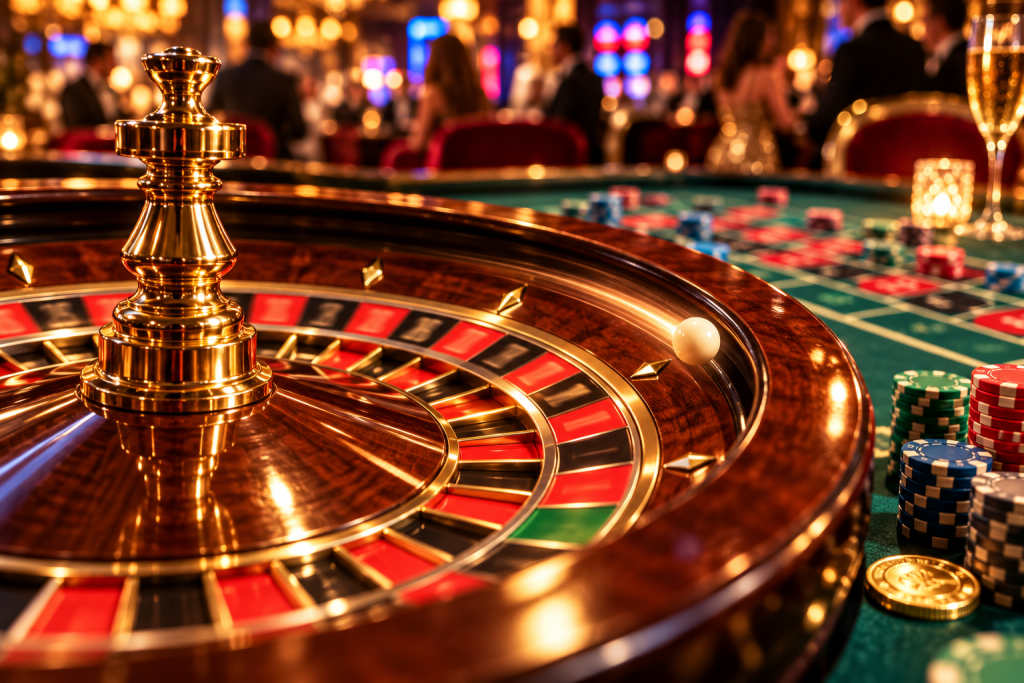
The edge is set before you place a chip
When a roulette player asks which 'juice' is better, they are usually comparing two different wheels or two different bets and trying to find the one that takes less from them over time. The juice is not a fee the casino adds at the end. It is built into the payout schedule itself, and it is different on every layout. A winning straight-up bet pays less than the true odds of that number appearing, and that gap is where the operator's advantage lives.
The comparison that matters most is the wheel itself. Roulette wheels come in two main layouts, and the difference between them is one extra pocket. A European wheel has 37 pockets with a single zero. An American wheel has 38 pockets with a single zero and a double zero. The extra pocket does not change the payout for a winning number, but it does change how often you can expect to win. That is the entire story of the juice: the same payout, a smaller chance of collecting it.
How the payout gap creates the edge
Every roulette bet pays as if the zero pockets did not exist. A straight-up bet on one number pays 35 to 1. If the wheel had 36 pockets and no zeros, that payout would match the true odds exactly and the game would be even. But the wheel has 37 or 38 pockets, so the payout is short by the value of the extra pocket or pockets. The house keeps that difference on every spin, whether you win or lose, because the payout schedule never changes.
The same logic applies to every bet on the layout. A split, a street, a corner, a column, a dozen, red or black, odd or even — each one pays slightly less than the true mathematical odds of that group appearing. The size of the shortfall is not identical across all bet types, which is why the question of which juice is better has a real answer beyond just the wheel type.
| Comparison point | European wheel (single zero) | American wheel (single and double zero) |
|---|---|---|
| Pockets on the wheel | 37 | 38 |
| Zero pockets | 1 | 2 |
| Effect on payout schedule | Payouts are short by one pocket | Payouts are short by two pockets |
| House edge on most bets | Lower, because only one pocket creates the gap | Higher, because two pockets create the gap |
| Where the edge is stated | The game information panel or rules page for the specific table | The game information panel or rules page for the specific table |
The table above is deliberately free of percentages. The exact house edge figure for a given table is printed in that game's information panel or in the operator's rules page, and it is the only number you should rely on for that specific table. What you can know without looking is the direction of the comparison: a single-zero layout always carries a smaller built-in edge than a double-zero layout for the same bet, because there is one fewer pocket creating the shortfall.
Inside bets, outside bets, and the difference between them
Roulette bets are usually grouped into inside bets, which sit on the numbered grid, and outside bets, which sit around it. The inside bets pay more when they hit and lose more often. The outside bets pay less when they hit and win more often. But the house edge on most of these bets is the same on a given wheel, because the payout shortfall is built the same way. A straight-up number and an even-money bet on red both pay as if the zeros were not there.
There is one well-known exception on some European layouts. Certain rule variants, often called 'la partage' or 'en prison', change what happens when the ball lands on zero while you have an even-money bet placed. Under one variant, half the stake is returned. Under another, the stake is held for the next spin and returned if the next spin wins. These rules do not remove the edge, but they reduce it on those specific even-money bets, because the zero stops taking the full stake in that situation.
| Bet type | What it covers | How often it tends to win | What the payout looks like | What changes the edge |
|---|---|---|---|---|
| Straight-up | One number | Rarely | Large multiple of the stake | Wheel type and any special zero rule |
| Split, street, corner | Small groups of numbers | Somewhat more often | Moderate multiple of the stake | Wheel type and any special zero rule |
| Column or dozen | Twelve numbers | Roughly one spin in three, before zeros | Fixed multiple of the stake | Wheel type and any special zero rule |
| Even-money outside bets | Red, black, odd, even, high, low | Just under half the time, before zeros | Equal to the stake | Wheel type, plus la partage or en prison rules where offered |
None of these bet types is 'better' in the sense of turning the game positive. The lower-juice choice is the one that reduces the expected rate of loss, not the one that promises a win. On a single-zero wheel, an even-money bet with a favourable zero rule carries less juice than a straight-up bet on the same wheel. On a double-zero wheel, every bet carries more juice than its single-zero equivalent. That is the full hierarchy.
Why a short session looks nothing like the long-run average
The house edge is a statement about a very large number of spins. It does not describe what happens in an evening. Over a few dozen spins, almost anything can happen: a player can be ahead, behind, or somewhere in between, and none of those outcomes contradicts the edge. The edge is the slow drift that accumulates across thousands and thousands of spins, not a force that corrects any particular session.
This is the central misunderstanding behind most roulette systems. A player who wins early has not beaten the juice. A player who loses early has not been cheated by it. Both are experiencing variance, which is the short-term scatter around the long-run average. The wheel has no memory, no target, and no obligation to return to any particular balance.
What decisions per hour do to total exposure
The house edge applies to every unit wagered, not to the session as a whole. That means the total expected loss is driven by three things: the edge on the specific bet, the size of each wager, and the number of wagers placed. A player who bets the same amount on a lower-edge bet but plays twice as many spins per hour is exposing twice as much money to the edge in that hour.
As an example, suppose a player wagers 100 units per hour on a bet with a lower edge, and another player wagers 100 units per hour on a bet with a higher edge. The second player's expected loss over that hour is larger, because the same total coin-in is multiplied by a larger edge. Now suppose the first player speeds up and wagers 200 units per hour. Their expected loss may now match or exceed the second player's, even though their bet carries less juice. The edge per bet is only one part of the arithmetic; volume is the other.
This is why the question 'which juice is better' has a practical answer only when the player also controls for speed and stake. The lower-edge wheel is the better choice on paper. But a lower-edge wheel played twice as fast, or at twice the stake, produces the same expected loss as a higher-edge wheel played more slowly or more cheaply.
Why progression systems redistribute outcomes instead of removing the edge
A progression system is any rule that changes the stake based on previous results. The most famous is doubling after a loss, sometimes called a martingale. The logic sounds appealing: eventually a win must come, and when it does, it recovers all previous losses plus one unit. The problem is not that the win never comes. The problem is that the stake required to keep the progression alive grows very quickly, and every casino table has a maximum bet.
Suppose a player starts with a stake of one unit and doubles after every loss. After a run of several losses, the next required stake is a large multiple of the original bet. If the table maximum is reached before a win arrives, the progression cannot continue, and the losses already incurred are locked in. The player has not removed the edge; they have concentrated it into a small number of large, table-limited bets.
Even when a progression completes successfully, it does not change the expected value of the game. It changes the shape of the outcomes. Most sessions end with a small win, and a small number of sessions end with a very large loss. The average of all those sessions still points in the same direction as the house edge. A progression is a way of rearranging when the losses arrive, not a way of making them disappear.
How to read the juice on any table you sit at
Before you place a chip, look at the wheel itself. Count the zero pockets. If there is one, you are on a single-zero layout. If there are two, you are on a double-zero layout, and every bet on that table carries more juice than its single-zero equivalent. Then check the table rules for any special zero treatment on even-money bets. If the table offers la partage or en prison, the even-money bets on that table carry less juice than they otherwise would.
The exact house edge percentage for the table you are playing is stated in the game information panel, the help screen, or the operator's rules page. That is the figure to trust for that specific table. The structural comparison in this article tells you which direction the comparison points, but the printed number is the one that applies to your money.
No bet on any roulette wheel removes the edge. No pattern of stakes removes it. The only choices under your control are which wheel you play, which bet you place, how much you stake, and how many spins you take. The lower-juice choice is the one that reduces the expected rate of loss, and that is the most any player can do at a roulette table.
FAQ
Is the house edge the same on every roulette bet?
On a given wheel, most bets carry the same house edge because the payout shortfall is built the same way. The exception is on single-zero tables that offer la partage or en prison, where even-money bets carry a reduced edge because the zero does not take the full stake.
Does a European wheel always have a lower house edge than an American wheel?
For the same bet under the same special-rule conditions, yes. The American layout adds a second zero pocket, which increases the payout shortfall on every bet. A single-zero wheel with a favourable zero rule on even-money bets carries even less juice than a standard single-zero wheel.
Can a betting system overcome the juice in roulette?
No. A betting system changes the size and timing of your stakes, not the payout schedule or the wheel. Progression systems produce many small wins and occasional large losses, and the average of all outcomes still reflects the house edge. Table maximums also limit how far any progression can run.
Play responsibly
Gambling should be treated as paid entertainment, never as a way to earn income or recover losses. 1-800-MY-RESET (1-800-697-3738)
18+ or 21+ depending on where you are; follow the minimum age that applies to you.
This article is general information about how these mechanics work. It is not legal advice and not a recommendation to gamble or to use any particular operator. Availability and legality differ by jurisdiction — check the rules that apply where you are.