


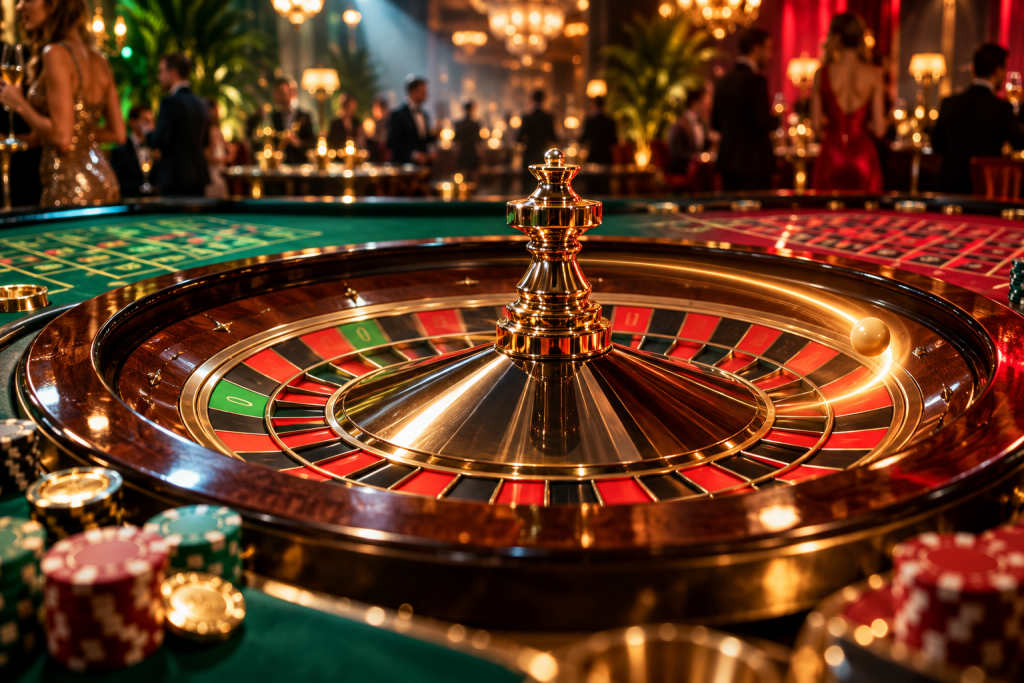
The Wheel You Sit Down At Changes the Math
When you walk up to a roulette table, the first thing to check is not the felt color or the minimum bet. It is the wheel itself. Count the green pockets. If you see one green pocket, you are looking at a European-style wheel. If you see two, it is an American-style wheel. That single extra pocket is the whole difference, and it quietly changes the price of every bet you place.
Both wheels carry the numbers 1 through 36, alternating red and black. The difference sits in the zeroes. A European wheel has a single zero, giving it 37 pockets in total. An American wheel adds a double zero, bringing the total to 38. Those green pockets are not red or black, which matters for even-money bets, and they are where the house takes its mathematical cut.
Why the Extra Pocket Matters
Roulette pays out as if the zeroes did not exist. A straight-up bet on a single number pays 35 to 1, but on a European wheel there are 37 pockets, not 36. On an American wheel there are 38. The payout does not change to match the extra pocket, and that gap is the house edge.
This is easiest to see on an even-money bet like red or black. A European wheel has 18 red numbers, 18 black numbers, and one green zero. If you bet red, 18 pockets win and 19 lose. An American wheel has the same 18 red and 18 black, plus two green pockets. Now 18 pockets win and 20 lose. You are still paid even money, but you lose slightly more often.
| Feature | European Wheel | American Wheel |
|---|---|---|
| Total pockets | 37 | 38 |
| Zero pockets | 1 (single zero) | 2 (single and double zero) |
| Red numbers | 18 | 18 |
| Black numbers | 18 | 18 |
| Payout for a straight-up bet | 35 to 1 | 35 to 1 |
| Losing pockets on an even-money bet | 19 | 20 |
The extra green pocket does not change the payout schedule. It changes how often each payout lands. That is why the same bet on an American layout carries a larger house edge than the identical bet on a European layout.
What a Round Looks Like
The sequence from buy-in to settlement is the same on both wheel types. You place cash on the table, never directly into the dealer's hand, and the dealer exchanges it for roulette chips. These chips have no value printed on them and are often a distinctive color so the dealer can tell your bets from everyone else's. They only have value at that table, and you cash them in before you leave.
Once you have chips, you place them on the layout. The dealer spins the wheel in one direction and sends the ball travelling the opposite way around the outer track. While the ball is moving, you may still place bets. At some point the dealer calls an end to betting, usually with a phrase like "no more bets" or a hand motion over the layout. From that moment, nothing on the felt may be touched.
The ball loses speed, drops into a pocket, and the dealer marks the winning number on the layout with a marker. Losing bets are swept away first, then winning bets are paid. Your chips stay on the table until the marker is removed, and then the next round begins.
The Bet Types and Where the Edge Sits
Roulette bets fall into two broad families: inside bets placed on the numbered grid, and outside bets placed around its edges. Inside bets cover specific numbers or small groups and pay more because they hit less often. Outside bets cover large sections of the wheel and pay close to even money.
What surprises many new players is that the house edge is not the same across every bet on the same table. On a European wheel, most bets carry the same edge because the single zero creates the same shortfall. On an American wheel, the double zero widens that shortfall for nearly every bet. There is one exception worth knowing: some American tables offer a five-number bet covering zero, double zero, one, two and three. That bet pays 6 to 1, but because it covers five numbers and loses on 33, it carries a larger house edge than any other bet on the layout.
| Bet Type | What It Covers | Payout | How the Zeroes Affect It |
|---|---|---|---|
| Straight-up | One number | 35 to 1 | Both zeroes lose |
| Split | Two adjacent numbers | 17 to 1 | Both zeroes lose |
| Street | Three numbers in a row | 11 to 1 | Both zeroes lose |
| Corner | Four numbers in a block | 8 to 1 | Both zeroes lose |
| Five-number | 0, 00, 1, 2, 3 | 6 to 1 | American layout only; larger edge |
| Red or black | 18 numbers | Even money | One green pocket beats you on European; two on American |
| Odd or even | 18 numbers | Even money | Same as red or black |
| High or low | 1-18 or 19-36 | Even money | Same as red or black |
The table layout prints the payout for each bet, and the wheel itself tells you which version you are playing. Before you put a chip down, read both.
Procedural Mistakes That Cost New Players
The first mistake is touching chips after the dealer calls no more bets. The call is not a suggestion. Once the ball is nearing the end of its run, any hand near the layout will be treated as an attempt to alter a bet, even if you were only adjusting your stack. Keep your hands back until the marker comes off.
The second is letting a winning bet ride without understanding what you are doing. When a straight-up bet wins, the dealer pays 35 to 1 and leaves your original chip in place. Many players leave the whole pile on the same number, not realising the payout is now at risk. You are free to do that, but it is a new bet at the same odds, not a continuation of the old one.
The third is buying in with a value chip and assuming it plays. Roulette tables use special unmarked chips. If you sit down with a regular casino chip, the dealer will exchange it for roulette chips before you can bet. Hand over cash or chips flat on the table and let the dealer handle the conversion.
What No Betting Pattern Changes
No placement pattern, progression, or combination of inside and outside bets removes the zeroes from the wheel. Covering more numbers changes the shape of your outcomes: you win more often and lose larger amounts when you miss. Covering fewer numbers does the reverse. Neither approach changes the fact that the wheel has one or two green pockets that pay no bet.
If you are choosing between two tables and both are otherwise identical, the wheel with fewer green pockets gives the house a smaller mathematical cut on the same wager. That is a fact about the layout, not a promise about any given spin. A single session can produce any result, because the short run is dominated by variance. The difference between the two wheels only asserts itself over a very large number of spins.
FAQ
Is European roulette always the better choice?
In terms of the built-in house edge on a given bet, yes, a single-zero wheel gives the house a smaller cut than a double-zero wheel on the same wager. But table minimums, atmosphere, and what you want from the session matter too. A cheaper American table may suit your bankroll better than an expensive European one, even though the edge differs.
Do the two wheels have different numbers on them?
No. Both carry 1 through 36 in the same alternating red and black sequence. The only difference in the numbered pockets is the presence of the double zero on the American wheel. The sequence around the wheel also differs between the two layouts, but the set of numbers is identical.
Can I bet on the zeroes themselves?
Yes. The zero and double zero are numbers like any other for betting purposes. You can place a straight-up bet on either, or include them in split or corner bets. They pay the same as any other number when they hit, but they are not covered by red, black, odd, even, high or low bets, which is exactly why they create the house edge.
Play responsibly
Gambling should be treated as paid entertainment, never as a way to earn income or recover losses. 1-800-MY-RESET (1-800-697-3738)
18+ or 21+ depending on where you are; follow the minimum age that applies to you.
This article is general information about how these mechanics work. It is not legal advice and not a recommendation to gamble or to use any particular operator. Availability and legality differ by jurisdiction — check the rules that apply where you are.