


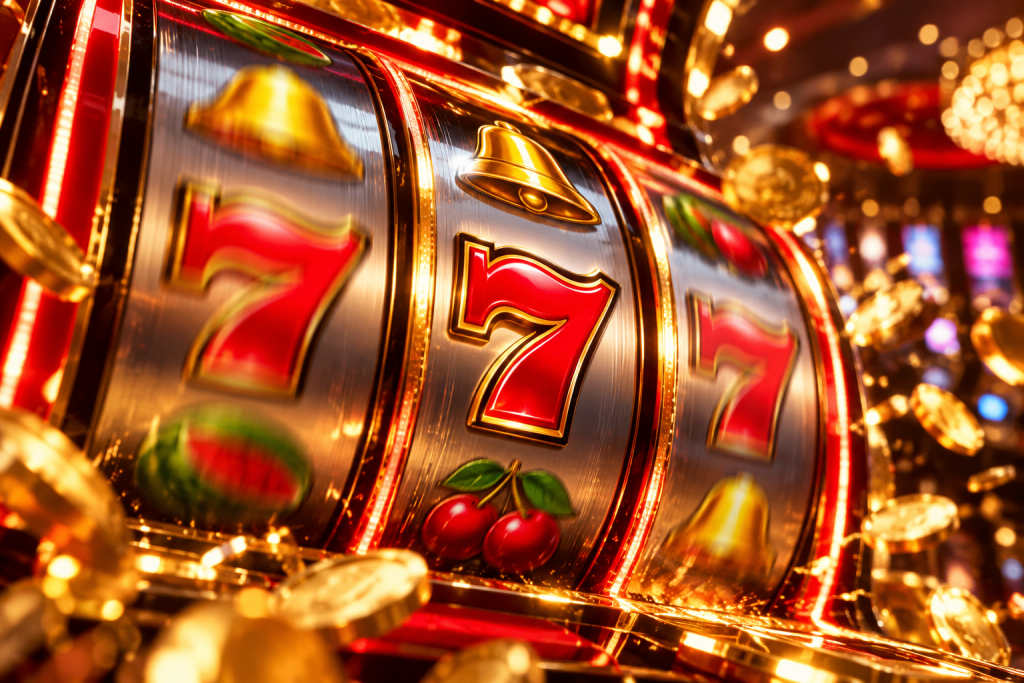
What Happens When the Spin Button Is Pressed
Every slot round begins with a decision you make and a decision made by software you never see. You choose the stake and press spin. The game then draws a random number, maps that number to a set of reel positions, and displays the result as symbols on a screen. The animation that follows is presentation. The outcome already exists before the reels visibly stop.
The random number generator, commonly shortened to RNG, is the algorithm that determines game outcomes. It produces numbers continuously, even when nobody is playing. When a spin is initiated, the game takes the next number in the sequence and uses it to select where each reel stops. Independent testing laboratories are commonly used to certify RNG behaviour; certification covers game mechanics, not an operator's financial conduct.
This matters because it means a spin cannot be influenced by what happened before it. A machine is not due for a win after a dry spell, and a recent jackpot does not make the next spin less likely to pay. Each round is a fresh draw from the same programmed distribution.
How a Random Number Becomes a Screen Full of Symbols
The mapping step is where the RNG output turns into something you can read. Each reel in a slot is a virtual strip of symbols, far longer than what is visible on screen. The RNG selects a position on each strip. The game then shows the symbols around that position in the display window.
This is why two spins can look similar but resolve differently. The visible symbols are a small window onto a much longer reel strip. A symbol that appears frequently on the visible portion may be rare on the full virtual strip, and the paytable reflects the full strip, not the five or so positions you see.
The paytable is the authoritative document for a given game. It lists every symbol's value, the patterns that pay, and any special rules. Reading it before playing answers most questions about what a spin can return. The game information panel, usually reached through an i or question-mark icon, carries the theoretical return percentage and the volatility setting where the operator publishes them.
Paylines and Ways-to-Win Are Different Scoring Systems
Two slots can look nearly identical and settle wins under completely different rules. The scoring system is the first thing to check in the paytable. Fixed-payline games require betting all lines. Ways-to-win formats pay on adjacent-symbol combinations instead of fixed lines.
The practical difference is how a winning combination is recognised. On a fixed-payline game, symbols must land on one of the printed lines, usually running left to right from the first reel. A ways-to-win game ignores printed lines and pays any matching symbols on adjacent reels, regardless of their vertical position. This tends to produce more frequent small wins and changes how the stake is divided across the possible outcomes.
| Feature | Fixed paylines | Ways-to-win |
|---|---|---|
| Winning pattern | Symbols on a printed line, left to right | Matching symbols on adjacent reels, any row |
| Stake structure | Split across all active lines | Single stake covering all positions |
| Win frequency feel | Fewer, often larger line hits | More frequent, often smaller hits |
| Where the rules are stated | Paytable line diagram | Paytable ways description |
Neither system is inherently better. They produce different distributions of outcomes, and the theoretical return is set independently of the scoring system.
Volatility Describes the Shape of the Ride
Volatility, also called variance, is how payouts are distributed over time. High volatility means rarer but larger payouts; low volatility means more frequent but smaller ones. Volatility does not change a game's RTP.
Two games can both return the same theoretical percentage over a very large number of spins and feel completely different session to session. A high-volatility game will spend long stretches taking small amounts and occasionally return a large hit. A low-volatility game will trade smaller swings more often. The choice between them is a choice about what kind of session you want, not about which game is more generous.
Return to Player, or RTP, is a theoretical percentage of total wagered money a game returns to players over a very large number of spins or hands. It is a long-run statistical average, not a per-session guarantee. A session of a few hundred spins can land far above or far below that number, and that spread is exactly what volatility measures.
Stake Size Changes the Scale, Not the Odds
Your stake multiplies every payout on the paytable. A symbol combination that pays a fixed multiple of the stake will return proportionally more when you wager more. The probability of that combination landing does not change with stake size.
This has a concrete consequence. Playing at maximum stake on a game with a progressive jackpot may be required to qualify for the top prize, because some progressives require a maximum-stake bet to qualify. On a non-progressive game, stake size simply scales both wins and losses. A player wagering twice as much per spin is moving through their bankroll twice as fast per spin, with the same expected rate of loss on each unit wagered.
No play pattern alters the programmed return. Changing stake size between spins, pausing, switching games, or following a sequence of increases and decreases does not change the RNG distribution or the house edge. The edge is built into the game's mathematics and stays the same on every spin.
Fixed and Progressive Jackpots Work Differently
Jackpot types matter because they change where the game's return goes. Fixed jackpots pay a set amount. Progressive jackpots grow from a share of qualifying wagers and reset after a win. Progressive contributions are typically taken out of the game's return, and some progressives require a maximum-stake bet to qualify.
A fixed jackpot is simply a large payout listed in the paytable. It is funded like any other symbol combination and does not change the game's overall return structure. A progressive jackpot pools contributions across many players, often across many operators, and the displayed amount grows until someone hits the qualifying combination.
The trade-off is visible in the base game. Because a portion of each wager feeds the progressive pool, the regular payouts on a progressive game are typically lower than on a comparable fixed-jackpot game. The theoretical return may be similar over the very long run, but it is concentrated in an event that almost never happens to any given player.
| Feature | Fixed jackpot | Progressive jackpot |
|---|---|---|
| Prize amount | Set in the paytable | Grows from wager contributions |
| Funding source | Standard game return | Share of qualifying wagers |
| Qualification | Standard paytable rules | Often requires maximum stake |
| Base game feel | Unchanged by jackpot | Often lower regular payouts |
Before chasing a progressive, check the rules screen for the qualification condition. If a maximum-stake bet is required and you are not wagering it, you are playing a game with reduced regular payouts and no access to the prize that justifies them.
Free Spins and Bonus Funds Are Not Cash
Many slot sessions include free spins or a no-deposit bonus, and the distinction between bonus funds and withdrawable cash is where confusion starts. Spins granted at a fixed stake on specified slot titles are free spins. Winnings are commonly credited as bonus funds subject to wagering requirements rather than as withdrawable cash.
A wagering requirement, also called playthrough, is a multiplier stating how much must be wagered before bonus-related funds can be withdrawn. Example arithmetic only: a 30x requirement on a 50-unit bonus means 1,500 units must be wagered. Game weighting can change how much each wager counts.
A no-deposit bonus is a promotional credit granted without a deposit. It is normally subject to wagering requirements, maximum-cashout caps, game restrictions and expiry windows, which determine whether any of it can become withdrawable. The terms page for the specific promotion is the only place where the real numbers are stated, and reading it before accepting the bonus is the difference between knowing what you hold and guessing.
Where to Find the Numbers for the Game You Are Playing
Every substantive number about a specific slot lives in two places: the paytable and the game information panel. The paytable lists symbol values, payline or ways rules, jackpot conditions, and special feature triggers. The information panel, usually behind an i or question-mark icon, carries the theoretical RTP, the volatility setting where published, and the game version number.
If a figure is not in either place, treat it as unknown. A game that does not publish its RTP in the panel may still publish it on the operator's site or in the game developer's documentation. The operator's terms page carries the wagering requirements and cashout caps for any promotional play. None of these numbers should be guessed from how a game feels during a short session.
The honest answer to whether a given slot is among the best available in any country is that no universal ranking exists. What can be compared are the published mechanics: RTP, volatility, scoring system, and jackpot structure. A game with a higher published RTP and a volatility setting that matches your session preference is a defensible choice. A game chosen because it felt hot for twenty minutes is a guess.
FAQ
Can a slot be due for a win after a long losing run?
No. Each spin draws a fresh random number from the same distribution. The RNG has no memory of previous outcomes, and the game's return is a long-run average, not a quota that must be met within any session or sequence.
Does playing at maximum stake improve the odds on a non-progressive slot?
It scales every payout and every loss by the same factor, but it does not change the probability of any combination landing. On some progressive games, maximum stake is required to qualify for the top prize, which is a separate condition stated in the game rules.
Why do two slots with the same RTP feel so different?
Volatility. Two games can return the same theoretical percentage over a very large number of spins while distributing wins very differently. One may pay small amounts often, the other large amounts rarely, and a short session will reflect that distribution rather than the long-run average.
Gambling can be addictive. Play responsibly and only with money you can afford to lose. If you or someone you know needs help, contact a responsible gambling helpline in your country.
Play responsibly
Gambling should be treated as paid entertainment, never as a way to earn income or recover losses. 1-800-MY-RESET (1-800-697-3738)
18+ or 21+ depending on where you are; follow the minimum age that applies to you.
This article is general information about how these mechanics work. It is not legal advice and not a recommendation to gamble or to use any particular operator. Availability and legality differ by jurisdiction — check the rules that apply where you are.