
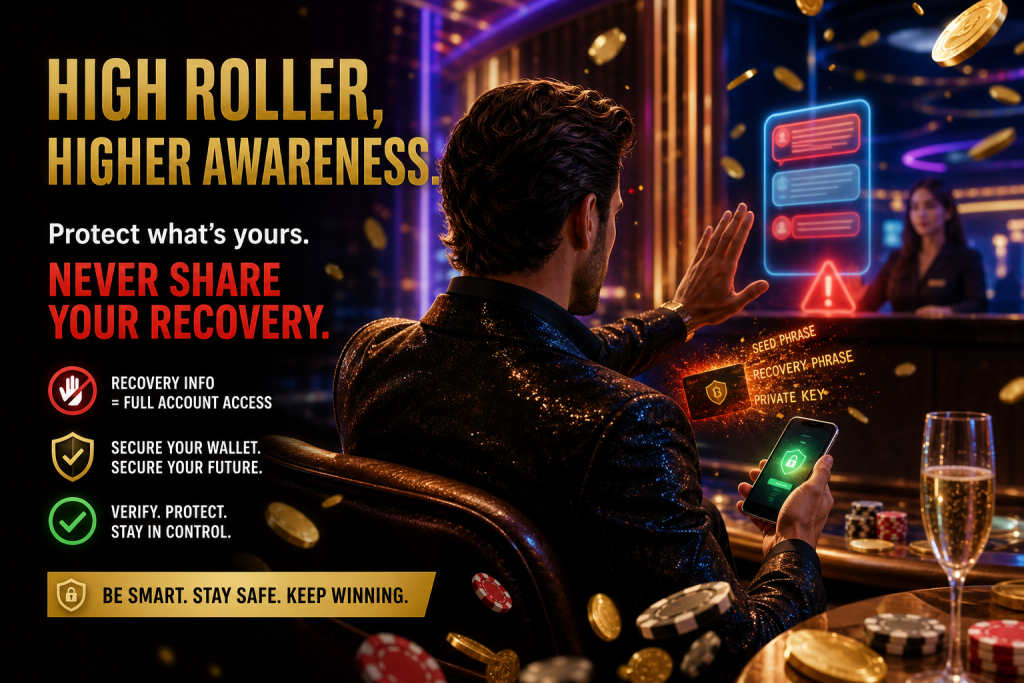
The problem usually starts on the cashier page. A deposit stays pending, a withdrawal does not arrive, or support asks for "wallet verification" and mentions your recovery words.
Stop there. A seed phrase should never be shared with casino support, payment staff, chat agents, or anyone claiming to fix a crypto transaction problem. Those words control the wallet itself, not a single payment, and anyone who gets them can typically recreate the wallet on another device and move the funds.
Why the request is dangerous
A seed phrase, sometimes called a recovery phrase, is the master backup for a self-custody crypto wallet. It is commonly a set of 12 or 24 words shown when the wallet is created.
Those words are not a password for customer service to "check" a transfer. They are closer to the keys for the whole account. If another person imports that phrase into compatible wallet software, they may gain access to the balances and addresses linked to it.
That is why support does not need it to investigate a missing deposit. For an ordinary on-chain payment, the useful details are the transaction hash, the sending address, the receiving address, the asset used, and the network used. A seed phrase adds control, not evidence.
What support may legitimately ask for instead
A real payment investigation focuses on the transaction, not on taking over your wallet. If a deposit or withdrawal has a problem, support may ask for details that help match your transfer to what their system expected.
| Detail requested | Why it can be relevant | What it does not allow |
|---|---|---|
| Transaction hash | Lets staff look up whether the transfer was included in a block and sent to the right address | It does not give access to your wallet |
| Wallet address | Helps confirm the sending or receiving address used | It does not let someone spend funds by itself |
| Network name | Checks whether the coin was sent on the network the cashier supports | It does not expose private keys |
| Screenshot of the transaction page | Can show amount, token and status if text details were copied incorrectly | It should not include recovery words or private keys |
| Identity documents | Some operators perform KYC before withdrawals | It is separate from wallet control |
Notice the pattern. Transaction data helps trace a payment. Identity documents may be part of account verification. Neither requires your recovery phrase.
How crypto payment problems are actually checked
On-chain transfers work differently from card payments. Once a transaction is confirmed, it is generally irreversible, so support cannot "pull it back" by logging into your wallet.
The normal checks are more mechanical than that. Staff or automated systems look at the blockchain record, confirm that the transaction was included in a block, compare the destination address with the cashier address generated for your account, and verify that the coin and network match what the platform accepts.
A common failure is sending the right asset on the wrong network. Another is copying an outdated deposit address if the site rotates addresses. Sometimes the transfer is fine on-chain but has not yet met the number of confirmations the receiving system waits for before crediting it.
None of those cases require your seed phrase. They require transaction facts.
Why scammers use support language
Fake support messages work because they sound routine. The message may mention a stuck deposit, a wallet sync issue, AML checks, node congestion, or a need to "verify ownership."
That wording can make a dangerous request seem technical. Yet ownership of a wallet is not proved by handing over the words that unlock it. Doing so gives away control. A genuine investigation can be done by asking you to sign in to your account, confirm public transaction details, or in some cases complete identity checks.
Scammers also exploit urgency. "Act within 10 minutes" is a familiar line. So is a warning that funds will be lost unless you provide the phrase immediately. On-chain settlement does depend on network confirmation times and fees, but support pressure does not change the blockchain.
Practical signs that a seed-phrase request is not normal
Small details matter here. Fraud often appears in direct messages, chat pop-ups, search ads, or replies under complaint posts.
- They ask for 12 or 24 words, or a screenshot containing them.
- They send you to an external "wallet validation" page.
- They ask you to connect a wallet and then reveal backup words.
- They claim the phrase is needed to cancel a pending transaction.
- They contact you first on social media or a messaging app.
- They use pressure, countdowns, or threats of account closure.
Even if the message includes the operator's logo or a ticket number, the request itself is the warning. Support can ask for a transaction hash. Support should not need the recovery phrase that controls the wallet.
What to do if a deposit is pending
Start with the blockchain record. Find the transaction hash in your wallet and check whether it was included in a block, whether the amount is correct, and whether the destination address matches the one shown in the cashier when you made the deposit.
Next, confirm the network. USDT, for example, may exist on multiple networks on many sites, and sending the token over a different network than the cashier expects can create a support case even when the token symbol looks right.
Then contact support only through the official channels listed after you sign in to your account. Provide the transaction hash, asset, network, amount, time sent, and screenshots with sensitive wallet information hidden.
Across the sites surveyed, the coins most often listed were BTC, ETH, XRP and USDT, with several others appearing less frequently. That variety is useful for users, but it also increases the chance of network mix-ups because the same asset name can appear in different forms.
What to do if you already shared the phrase
Move fast. Time matters once someone else may have the ability to import your wallet.
Create a brand-new wallet with a newly generated recovery phrase on a device you trust. Then transfer any remaining funds from the exposed wallet to the new one as soon as possible, taking care to use the correct network and destination address.
After that, review token approvals and connected applications if your wallet supports those features. Change passwords on related accounts, especially email, because support scams sometimes arrive as part of a broader account-takeover attempt.
Finally, notify the operator through the account's official support path that you may have interacted with an impersonator. They may not be able to reverse an on-chain transfer, but the report can still help if there is an account-security issue running alongside the wallet compromise.
Seed phrase, private key, password: not the same thing
People often mix these up, which is exactly why scam messages use broad terms like "security check." The differences are practical.
| Item | What it is for | Should support ever need it? |
|---|---|---|
| Seed phrase / recovery phrase | Backs up and restores the wallet | No |
| Private key | Authorises spending from a specific address | No |
| Wallet app password | Unlocks the app on your device | No |
| Transaction hash | Identifies a specific blockchain transfer | Often, yes |
That last row is the useful contrast. Support investigates transactions with transaction identifiers. It does not need the secrets that let someone control your funds.
How to handle support safely
Use a short routine every time. It reduces mistakes when a payment is delayed and emotions are high.
- Open support from the signed-in account area, not from a search result or direct message.
- Share public transaction details only: hash, address, asset, network, amount and timestamp.
- Redact recovery words, private keys and full wallet balances from screenshots.
- Do not install remote-access software for a payment issue.
- If a chat agent asks for seed words, end the chat and contact support again through another official channel.
Short delays are not rare. Across the surveyed sites, withdrawal wording ranged from very fast claims to broad windows such as up to 24 hours or up to 72 hours. That variation makes it even more important not to treat delay alone as proof that an unusual security step is normal.
FAQ
Can casino support ever need my seed phrase to find a missing deposit?
No. A missing deposit is checked with the transaction hash, address, amount, asset and network. A seed phrase controls the wallet and is not needed to trace a transfer.
What if support says they only need the phrase to verify ownership?
Do not provide it. Ownership can be checked in other ways, depending on the situation, such as account access, transaction details, or identity checks where those are used. Recovery words give control, not simple proof.
Is it safe to share a screenshot of my wallet?
Only if it shows public transaction details and no secret data. Never include recovery words, private keys, QR backups, or anything that could restore the wallet.
Play responsibly
Gambling should be treated as paid entertainment, never as a way to earn income or recover losses.
18+ or 21+ depending on where you are; follow the minimum age that applies to you.
Help line (US): 1-800-MY-RESET (1-800-697-3738)
This article is general information about how these mechanics work. It is not legal advice and not a recommendation to gamble or to use any particular operator. Availability and legality differ by jurisdiction — check the rules that apply where you are.