


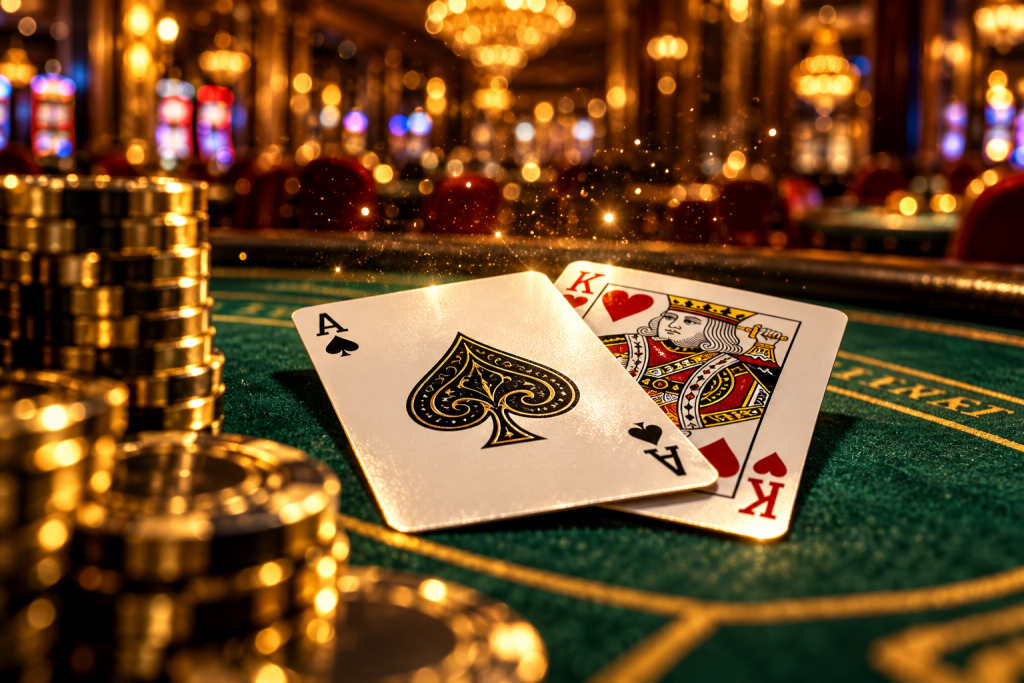
The first two cards decide the question
A natural blackjack is not any hand that reaches 21. It is specifically an ace and a ten-value card—a ten, jack, queen, or king—as the first two cards dealt. The question of odds is really two smaller questions: how many cards in the shoe can start the hand, and how many can complete it. The answer changes with the number of decks because removing one card from a single deck changes the remaining proportions more than removing one card from six decks.
Think of the deal as a sequence. The first card must be either an ace or a ten-value card. The second card must be the other type. The order does not matter for the hand itself, but the arithmetic has to account for both possible orders: ace first then ten, or ten first then ace.
Counting the combinations in a single deck
A standard deck has 52 cards, of which 4 are aces and 16 are ten-value cards. If the first card is an ace, the probability is 4 out of 52. After that ace is gone, 51 cards remain, and 16 of them are ten-value cards, so the chance the second card completes the natural is 16 out of 51. Multiply those two fractions together and you get the probability for the ace-first order.
The ten-first order works the same way in reverse: 16 out of 52 for the first card, then 4 aces among the remaining 51 cards. The two orders produce the same product, so the total probability is twice one of them. The result is a small single-digit percentage—a natural blackjack is an uncommon event, which is exactly why it pays at a premium to an ordinary winning hand.
Why more decks change the number
Adding decks changes the composition less than intuition suggests, but it does change it. In a six-deck shoe there are 312 cards: 24 aces and 96 ten-value cards. The first-card probabilities look similar to a single deck at a glance, but the second card is drawn from a much larger remaining pile, so the removal of the first card matters less. The probability of a natural drifts slightly downward as decks are added.
The direction of the change is what matters for a player comparing games. A single-deck game deals a natural a little more often than a six-deck game. The difference is small in absolute terms, but it is real, and it is one of several rule variations that shift the expected cost of playing.
| Factor | Single deck | Six-deck shoe |
|---|---|---|
| Aces in play | 4 | 24 |
| Ten-value cards in play | 16 | 96 |
| Total cards | 52 | 312 |
| Effect of first card removed | Larger shift in remaining proportions | Smaller shift in remaining proportions |
| Frequency of natural blackjack | Higher | Lower |
What the probability means for the bet
A natural blackjack usually pays at a rate above even money, often stated as 3 to 2 at many tables, though some layouts advertise a different rate. That payout is not a bonus the house gives away. It is priced into the game's overall return. The house edge on a blackjack bet comes from several sources: the dealer acting last, the possibility that both player and dealer bust with the player losing first, and the specific rules for splitting, doubling, and standing.
The natural blackjack payout works in the player's favour relative to a flat even-money win, which is why a table that reduces that payout makes the game more expensive for the player even though nothing else on the felt changes. The probability of being dealt the natural is only one input into that cost. The payout attached to it is the other.
Short sessions and long-run averages
If a natural blackjack occurs on a small single-digit percentage of hands, a player might still see several in one evening or none at all across a hundred hands. That spread is variance. The long-run average describes what happens over a very large number of hands, not what any particular sitting will produce.
Variance does not change the built-in edge. It only changes how the session feels. A player who receives three naturals in twenty minutes has not found a favourable shoe; they have experienced a run of outcomes that sits inside the normal distribution of a game with a low-probability, high-payout event. A player who sees none has experienced the other side of the same distribution.
Decisions per hour and total exposure
The chance of being dealt a natural is a per-hand probability. The number of hands played per hour multiplies how often that event is expected to appear, but it also multiplies the total amount wagered. A faster table or a player who makes decisions quickly will see more naturals in absolute terms over the same period, and will also put more money through the game.
That is the useful way to read any per-hand probability: it describes the frequency of an event, not the profitability of a session. A player who wants to see a natural more often simply plays more hands. A player who wants to reduce total expected loss plays fewer hands or smaller stakes. The probability of the natural itself does not move.
Where the exact figure for your table comes from
The exact probability for a given game depends on the number of decks in the shoe and whether the game uses a continuous shuffler or a cut-card deal. The table layout and the game information panel usually state the deck count and the blackjack payout. The house edge for the full rule set is not printed on the felt, but the rules that determine it are: deck count, dealer stand rules, doubling restrictions, splitting limits, and the natural payout.
If a player wants to compare two blackjack games, those printed rules matter more than any single probability. The chance of being dealt a natural is one small line in a longer calculation.
FAQ
Does the order of the ace and ten-value card change the odds?
No. The hand is the same whether the ace arrives first or second. The probability calculation counts both orders and adds them together, but the result is a single number for the two-card combination.
Is a natural blackjack more likely with fewer players at the table?
The number of other players does not change the probability that your first two cards form a natural. Other players' cards are unknown at the moment of the deal, so they do not alter the count of aces and ten-value cards that can reach your hand. What changes is only the number of hands dealt per hour, which affects how many naturals you expect to see over time.
Does a continuous shuffler change the odds of a natural?
A continuous shuffler returns used cards to the pool quickly, so the composition of the shoe stays closer to a fresh shoe throughout play. The per-hand probability of a natural is effectively the same as the fresh-shoe probability for that deck count. A cut-card game removes cards from play until the shuffle, which lets the remaining composition drift, but a natural is still an uncommon event in either format.
Play responsibly
Gambling should be treated as paid entertainment, never as a way to earn income or recover losses. 1-800-MY-RESET (1-800-697-3738)
18+ or 21+ depending on where you are; follow the minimum age that applies to you.
This article is general information about how these mechanics work. It is not legal advice and not a recommendation to gamble or to use any particular operator. Availability and legality differ by jurisdiction — check the rules that apply where you are.