


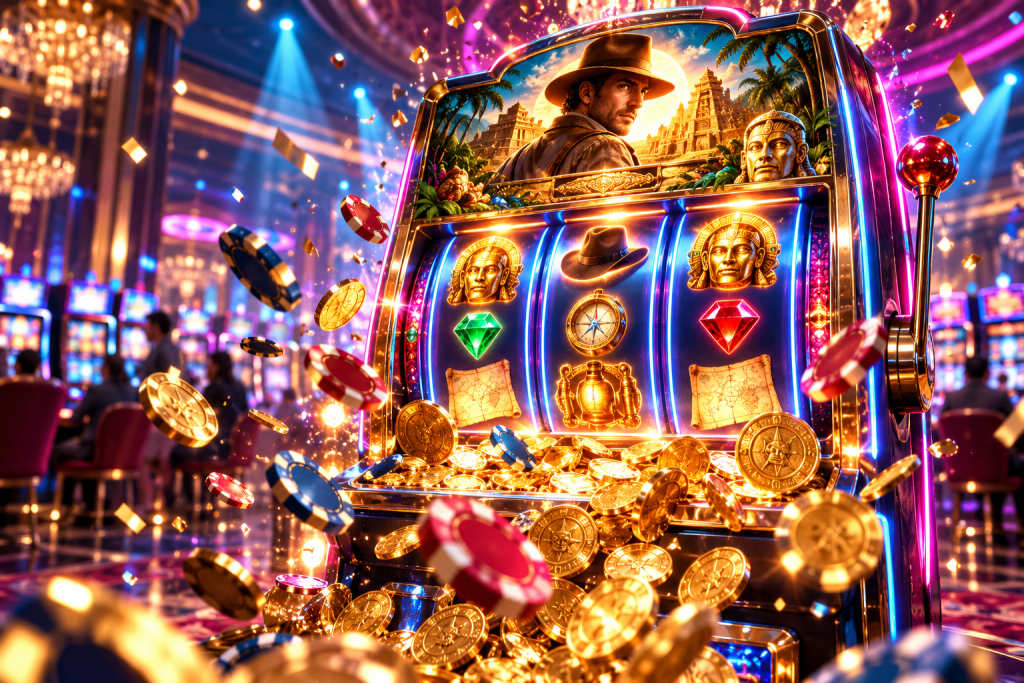
The licence is a costume, not a new engine
When a casino floor or an online lobby shows a game covered in a film franchise, a rock band, a game show, or a board game, you are looking at a branded slot. The operator has paid for the right to use those names, faces, clips, and sounds. That licence changes what the game looks and sounds like, and it changes the commercial deal behind the game. It does not change the machinery that decides whether a spin pays.
Underneath the theme, a branded slot is still a slot. It has reels or a reel-like grid, a random number generator, a paytable, a return percentage, and a volatility profile. The licence fee is a cost of making the game, and in some cases a share of the wager goes to the rights holder. That can affect the return offered to players, which is why two games with identical maths can publish different RTPs. But the presence of a famous character does not make the game looser, tighter, or more likely to pay.
What the licence covers
A branded slot is a commercial arrangement between a game studio and the owner of an intellectual property. The studio gets the right to use specific assets for a defined period and in defined markets. The rights holder gets a fee, a revenue share, or both, and retains approval over how the property is presented.
That arrangement has practical consequences for the player. A game can disappear from a lobby when the licence expires and is not renewed. The same title may be available in one country and not another because the licence was negotiated territory by territory. An operator may run a branded game as a timed exclusive, then lose it to a competitor. None of this changes the game's fairness; it changes where and for how long you can find the title.
The licence also shapes the game design. A film franchise comes with characters, locations, and story beats that map naturally onto bonus rounds and free-spin features. A music act comes with a catalogue of tracks that can play during base game and features. The studio's job is to fit those assets onto a slot chassis without breaking the underlying maths.
How a spin resolves, branded or not
Every spin on a modern slot, branded or otherwise, resolves through the same sequence. The random number generator produces a number. The game maps that number onto reel positions. The reels stop. The game checks the resulting symbols against the paytable and awards any win. The theme, the licence, and the celebrity face have no role in that sequence.
The random number generator is the algorithm that determines game outcomes. It runs continuously, generating numbers whether or not anyone is playing. When you press spin, the game takes the current number and uses it to decide where each reel stops. The stop positions are determined at that moment; the spinning animation is a presentation of a result that already exists.
Independent testing laboratories are commonly used to certify RNG behaviour. That certification covers game mechanics, not an operator's financial conduct, and it applies to the game engine rather than to the theme wrapped around it. A branded game and an unbranded game from the same studio will typically run on the same certified engine.
Reading the paytable and the information panel
Every branded slot carries the same set of documents as any other slot, and they are the fastest way to understand what a specific game does. The paytable lists every symbol, every payline or winning pattern, and every feature. The information panel, often behind an "i" or "?" icon, carries the RTP, the volatility rating if one is published, the bet limits, and the rules for any jackpot.
Return to Player is a theoretical percentage of total wagered money a game returns to players over a very large number of spins or hands. It is a long-run statistical average, not a per-session guarantee. The house edge is the mathematical advantage the operator holds on a given game, expressed as a percentage of each wager. House edge and RTP are complements: they sum to 100% for the same game.
Volatility describes how payouts are distributed over time. High volatility means rarer but larger payouts; low volatility means more frequent but smaller ones. Volatility does not change a game's RTP. A high-volatility branded slot and a low-volatility branded slot can publish the same return percentage and still play very differently session to session.
Paylines versus ways-to-win
The paytable will tell you which format a branded slot uses, and the difference matters for how you read a win. Paylines are the patterns across reels that produce a paying combination. Fixed-payline games require betting all lines. Ways-to-win formats pay on adjacent-symbol combinations instead of fixed lines, which changes how many possible winning arrangements exist on every spin.
| Feature | Fixed paylines | Ways-to-win |
|---|---|---|
| Winning condition | Symbols land on an active payline | Matching symbols land on adjacent reels |
| Bet structure | All lines are usually active on every spin | Single bet covers all possible patterns |
| Paytable display | Shows each line and its pattern | Shows symbol values without line diagrams |
| Win count on a spin | Multiple lines can pay at once | Multiple adjacent combinations can pay at once |
The format does not change the underlying return. It changes how wins are counted and displayed, and it changes how many small wins versus large wins a session tends to produce. A branded game built on a ways-to-win engine will often feel different from a fixed-payline game even when the theme is similar, because the distribution of outcomes is shaped by the format as much as by the volatility setting.
Fixed and progressive jackpots in branded games
Some branded slots carry a jackpot, and the paytable or information panel will state which kind. Fixed jackpots pay a set amount. Progressive jackpots grow from a share of qualifying wagers and reset after a win. Progressive contributions are typically taken out of the game's return, and some progressives require a maximum-stake bet to qualify.
A branded progressive is often itself a licensed product: a network of games across multiple operators may feed a single jackpot carrying a film or game-show name. The jackpot amount shown on screen is real in the sense that it is the current pool, but the chance of winning it is built into the game's maths and is typically very small. The licence does not make the jackpot easier or harder to hit; the game's design does.
What the theme does and does not change
The honest answer to whether branded slots play differently is: the theme changes your experience, and the maths changes your results. The licence determines the symbols, the sounds, the bonus-round presentation, and often the feature names. The RNG, the RTP, the volatility, and the paytable determine the outcomes.
There is no mechanical reason a branded slot should pay more or less than an unbranded one with the same maths. There is a commercial reason it might: the licence fee has to be paid by someone, and in some cases the return percentage is set slightly lower on a branded title than on a comparable unbranded title from the same studio to cover that cost. The only way to know is to read the information panel on the specific game you are playing and compare it with the studio's other titles.
No play pattern alters the programmed return. Stopping the reels early, changing your stake, playing at a certain time, or following a sequence of spins does not change the RNG's output or the game's long-run return. What stake size and volatility do change is the size of the swings you experience in a session. A higher stake multiplies both wins and losses. Higher volatility stretches the gaps between wins and makes the wins that do land larger. Neither changes the edge.
FAQ
Do branded slots pay worse than regular slots?
Not inherently. The maths is set per game, and a branded title can publish the same RTP as an unbranded one. Some branded games publish a lower RTP because the licence fee is a cost, but the only way to know is to check the information panel on the specific game.
Why did a branded slot disappear from my casino?
Licences are time-limited and territory-limited. When a deal expires without renewal, the operator must remove the game. The same title may remain available elsewhere, and it may return later if a new agreement is signed.
Are branded progressive jackpots harder to win?
The jackpot odds are set by the game's design, not by the theme. A progressive jackpot is typically a very low-probability event, and some require a maximum-stake bet to qualify. The information panel states whether a qualifying bet is required.
Play responsibly. If you or someone you know has a gambling problem, call the helpline printed in the footer below.
Play responsibly
Gambling should be treated as paid entertainment, never as a way to earn income or recover losses. 1-800-MY-RESET (1-800-697-3738)
18+ or 21+ depending on where you are; follow the minimum age that applies to you.
This article is general information about how these mechanics work. It is not legal advice and not a recommendation to gamble or to use any particular operator. Availability and legality differ by jurisdiction — check the rules that apply where you are.