
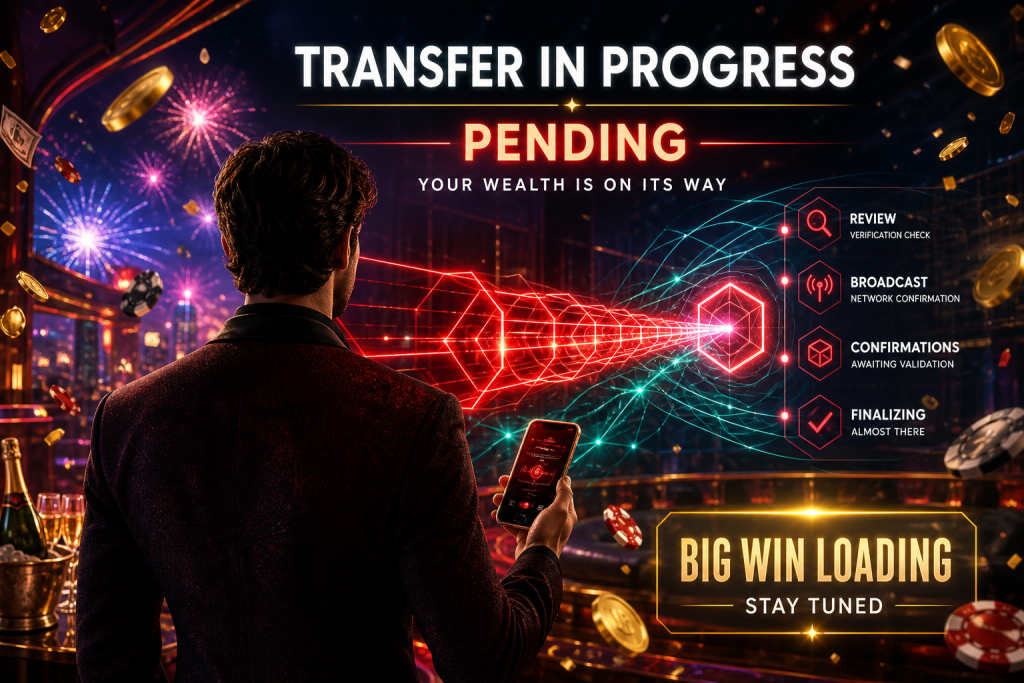
You open the cashier, see a completed or pending withdrawal, copy the wallet address, and the funds still are not in your TRON wallet. That gap between the site status and the wallet balance is usually where the confusion starts.
A TRON USDT withdrawal can stall at three different stages: operator-side review, blockchain broadcast, or confirmation on the network after the transaction has been included in a block. Each stage has its own timing, and only part of it is visible from your side.
Why a TRON USDT withdrawal may look missing
One label often hides several steps. A withdrawal marked pending may still be under internal review, while a withdrawal marked sent may already have a transaction ID but still need confirmations before some wallets show it as fully available.
That matters because “not received” can mean different things:
- the withdrawal has not yet been approved internally
- it has been approved but not yet broadcast to the TRON network
- it was broadcast and included in a block, but your wallet or service is waiting for more confirmations
- it was sent on a different network than the receiving wallet expects
On-chain transfers do not follow bank opening hours. They settle according to network processing and confirmation depth, but the operator still controls when the transaction is first released.
Stage 1: Operator review happens before any blockchain transfer
The first delay is often off-chain. Before any TRC20 USDT transaction exists, the withdrawal request may sit in a queue for checks.
Those checks commonly include balance review, internal risk rules, and identity verification. KYC can be requested before withdrawal, and requirements differ by operator and jurisdiction. If documents are missing or a review is triggered, no blockchain transaction will appear yet because nothing has been broadcast.
This is the point many players cannot influence much beyond responding quickly to requests. If the cashier shows no transaction hash, or only shows a status such as pending, processing, or under review, then the hold-up is usually still on the operator side.
Across the sites surveyed, withdrawal timing was worded very differently, including phrases such as “up to 24 hours,” “up to 72 hours,” “90% under one minute,” and even an average shown down to minutes and seconds. Those statements describe site handling, not the TRON network itself, and they are not all measuring the same part of the process.
Stage 2: Broadcast to TRON is the handoff to the network
Once approved, the withdrawal still is not in your wallet until it is broadcast. Broadcast means the signed transaction is sent out to the TRON network for inclusion in a block.
If support says the payment was approved but cannot provide a transaction ID, that often suggests the transfer has not yet been broadcast, or at least the reference has not been exposed to the user. Without a transaction hash, you cannot independently check whether the USDT moved on-chain.
After broadcast, the next useful question is simple: was the transaction included in a block? A blockchain explorer for TRON can show that. Inclusion in a block means the network has recorded the transfer. It does not automatically mean every wallet, exchange, or app will credit it at the exact same moment.
Stage 3: Confirmation depth affects when funds appear usable
Some wallets display incoming TRC20 USDT quickly. Others wait for more confirmations before they treat the transfer as final enough to credit or make spendable.
That is where users often mix up two separate events: block inclusion and final crediting by the receiving service. A transaction can already exist on-chain while the receiving platform still marks it pending.
The practical result is this:
| Stage | What it means | What you can check |
|---|---|---|
| Internal review | The withdrawal request exists only inside the operator system | Cashier status, email notices, document requests |
| Broadcast | The signed transaction has been sent to the TRON network | Transaction ID or hash |
| Block inclusion | The transfer was included in a TRON block | Explorer result showing the transaction |
| Confirmation depth | Additional blocks have followed, and the receiver may require a threshold | Explorer confirmations and receiving-wallet status |
So if your TRON USDT withdrawal is “not received,” the most useful dividing line is whether a transaction hash exists yet. That tells you if the problem is still internal or already on-chain.
What you can influence yourself
You cannot control another party’s review queue. You can, however, avoid the mistakes that create the longest delays.
The biggest one is network mismatch. USDT exists on multiple networks, and TRON withdrawals usually mean the TRC20 version. If the receiving wallet expects another network, the funds may not show up there even though a transfer was completed on-chain.
You can also check the address format and whether the wallet supports TRC20 USDT deposits. A pasted address can be valid in form yet still belong to a destination that does not credit that token or network the way you expect.
What else is under your control:
- confirm that you selected TRON/TRC20, not another USDT network
- verify the full receiving address, not just the first and last characters
- check whether the receiving wallet or exchange requires a minimum deposit amount for crediting
- look for a transaction hash before contacting support
- use a TRON explorer to confirm whether the transfer was included in a block
One thing to phrase carefully: for an ordinary crypto send, network fees are part of how the transaction is constructed, but they do not work like a surprise deduction from the amount the recipient must receive. The sender defines the output, while the fee is handled separately within the transaction structure.
What you cannot influence
Several timing factors sit outside your control even if you entered everything correctly.
Internal approval speed is one. Queue length, manual checks, and withdrawal batching vary from site to site. Another is the receiving service’s own credit policy. Even after the transaction is visible on the TRON network, a wallet app or exchange may wait before showing the funds as available.
Network conditions matter too, though they are only one part of the story. People often blame the blockchain first, but many “missing” withdrawals have not reached the broadcast stage yet.
A practical checklist for a missing TRON USDT withdrawal
Start with the simplest evidence trail. Do not jump straight to “the network lost it,” because confirmed blockchain transfers are not reversible in the ordinary sense.
| Question | If yes | If no |
|---|---|---|
| Do you have a transaction hash? | Check a TRON explorer for block inclusion and confirmations | The delay is likely still at review or broadcast stage |
| Does the explorer show the correct receiving address? | Focus on receiver crediting and confirmation policy | Raise it immediately with support using the mismatch details |
| Was TRON/TRC20 the selected network? | Move to confirmation and wallet-support checks | Recovery depends on the receiving service and is not always possible |
| Has the receiving wallet credited TRC20 USDT before? | Check whether it is waiting for more confirmations | Confirm that the wallet supports this asset-network combination |
If support replies with only a generic status, ask one precise question: “Has the withdrawal been broadcast to the TRON network, and if so, what is the transaction hash?” That separates internal delay from blockchain delay in one step.
Worked example: where the time actually goes
Take an example withdrawal of 140 units in TRC20 USDT. Suppose the request is submitted at 14:10, approved internally at 16:40, broadcast at 16:52, included in a block a short time later, and credited by the receiving wallet at 17:08 after extra confirmations.
The user experiences a delay of almost three hours. Yet only part of that was network time. Most of it was the gap before broadcast.
That is why the search query “tron usdt withdrawal not received” usually needs a staged answer, not a single average wait time. A site can advertise rapid withdrawals, but your own transaction may still be slowed by review, missing documents, address checks, batching, or the receiving wallet’s confirmation threshold.
How to talk to support efficiently
Short, specific messages work better than vague complaints. Include the withdrawal amount, time requested, selected network, receiving address, and whether a transaction hash has been provided.
If you already found the transaction on a TRON explorer, mention whether it shows successful block inclusion and how many confirmations are visible. That helps support determine whether the issue sits with the sender side or the receiver side.
A useful message looks like this: “My TRC20 USDT withdrawal requested at 18:25 still is not credited. Please confirm whether it has passed internal review, whether it was broadcast, and provide the transaction hash if available.”
FAQ
Why does my cashier say sent but my wallet shows nothing?
“Sent” is not always used consistently. On many sites it may mean approved internally, while on others it may mean broadcast already happened. The transaction hash is the clearest proof that the transfer reached the TRON network.
How do I know if the problem is the operator or the blockchain?
If there is no transaction hash, the delay is usually still before or at broadcast. If a hash exists and a TRON explorer shows block inclusion, the transfer is on-chain and the remaining wait may be down to confirmation depth or the receiving service’s credit process.
Can I reverse a TRON USDT withdrawal if I used the wrong network or address?
On-chain crypto transfers are irreversible once confirmed. Recovery, if any, depends on whether the receiving service controls the destination and is able to assist, which varies by implementation and is not assured.
Play responsibly
Gambling should be treated as paid entertainment, never as a way to earn income or recover losses.
18+ or 21+ depending on where you are; follow the minimum age that applies to you.
Help line (US): 1-800-MY-RESET (1-800-697-3738)
This article is general information about how these mechanics work. It is not legal advice and not a recommendation to gamble or to use any particular operator. Availability and legality differ by jurisdiction — check the rules that apply where you are.