


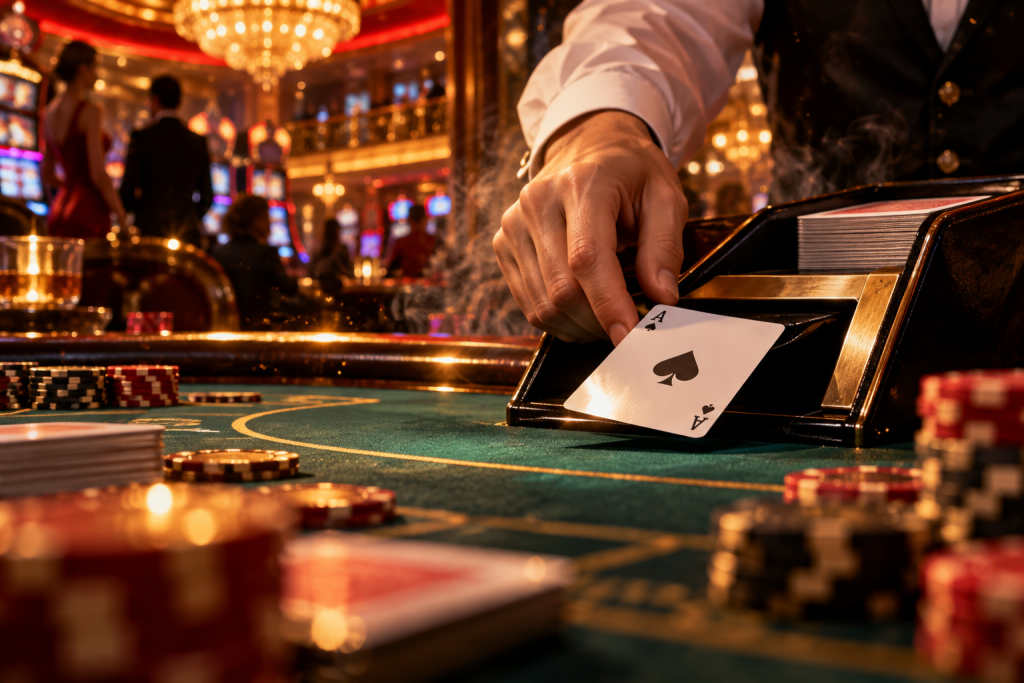
The Shoe Exists So the Deck Has a Memory
Walk up to a blackjack table and the dealer rarely shuffles. Cards come from a plastic box called a shoe, and the same physical deck or decks keep feeding hands for minutes at a time. That is not laziness or a time-saving shortcut. The game's mathematics depend on cards leaving play and staying out until the shuffle puts them back.
Blackjack is a comparing card game: the objective is a hand total closer to 21 than the dealer's without exceeding it. What makes it different from most casino games is that each round changes the composition of what remains. If a hand uses four aces, those aces cannot appear again until the deck is reassembled. A player who tracks what has left can adjust decisions to what remains. The moment cards are shuffled back in after every hand, that entire structure disappears and blackjack becomes a different game.
So the practical answer to whether you should shuffle after each play is no, not in a conventional shoe-dealt game. The dealer shuffles only when the shoe is exhausted or when a marker card tells them the next round would cut too close to the end. The exact trigger point varies by house procedure, but the principle is constant: the shuffle is a boundary between sequences, not a step between hands.
What Happens Between Hands
A round of blackjack moves through a fixed sequence. The dealer collects the used cards from the previous hand and places them in a discard tray. New cards are drawn from the front of the shoe. No shuffle occurs. The discard tray grows while the shoe shrinks, and the two only meet when the shoe is done or the cut card appears.
The cut card is a solid plastic card, usually red or yellow, inserted into the stack during the shuffle. Its position determines how deep into the shoe the dealer deals before stopping. When the cut card emerges during a round, the dealer finishes that round and then shuffles everything—the undealt remainder and the discards—into a fresh shoe. Some venues place the cut card near the back, leaving only a few hands unplayed; others cut deeper, leaving half a deck or more behind. The placement is a house decision and it is visible to anyone watching the shuffle.
Why cut at all? Because if the dealer dealt to the literal last card, a player who had counted every card would know the final hands with certainty. The cut card creates a buffer of unknown cards, which is the structural reason it exists. It is not a rule about fairness; it is a rule about information.
Where Shuffling After Every Hand Does Happen
There is one common exception: tables using a continuous shuffling machine, often abbreviated CSM. Here the dealer places the discards back into the machine after every round, and the machine constantly recombines them with the remaining cards. The next hand is dealt from a freshly mixed supply every time.
The effect is exactly what the name suggests. No card-removal information survives from one hand to the next, because the cards are always being reintroduced. The game plays faster—dealers do not pause for a full shuffle—and the house removes the possibility that a player can gain an edge by tracking what has been dealt. The trade-off for the player is that the game becomes closer to independent trials, like a slot pull, rather than a sequence with a changing composition.
Some players avoid CSM tables on principle; others prefer them because they deal more hands per hour. Neither choice changes the built-in house edge on a given bet. It changes the texture of the information available, and for most recreational players that distinction matters less than the speed of play.
| Dealing method | When the shuffle happens | What the player can track | Effect on game speed |
|---|---|---|---|
| Hand-shuffled shoe | Only when the cut card appears or the shoe is exhausted | Which ranks have left play since the last shuffle | Slower; full shuffle pauses the table |
| Machine-shuffled shoe | Same boundary, but the shuffle itself is automated | Same as hand-shuffled once cards are in the shoe | Faster; shuffle downtime is shorter |
| Continuous shuffling machine | Effectively after every round | Nothing meaningful across hands | Fastest; no full-shuffle pause |
Why the Shuffle Boundary Matters to How You Play
If you are not counting cards, the shuffle boundary still affects one decision: when to sit down and when to leave. At a shoe-dealt table, the composition of the remaining cards drifts as hands are played. Sometimes the remainder is rich in high cards, sometimes in low cards. A basic-strategy player does not change decisions based on that drift, but the drift is real and it is why some players wait for a fresh shuffle before joining a table—they want to start from a known, complete deck rather than an unknown partial shoe.
Basic strategy itself is a set of published charts telling you the mathematically best action for every hand total against every dealer upcard. Those charts derive from the specific rule set in use: number of decks, whether the dealer stands or hits on soft 17, whether doubling after splitting is allowed, and whether surrender is offered. A chart built for a six-deck game where the dealer stands on soft 17 is not exactly correct for a single-deck game where the dealer hits. The shuffle method does not change basic strategy, but the rule set does, and the two are often confused because they both live in the same physical procedure.
So when you sit down, you are not just choosing a table. You are choosing a rule set, a number of decks, a shuffle method and a cut-card depth. The game information panel or a printed placard on the table lists the rules. Read it before you buy in, because the dealer will not pause the shoe to explain them.
The Buy-In and the Round, Step by Step
The procedural sequence from cash to settled bet is the same whether the table shuffles once an hour or after every hand.
You place cash on the felt rather than handing it to the dealer. The dealer spreads it, counts it, and calls the amount to the floor supervisor. The cash goes into the drop box, and the dealer pushes you an equal value in chips. You now have a stack of non-negotiable casino chips that must be converted back to cash at the cage or a chip-redemption point before you leave.
Each round then moves through four decision layers. First, you place a wager in the betting circle before any cards are dealt. Second, the dealer gives each player two face-up cards and takes two for themselves, one face up and one face down—or in some regions, one card only until all player hands finish. Third, you act on your hand: stand, hit, double down, split, or surrender where offered. Fourth, the dealer reveals their hole card and plays their hand according to a fixed rule, usually drawing to 17 or higher. Winning bets are paid, losing bets are collected, and pushes return the stake.
The shuffle is not part of that round sequence. It sits outside it, as a boundary event. New players sometimes ask the dealer to shuffle because they have had a run of bad hands and feel the cards are against them. The dealer will not shuffle on request in a shoe game, and asking will not change the mathematics. The cards have no memory of your losses, and a shuffle does not reset luck. It resets the composition, which only matters if you are tracking composition.
Procedural Mistakes That Slow the Table
The first mistake is touching the cards. In shoe-dealt games, player cards are dealt face up and you never touch them. In single- and double-deck games dealt face down, you may pick them up, but you must keep them above the table and in view, and you signal decisions with hand gestures rather than words alone. Reaching for a card in a shoe game will draw an immediate correction from the dealer.
The second is buying in mid-shoe without knowing the rule set. There is no rule against joining at any point, but if you sit down assuming a chart that does not match the table's rules, you will make avoidable errors. Check the placard first. The number of decks and the dealer's soft-17 rule are printed there in most venues.
The third is treating the cut card as a signal that something is wrong. When the red card appears, the dealer is not stopping early to cheat you. The cut card is part of the shuffle procedure, placed in view during the shuffle, and its appearance simply means the next boundary has arrived. The dealer finishes the round and shuffles. Nothing about the appearance of the cut card changes the odds on the hand in progress.
What the Shuffle Does and Does Not Change
A shuffle reassembles the physical deck. It does not change the house edge on any bet, the dealer's drawing rules, the payout on a blackjack, or the correctness of basic strategy for the table's rule set. What it changes is the information state: before a shuffle, the remaining shoe has a known composition only to a player who has tracked every card; after a shuffle, the composition is complete again.
For a recreational player using basic strategy and flat betting, the shuffle boundary is mostly a pacing event. For a player who counts cards, it is the clock that restarts the count. For a player at a CSM table, it is irrelevant because the boundary is dissolved. Knowing which of those three situations you are in is the real answer to the question of whether the cards should be shuffled after each play.
FAQ
Can I ask the dealer to shuffle the cards if I'm losing?
You can ask, but in a shoe-dealt game the dealer will decline. The shuffle happens only at the cut card or the end of the shoe, and it is not a response to a player's results. A shuffle resets the card composition; it does not reset your luck, because the odds on the next hand are the same whether the deck was shuffled ten seconds ago or ten minutes ago.
Does a continuous shuffling machine change the house edge?
The machine changes the availability of card-removal information, not the house edge on the bets themselves. The same rule set has the same expected loss per wager whether the cards come from a shoe or a CSM. What changes is that no player can track which ranks have left play, because the discards are constantly reintroduced.
How many decks are in a typical blackjack shoe?
The number varies by venue and table, and it is always printed on the table placard or the game information panel. Six and eight decks are common in shoe-dealt games, while single and double decks appear in pitch games dealt from the dealer's hand. The deck count matters because basic-strategy charts are built for a specific number of decks, so read the placard before you rely on a chart.
If you or someone you know is struggling with gambling, help is available. Contact the National Problem Gambling Helpline at the helpline printed in the footer below for confidential support, or visit a local responsible gambling resource in your area.
Play responsibly
Gambling should be treated as paid entertainment, never as a way to earn income or recover losses. 1-800-MY-RESET (1-800-697-3738)
18+ or 21+ depending on where you are; follow the minimum age that applies to you.
This article is general information about how these mechanics work. It is not legal advice and not a recommendation to gamble or to use any particular operator. Availability and legality differ by jurisdiction — check the rules that apply where you are.