


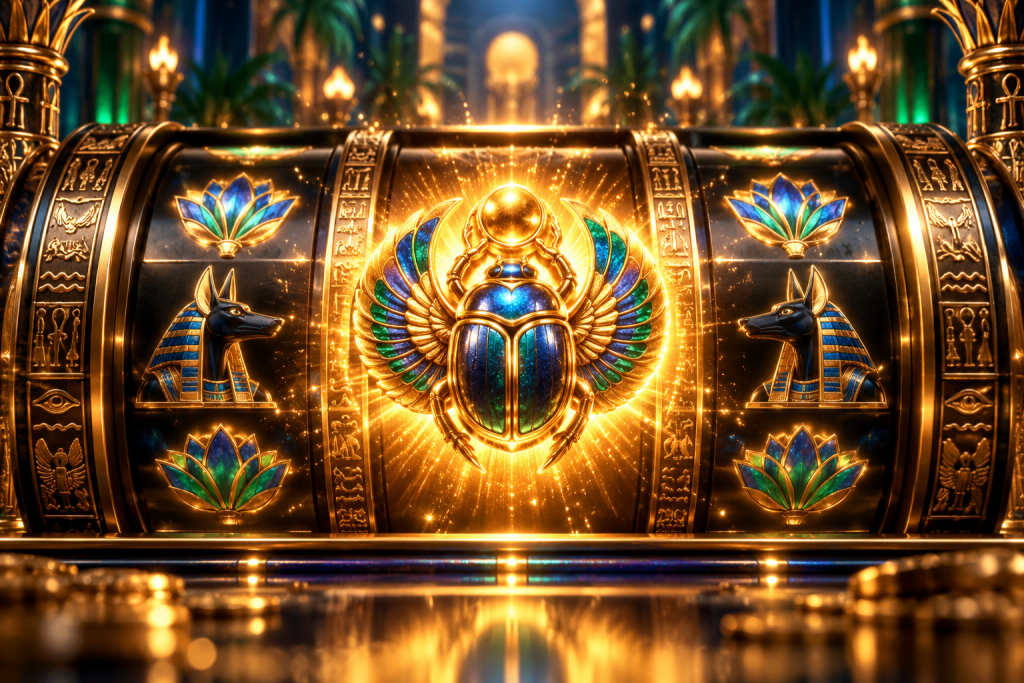
Start with the paytable, not the symbol
A scarab on the reels is not a switch you flip. It is a symbol with a rule attached to it, and that rule lives in one place only: the game's own information panel. Open the paytable before you spin, find the scarab's entry, and read what the game says it does. Some scarabs act as wilds that substitute for other symbols. Some act as scatters that pay or trigger a feature when a set number land anywhere on the reels. Some do nothing until a bonus round is already running, where they then collect, expand, or upgrade. The same artwork can mean completely different things in different titles, even from the same studio.
When a player asks what activates a particular symbol, the honest answer is that the game's rules activate it, and the game's random number generator decides when those rules are satisfied on any given spin. Nothing the player does before or during the spin changes that. The scarab does not have a secret trigger, a timing window, or a pattern you can learn by watching the reels.
What the RNG does on a spin
A modern slot does not spin physical reels that can be nudged or stopped. When you press the button, a random number generator selects an outcome from the game's full set of possible results, each mapped to a position on the virtual reels. The animation you see afterwards is a presentation of that outcome, not a live physical process you can influence. The scarab either appears in the selected outcome or it does not.
The RNG is the algorithm that determines game outcomes. Independent testing laboratories are commonly used to certify RNG behaviour; certification covers game mechanics, not an operator's financial conduct. That certification means the selection process is tested for randomness and fairness of mapping, not that any particular symbol is due to appear.
Because each spin is an independent selection from the same distribution, a scarab that has not appeared for fifty spins is no more likely to appear on spin fifty-one than it was on spin one. The machine does not remember, and the scarab does not build toward activation.
How trigger conditions are written
Bonus symbols in slots typically activate through one of a few structural patterns. The game's paytable states which pattern applies, how many symbols are needed, and whether they must land on specific reels or can land anywhere.
| Trigger pattern | How it works | Where the requirement is stated |
|---|---|---|
| Scatter count | A fixed number of matching symbols must land anywhere on the reels in a single spin | Paytable, usually under a bonus or feature section |
| Reel-specific scatter | The symbols must land on designated reels, often reels 1, 3 and 5 | Paytable or the game's help screen |
| Collector symbol | A symbol appears only during a bonus round and is collected or upgraded by another symbol | Bonus round rules within the paytable |
| Stacked or expanding trigger | Full stacks of a symbol on one or more reels activate a feature | Paytable, with a diagram of the required stacks |
| Random feature trigger | The game can activate the feature on any spin regardless of symbols | Paytable, often under a random feature heading |
If the scarab in the game you are looking at is a scatter, the paytable will state the exact number required. If it is a collector, the paytable will state which symbol it collects and what threshold triggers the payout or upgrade. If the game offers a random feature, the paytable will say so, and in that case the scarab may be decorative during the base game and functional only inside the feature.
Paylines versus ways-to-win change what a symbol must do
Where a symbol must land depends on the game's reel format. Fixed-payline games require betting all lines, and a paying combination must follow one of those lines. Ways-to-win formats pay on adjacent-symbol combinations instead of fixed lines, which changes how a scatter or bonus symbol is evaluated.
In a fixed-payline game, a line hit means the symbols sit on one of the printed patterns. In a ways-to-win game, the game checks for matching symbols on adjacent reels starting from the leftmost reel, regardless of vertical position. A scarab that triggers a feature in a ways-to-win title may need to appear on consecutive reels, while the same artwork in a payline title may need to sit on an active line. The paytable states which format the game uses and how the trigger is evaluated under that format.
What stake size does and does not change
Raising or lowering your stake changes the amount you wager and the size of any payout that follows, because payouts are expressed as multiples of the stake or as fixed amounts tied to the stake. It does not change the probability of the scarab appearing, the probability of a feature triggering, or the game's programmed return.
Return to Player (RTP) is a theoretical percentage of total wagered money a game returns to players over a very large number of spins or hands. It is a long-run statistical average, not a per-session guarantee. House edge and RTP are complements: they sum to 100% for the same game. That percentage is set in the game's maths and does not move because you bet more or less per spin.
Some games do gate certain features behind a stake condition. Progressive jackpots are the clearest example: fixed jackpots pay a set amount, while progressive jackpots grow from a share of qualifying wagers and reset after a win. Progressive contributions are typically taken out of the game's return, and some progressives require a maximum-stake bet to qualify. If the scarab is tied to a progressive or a feature that requires a qualifying stake, the paytable will state that requirement explicitly. If it does not state it, stake size does not affect the trigger.
Volatility shapes how the scarab feels, not whether it triggers
Volatility, also called variance, describes how payouts are distributed over time. High volatility means rarer but larger payouts; low volatility means more frequent but smaller ones. Volatility does not change a game's RTP.
A high-volatility game may keep the scarab feature dormant for long stretches and then deliver a large feature payout. A low-volatility game may trigger the scarab more often but pay smaller amounts when it does. The trigger probability is built into the game's maths alongside the payout distribution. Watching the scarab appear frequently does not mean the game is about to pay, and a long absence does not mean a feature is due. Both are expressions of the same underlying distribution.
Fixed versus progressive jackpots and the scarab's role
If the scarab is linked to a jackpot, the paytable will tell you which kind. Fixed jackpots pay a set amount. Progressive jackpots grow from a share of qualifying wagers and reset after a win. A scarab that awards a jackpot in one game may award a fixed amount, while in another it may award a progressive that requires a maximum-stake bet to qualify.
Progressive contributions are typically taken out of the game's return. That means a portion of each qualifying wager feeds the jackpot rather than the base game's payout pool. The paytable or the jackpot rules screen states the contribution rate and the qualification condition. If the scarab is the jackpot trigger, the same screen states how many scarabs are needed, whether they must land on specific reels, and whether the jackpot tier depends on the number of triggering symbols.
How to read the information panel for any slot
Every regulated slot carries an information panel, usually behind a button labelled with an "i", a question mark, or a menu icon. Open it before you play. The panel contains the paytable, the game rules, and the RTP for the specific configuration you are playing. Some games offer multiple RTP settings, and the panel states which one applies.
When you are looking for what activates a specific symbol, work through the panel in this order. First, find the symbol in the paytable and read its stated function. Second, check the feature or bonus section for the trigger condition. Third, check the jackpot section if the symbol appears there. Fourth, check the game rules for any stake qualification or random trigger note. If the panel does not answer the question, the game's help file on the operator's site usually repeats the same information in a searchable format.
Do not rely on forum posts, video titles, or streamer commentary for trigger conditions. Those sources often describe one session's experience as if it were a rule. The paytable is the rule. If the paytable says a scarab needs three appearances to trigger, then three appearances trigger it, regardless of what a video showed.
What no play pattern can change
No betting pattern, spin timing, stop-button technique, or session length changes the probability of the scarab triggering. The RNG selects outcomes independently on each spin, and the trigger condition is a fixed rule applied to that outcome. You cannot make the scarab appear more often by changing your stake, pausing between spins, switching games, or playing at a particular time of day.
The only decisions under your control are the game you choose, the stake you set, and how long you play. Choosing a game with a lower house edge on its base game or a feature structure you enjoy changes your expected rate of loss and your experience. It does not change the outcome of any individual spin, and it does not make a feature trigger more likely than the game's maths specifies.
FAQ
Do I need to bet maximum to activate a scarab bonus feature?
Only if the paytable says so. Most base-game features trigger regardless of stake, but some progressive jackpots and a small number of features require a maximum-stake bet to qualify. The requirement is stated in the game's information panel, usually in the jackpot rules or the feature description. If no stake condition is written there, stake size does not affect the trigger.
Can I tell when a scarab feature is about to trigger?
No. Each spin is an independent random selection, and the game does not track how long it has been since the last feature. A long run without a scarab trigger does not make the next spin more likely to trigger it. Any pattern you think you see is a short-run artefact of variance, not a signal.
Does a scarab that acts as a wild also trigger a bonus?
Sometimes, but the two functions are separate rules. A wild scarab substitutes for other symbols to complete paying combinations. A scatter or bonus scarab triggers a feature when a set number land. Some games use the same symbol for both, and some use different scarab designs for each function. The paytable states which scarab does what, so check the symbol's entry rather than assuming one role implies the other.
Gamble responsibly. If you or someone you know has a gambling problem, call the helpline printed in the footer below.
Play responsibly
Gambling should be treated as paid entertainment, never as a way to earn income or recover losses. 1-800-MY-RESET (1-800-697-3738)
18+ or 21+ depending on where you are; follow the minimum age that applies to you.
This article is general information about how these mechanics work. It is not legal advice and not a recommendation to gamble or to use any particular operator. Availability and legality differ by jurisdiction — check the rules that apply where you are.