


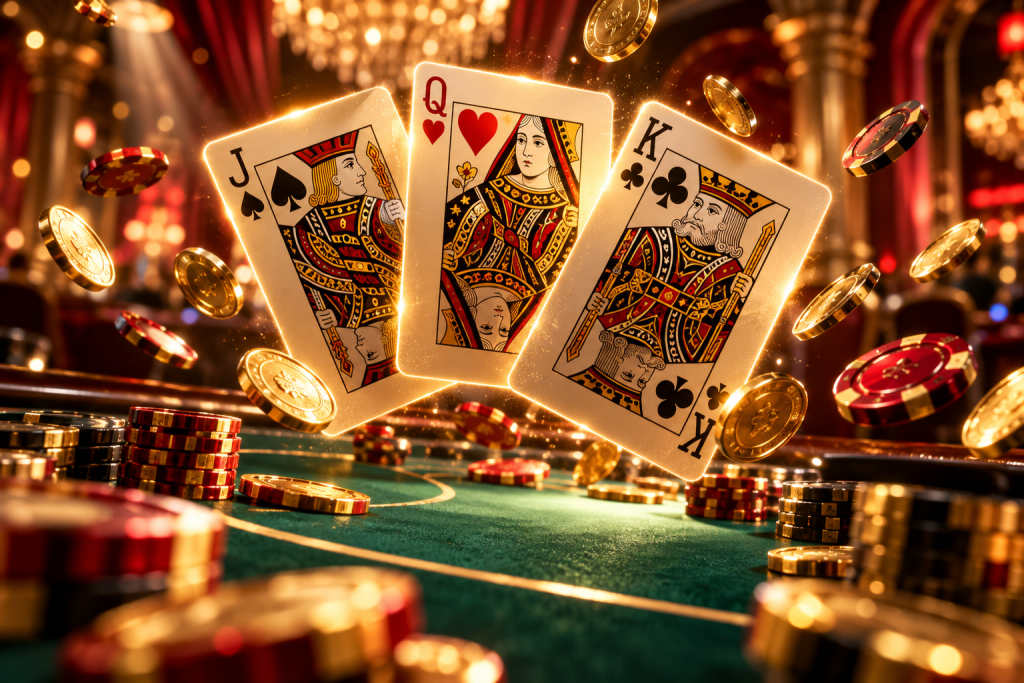
Three cards share one job: they are all worth ten
When you sit down at a blackjack table and the cards come out, the letters you see are J, Q and K. The Jack, the Queen and the King do not carry their own numerical values. Each one counts as ten, exactly the same as a printed 10 card. That means sixteen cards in a standard 52-card deck are worth ten: the four 10s, four Jacks, four Queens and four Kings. Roughly three cards in every ten you are dealt will be a ten-value card, which is the single most important fact about how blackjack hands build and break.
An Ace is not a letter card, but it sits next to them in the deck and behaves differently. It counts as either one or eleven, whichever helps the hand more at that moment. The letter cards have no such flexibility. A Jack is ten, a Queen is ten, a King is ten, and that never changes during a hand.
Why the ten-value density shapes every decision
Because so many cards in the shoe are worth ten, the dealer's down card and the next card out of the shoe are more likely to be a ten than any other single value. That probability sits underneath most of what a player does. When the dealer shows a 6, the player's decision to stand on a modest total is built partly on the chance that the dealer's hidden card is a ten, putting the dealer on 16 and forcing a hit that can bust. When a player holds 11 and doubles down, the hope is that the next card is one of those sixteen ten-value cards, producing 21.
None of this makes a ten-value card certain to appear. A single-deck game and an eight-deck shoe have different proportions remaining after cards are dealt, and the exact rule set changes the arithmetic. What stays fixed is the starting point: four ranks out of thirteen are worth ten.
How a hand total is built
A blackjack hand is the sum of the card values. A 7 and a Queen make 17. A King and a 5 make 15. Two Queens make 20. The objective is a total closer to 21 than the dealer's without exceeding 21. If the player or the dealer goes over 21, that hand busts and loses immediately.
An Ace plus any ten-value card is the game's best starting hand: a natural blackjack, or simply blackjack, worth 21 in two cards. A Jack and an Ace, a Queen and an Ace, a King and an Ace, and a 10 and an Ace are all identical naturals. They pay at the table's posted rate for a blackjack, which is typically higher than an even-money win on an ordinary hand, but the exact multiple is printed on the table layout and can differ by venue. The letter on the ten-value card does not change the payout.
Soft hands and the letter cards
An Ace plus a 6 is a soft 17: it can be 7 or 17. Add a King to that and the total becomes 17, because the Ace must now count as one to avoid busting. The ten-value card has forced the Ace to drop from eleven to one. That is the difference between a soft hand and a hard hand. A hard hand contains no Ace, or an Ace that can only count as one because counting it as eleven would bust.
This matters at the table because the dealer's own rules often reference 17. Many tables require the dealer to stand on all 17s, while others require the dealer to hit a soft 17. A dealer holding an Ace and a 6, then drawing a King, has a hard 17 under either rule. The letter card is what removed the softness.
What a round looks like from buy-in to settlement
The sequence is the same whether the cards carry letters or numbers. You buy chips at the cage or from the dealer, place a wager in the betting circle, and receive two cards face up in most shoe games. The dealer gets one card face up and one face down. Decision points follow in order: stand, hit, double down, split, or surrender where the table allows it.
Stand means you keep the total you have. Hit means you take another card. Doubling down lets you add a second wager equal to the first and receive exactly one more card. Splitting is available when your first two cards are a pair; you separate them into two hands and place a second wager. Surrender, where offered, lets you forfeit half the wager and end the hand before playing it out. Each choice is a decision about a total that is heavily influenced by how many ten-value cards remain.
Bet types and how their edges differ
Blackjack has fewer bet types than most table games, but the ones that exist carry different house edges, and the edge on each is set by the exact rules of the table. The main wager is the hand itself. Side bets, where offered, are separate wagers with their own pay tables and their own edges.
| Bet or option | What it means | How the edge behaves |
|---|---|---|
| Main hand | The wager on your two cards beating the dealer without busting | The lowest house edge on the table, but the exact figure depends on deck count, dealer soft-17 rule, doubling and splitting rules, and blackjack payout |
| Double down | An additional wager equal to the original, after which you receive one card only | Does not change the edge of the underlying hand; it lets you put more money on a favourable situation when the rules allow |
| Split | Separating a pair into two hands, each with its own wager | Edge depends on the pair and the table rules; splitting tens is generally a poor play because a 20 is already a strong total |
| Insurance | A side wager offered when the dealer shows an Ace, paying if the dealer has a natural | Carries a materially higher house edge than the main hand under most rule sets |
| Other side bets | Wagers on combinations such as pairs or suited cards, with fixed pay tables | Edges are set by the pay table and are usually higher than the main hand |
The house edge and the return to player on the same bet under the same rule set sum to 100%. That relationship holds for one bet at a time. It does not mean the whole table has one edge, and it does not predict what happens in a single session. A player can win on a high-edge side bet and lose on a low-edge main hand in the same shoe.
Strategy charts come from a specific rule set
Published basic-strategy charts tell a player whether to hit, stand, double, split or surrender for every combination of player total and dealer up-card. Those charts are not universal. They are derived from the exact rules in force: how many decks are in the shoe, whether the dealer stands or hits on soft 17, whether doubling after splitting is allowed, whether surrender is offered, and what a natural blackjack pays. Change one rule and some chart entries change.
A chart built for a game where the dealer stands on all 17s will not match every decision in a game where the dealer hits soft 17. A chart built for a six-deck shoe will not match a single-deck game exactly. The correct approach is to find the chart that matches the table you are sitting at, and to read the table's rule placard before you sit down. The placard states the blackjack payout, the dealer's soft-17 rule, and the doubling and splitting options.
Procedural mistakes new players make
The first is treating a Jack, Queen or King as anything other than ten, or pausing to calculate a total that should be automatic. A Queen and a 7 is 17, not a hand that needs thought. The second is touching the cards in a shoe game. In most shoe-dealt blackjack, the cards stay on the table and the player signals decisions with hand gestures: a tap to hit, a wave to stand, a point to double. Grabbing the cards or placing chips on top of them can confuse the camera record and the dealer's read of your action. The third is splitting a pair of ten-value cards because they look like a winning opportunity. Two Queens are 20, which is one point from the maximum total. Splitting them into two hands that each start at ten is a worse position than the 20 you already hold.
A fourth mistake is buying insurance because you hold a good hand and want to protect it. Insurance is a separate wager on the dealer's hidden card, not a protection on your own hand. It carries its own edge, and the main hand's outcome is unaffected by whether you take it.
What the letter cards do not change
The letters on the cards do not change the game's objective, the sequence of a round, the house edge on the main bet, or the way a strategy chart is built. They are simply three more ranks worth ten. What they do change is the texture of the shoe: the high proportion of ten-value cards is the reason a dealer's 6 is dangerous to the dealer, the reason doubling an 11 is attractive, and the reason a hand of 20 is usually a hand to stand on.
FAQ
Is a Queen worth more than a Jack in blackjack?
No. The Jack, Queen and King are all worth exactly ten. The suit and the face on the card have no effect on the hand total or the payout.
Does an Ace and a King count as 21 or as blackjack?
An Ace and any ten-value card, including a King, is a natural blackjack in the first two cards. It is worth 21 and pays at the table's posted blackjack rate. A 21 built from three or more cards is an ordinary 21 and pays differently.
Why do so many blackjack decisions depend on ten-value cards?
Because sixteen of the fifty-two cards in a standard deck are worth ten, more than any other value. That density makes the next card more likely to be a ten than any other single rank, which is why totals near 21 and dealer up-cards near the bottom of the range are read the way they are.
If you or someone you know is struggling with gambling, help is available. Call or text the National Problem Gambling Helpline at the helpline printed in the footer below for free, confidential support available 24/7 in most states. You can also visit www.ncpgambling.org for resources and information. Please gamble responsibly and only wager what you can afford to lose.
Play responsibly
Gambling should be treated as paid entertainment, never as a way to earn income or recover losses. 1-800-MY-RESET (1-800-697-3738)
18+ or 21+ depending on where you are; follow the minimum age that applies to you.
This article is general information about how these mechanics work. It is not legal advice and not a recommendation to gamble or to use any particular operator. Availability and legality differ by jurisdiction — check the rules that apply where you are.