


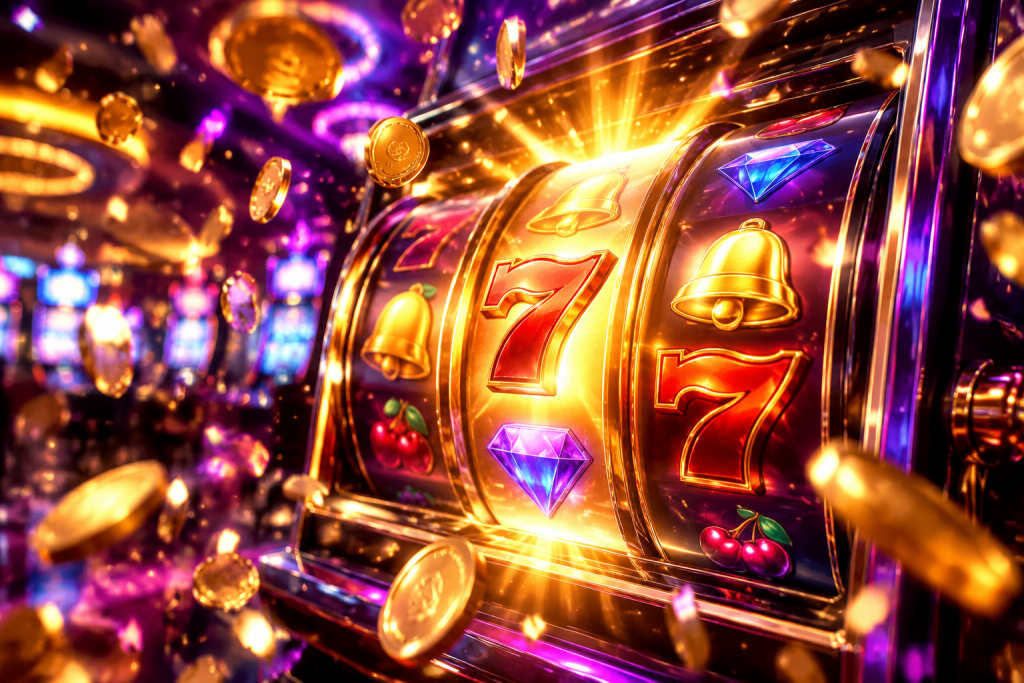
The reel is a display, not a wheel of pictures
When you look at a slot screen, you are seeing the last step of a process that was already finished before the reels began to spin. The images themselves are not being selected by physical momentum or by where a mechanical wheel stops. On a modern machine, the outcome is chosen by a random number generator, and the symbols you see are the machine's way of showing you that outcome in a form you can read.
Think of the reel strip as a long printed tape of symbols wrapped around a virtual wheel. Each position on that tape is mapped to a number. The RNG produces a number, the game logic looks up which symbol that number corresponds to on each reel, and the animation then plays so the right symbols land on the screen. The spinning is a presentation layer. The result was fixed the instant the spin was triggered.
This matters when you are trying to read a machine. The images are not hints about what is coming next. A reel that shows three cherries just above the payline does not mean a cherry is more likely on the next spin. Each spin draws from the full reel mapping again, independently of what came before.
The classic set and where it came from
Early mechanical slots used a small set of images that could be printed clearly on metal or card reels and read from a few feet away. Those constraints produced the icon set most people still recognise: fruit, bells, bars, sevens, and the word symbols like BAR and jackpot. The fruit symbols were not chosen for any mathematical reason. They were practical, cheap to print, and easy for a player to check at a glance.
Modern video slots keep those symbols partly out of tradition and partly because they give a game instant legibility. A cherry or a bell reads as a slot symbol without any explanation. But a modern game will usually layer a second vocabulary on top: themed symbols tied to whatever story or setting the game uses, and a small group of functional symbols that behave differently from everything else on the reels.
The themed images are just standard symbols wearing a costume. An Egyptian slot might use scarabs and ankhs where another game uses fish or gems. Their job is the same: form matching combinations across the reels according to the paytable. The art changes, the function does not.
The functional symbols that change how a spin pays
Beyond the ordinary paying symbols, most modern slots include a handful of images with special rules attached. The exact names and behaviours vary by game, but the categories are stable enough that you can read any paytable once you know what to look for.
| Symbol type | What it does | Where its rules are stated |
|---|---|---|
| Standard symbol | Pays when a matching set lands on an active payline or in a ways-to-win pattern | Paytable, usually with a payout per symbol count |
| Wild | Substitutes for other paying symbols to complete a combination; some carry their own payout | Paytable and game rules panel |
| Scatter | Often pays regardless of payline position and may trigger a bonus feature when enough land | Paytable and bonus rules section |
| Bonus or feature symbol | Triggers a specific feature such as free spins or a pick round, usually only on certain reels | Bonus rules section of the paytable |
| Jackpot symbol | Collects or triggers a fixed or progressive jackpot under stated conditions | Jackpot rules panel, separate from the main paytable |
A wild does not have to look like the word WILD. It can be a logo, a character, or any image the designer chooses. The paytable will always identify it, because the substitution rule is the only thing that makes it a wild. Likewise, a scatter is only recognisable by its stated behaviour, not by its artwork. This is why the information panel matters more than the theme.
Paylines and ways-to-win change what the images must do
The same set of symbols can behave differently depending on how the game counts winning combinations. On a fixed-payline game, a symbol only pays when it lands on one of the lines the player has bought. The paytable will show a diagram of those lines, and the symbols must align along one of them. On a ways-to-win game, there are no line diagrams. Matching symbols pay when they land on adjacent reels, usually starting from the leftmost reel, regardless of their vertical position.
This changes how you read the screen. On a payline game, two symbols sitting one row apart might be worthless because no line connects them. On a ways-to-win game, those same two symbols could form the start of a paying combination. The artwork is identical. The rule set is what assigns value to the positions.
Some games mix both ideas, or add a cluster-pays mechanic where symbols pay when they touch in a block rather than along a line. The only reliable way to know which rule applies is the game's own information panel, usually opened with a button marked with an i, a question mark, or the word INFO. The paytable inside that panel states the paying combinations, the line or ways count, and what each symbol is worth at the current stake.
How the paytable prices each image
A paytable is not a list of fixed cash amounts. It is a multiplier table, and the numbers shown usually scale with your stake. If the paytable says five sevens pay 500, that typically means 500 times your line bet or your total bet, depending on the game's convention. The same symbol can therefore be worth a different amount of money on two spins, because the stake changed, even though the multiplier did not.
Read the top of the paytable before you read the symbol list. It will state whether the figures are expressed as a multiple of the line bet, the total bet, or the coin value. This is the single most common source of confusion when players compare what a win looked like on screen with what landed in their balance. A 500 shown on the paytable is not 500 units of currency unless the stake is exactly one unit and the game expresses payouts that way.
The paytable also carries the rules for special symbols. It will say whether a scatter pays in addition to triggering a feature, whether wilds appear on all reels or only some, and whether a jackpot symbol needs to land on a specific payline or in a specific count. If a symbol's behaviour is not stated in the paytable, it does not have that behaviour, no matter what the artwork suggests.
Volatility changes which images you see most often
Two slots can use the same fruit symbols and feel completely different to play. The difference is volatility, which describes how payouts are distributed over time. A low-volatility game pays small amounts frequently, so you will see low-value symbol combinations land often and the balance move in small steps. A high-volatility game pays rarely but in larger chunks, so the screen will show many near-misses and dead spins, then occasionally a big combination or a bonus round.
Volatility does not change the return to player percentage. It changes the shape of the ride. The same theoretical RTP can be delivered as a steady drip or as long dry spells punctuated by large hits. The symbols on the reels are weighted to produce whichever distribution the game designer selected, and that weighting is part of the reel mapping, not something the player can read off the artwork.
This is why two games with identical fruit symbols can have different paytables and different feels. The images are a skin. The reel mapping underneath, the symbol weights, and the paytable multipliers are the actual game.
Fixed and progressive jackpots sit on top of the base game
Some symbols are tied to a jackpot rather than a standard paytable line. A fixed jackpot pays a set amount when the stated combination lands. A progressive jackpot grows over time, because a share of qualifying wagers is added to the pool, and it resets after someone wins it. The jackpot rules are usually displayed in a separate panel from the main paytable, and they state exactly which symbols, reels, and stake levels qualify.
On some progressive games, the top jackpot only becomes available when you play at the maximum stake. The jackpot panel will state this. If it does, then playing below that stake still gives you the base game and any fixed pays, but not a chance at the progressive amount. The progressive contribution is taken out of the game's return, which means the base-game paytable on a progressive slot can be leaner than on a comparable non-progressive game.
None of this is visible from the reel art. A game with a huge jackpot number displayed above the reels is still running the same RNG and reel-mapping process as any other slot. The jackpot is a separate prize layer with its own trigger conditions.
What the images cannot tell you
The symbols on a slot machine are a language, but they are a closed one. The artwork does not reveal the RTP, the volatility, the symbol weights, or the jackpot contribution rate. Those figures live in the game's information panel, the paytable, and the operator's published game documentation. A game that looks like a low-stakes fruit machine can be a high-volatility game with a progressive on top, and a game covered in gold and treasure imagery can pay small, frequent amounts.
To read a machine properly, open the information panel before you play. Check the paytable convention so you know whether the figures are line-bet or total-bet multipliers. Read the wild and scatter rules so you know what the special symbols do. Look at the jackpot panel if one is present, and note any maximum-stake condition. The images will then make sense, because you will be reading them through the rule set instead of through the theme.
FAQ
Do the pictures on the reels tell you if a machine is about to pay?
No. The symbols are a display of an outcome that was already determined by the random number generator. What appeared on previous spins does not change the probability of what appears next. A reel showing many high-value symbols near the payline is not a sign of an upcoming win.
Why do some symbols pay when they are not on a payline?
That is usually a scatter symbol. Scatters are typically programmed to pay based on the number that land anywhere on the reels, or to trigger a bonus feature, rather than requiring a position on a specific payline. The paytable states the exact rule for the game you are playing.
Are the fruit symbols worth the same on every slot?
No. The same cherry or bell artwork can carry different paytable multipliers on different games, and the multiplier is applied to your stake according to the game's stated convention. Always check the paytable of the specific game, because the artwork is reused across many titles with different maths underneath.
Play responsibly
Gambling should be treated as paid entertainment, never as a way to earn income or recover losses. 1-800-MY-RESET (1-800-697-3738)
18+ or 21+ depending on where you are; follow the minimum age that applies to you.
This article is general information about how these mechanics work. It is not legal advice and not a recommendation to gamble or to use any particular operator. Availability and legality differ by jurisdiction — check the rules that apply where you are.