


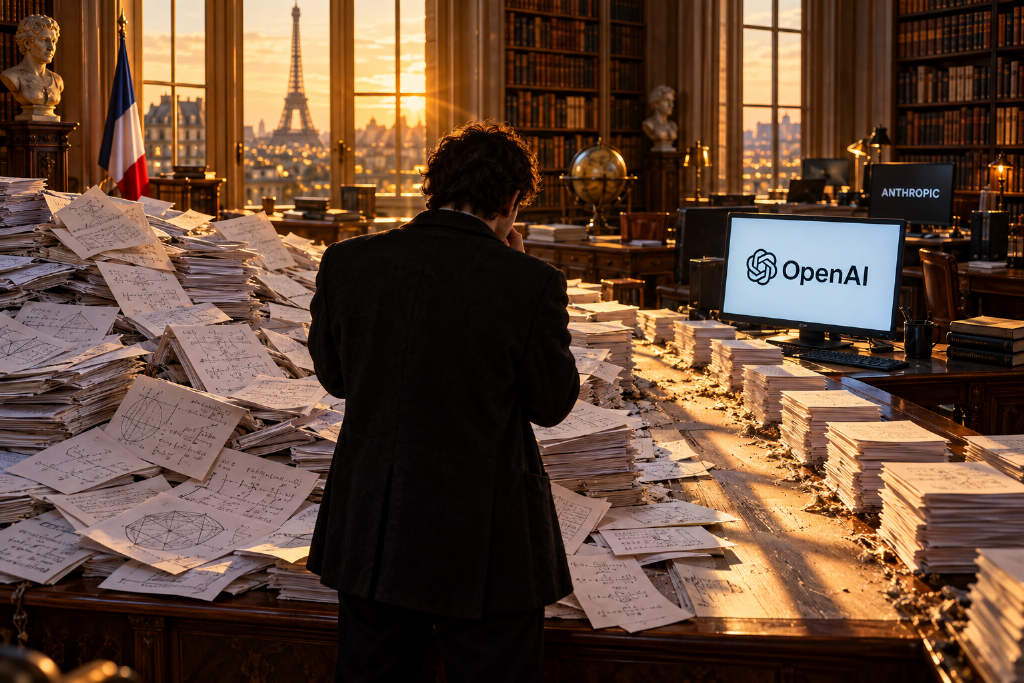
AI-generated and AI-assisted math research is now striking a nerve well outside academia, and top researchers are flatly describing the jolt of watching years of work get overtaken at machine speed.

On Oct. 8, French mathematician Hugo Duminil-Copin, winner of the 2022 Fields Medal, said during an online meeting, "On Tuesday night, I cried and woke up my daughter." In a later radio interview, he said AI felt like a bulldozer crushing the problems he had been studying. The report says 16 of the questions in OpenAI’s latest release were directly tied to his research.
OpenAI’s release spans 722 math papers
According to the report, OpenAI dumped 722 mathematics papers all at once, covering hundreds of results across number theory, geometry, theoretical computer science, and other fields.
The article uses arXiv for comparison. On that preprint platform, one person can upload only 2 papers per month. At that pace, putting up all 722 papers would take more than 300 accounts.
Several of the claimed results touch problems that have sat open for decades, or for more than a century. The article gives three examples:
- The Riemann hypothesis, first proposed in 1859 and still unresolved. OpenAI said it obtained a stronger zero-free region result connected to the problem.
- The question of whether Catalan’s constant is irrational, which the article says has troubled mathematicians for more than 100 years. OpenAI said it proved that the constant is indeed irrational.
- The Kakeya conjecture, proposed in 1917. A two-dimensional proof did not arrive until 1971. The report says Wang Hong produced a three-dimensional proof in 2025, and AI then produced a four-dimensional proof one year later.
The article says the release included many other breakthroughs of similar weight. And it says the average compute used for each result was roughly equal to 3 hours of ChatGPT Pro reasoning time.

The shock is about speed as much as substance
The report says the disruption is not just about whether the answers are right. It is the mix of volume, range, and speed. That’s the real blow.
It says some mathematicians reacted in disbelief, sitting there stunned as if they had seen an atomic blast. But the article also points out that the results have not yet been peer reviewed, so the academic community still has to test how reliable they are.
Even before that happens, the pressure is already hitting individual researchers. The article says AI’s fast advance is putting years of human work at risk of being dropped halfway through, and it is pushing some mathematicians to wonder whether they spent decades heading in the wrong direction.
One example in the report involves operator algebras. After reviewing a batch of OpenAI results in that area, one mathematician reportedly decided AI was right and humans had spent 30 years on the wrong path.
The real-world fallout is immediate. Some researchers are now unsure about grant funding after their topic was effectively blown open. Others are halfway through papers or dissertations and suddenly do not know whether their original project still has the same value.
The article cites a Reddit post from a self-described PhD student in operator algebras. The student said he and his classmates had already solved a special case of a problem and had discussed the next step with their adviser, planning to turn it into a dissertation on the more general case. Then OpenAI released its result. So they rushed to organize what they had already done, hoping to publish it as independent work. He said the topic still had research value, but a lot of the original excitement had evaporated.

Anthropic and OpenAI have turned mathematics into a proving ground
The article places the latest release inside a bigger AI race and says Anthropic fired one of the early shots.
On July 19, the night of the World Cup final, a researcher at Anthropic posted on X saying he had disproved the Jacobian conjecture. The report describes the conjecture as a major problem that has troubled mathematicians for more than 80 years. Its statement is short: if the Jacobian determinant of a polynomial map is a nonzero constant, then the map must have a polynomial inverse. Easy to say. Infamously hard to settle.
The article says mathematicians have claimed solutions again and again over the decades, only for flaws to be exposed later. It adds that many mathematicians, including Chinese mathematician Zhang Yitang, have been worn down by the problem’s history.
OpenAI then entered the race. Over the following months, the report says, the two companies claimed progress on a growing list of mathematical problems, creating an unusually intense stretch for the field.
The article also says that Jacob Tsimerman, who won this year’s Fields Medal alongside Wang Hong and Deng Yu, has joined OpenAI to work on AI safety. Alpöge, described in the report as the person who cracked the Jacobian conjecture earlier, was Tsimerman’s student and now works at Anthropic.

Tsimerman once said, "I do mathematics mainly because I enjoy it, and because I am good at it." The article sets that view against the incentives driving AI companies, arguing that mathematics appeals to them because it offers formal logic, clean evaluation, and results that make headlines.
Why mathematics moved to the front line
The report gives two reasons.
First, mathematics is structurally well suited for testing reasoning systems. Second, a breakthrough on a famous open problem is easier for the public to understand than incremental gains in benchmark scores or token efficiency. A company can say reasoning improved by a few percentage points. Fine. That does not hit like saying a machine took on a problem that had resisted mathematicians for decades.
In that sense, the article argues, AI companies are not really battling over mathematics itself. They are battling over technical leadership, users, capital, and market position, with mathematics serving as a very visible stage.
The piece describes the current AI race as a 100-meter sprint with no finish line in sight. If one company slows, it risks falling behind. It points to the rhythm of model releases, saying the major iterations from GPT3 to GPT6 took 3 years, then 2 years, then 1 year, while smaller updates arrived even faster.
Google’s Gemini is cited as an example of how fast outside perception can turn when a key version falls behind. In that setting, the article says, OpenAI chief executive Sam Altman and Anthropic chief executive Dario Amodei keep pushing fresh technical narratives, and mathematics has become one of the clearest arenas for that fight.

The report adds that in September, after OpenAI learned Anthropic was challenging the Navier-Stokes equations, it shifted resources to the same area and organized 10,000 AI agents to work in parallel, eventually releasing its own result first. The article notes that the Navier-Stokes equations are one of Wei Dongyi’s main research directions.
The article links mathematics to a broader pattern of displacement
Instead of treating math as a one-off, the report puts it inside a longer chain of AI moving into skilled work.
One early turning point was Go. After 2016, AlphaGo defeated Lee Sedol and Ke Jie, and the symbolic meaning of professional Go changed. What had once stood as a marker of human intelligence became a field where humans were regularly measured against machines.
From there, the pressure moved off the board and onto the desk. Midjourney and Stable Diffusion began cutting into illustration work. Better coding systems lowered barriers in software creation. Copywriting and office work also became easier targets for automation.
The article says the same pattern has spread into consulting, finance, and other knowledge-heavy industries. It also says sectors built around appearance and emotional appeal are no longer protected either.

Examples in the report include AI comic-style dramas challenging short-form live-action productions, AI performers signing endorsement deals, and Mango TV launching an AI lineup. The article even mentions an AI girl group character with a "premarital pregnancy" storyline.
Its bigger point is simple: AI is moving first into high-value work tied to knowledge, creativity, and professional training, while many of the chores people once hoped machines would take over, such as housework, have not vanished anywhere near as fast.
The old logic of staying ahead may be breaking down
The final section widens the frame from mathematicians to everyone else. For years, people have tried to protect themselves from obsolescence through school, credentials, projects, and accumulated experience. The assumption was straightforward: sharpen a skill, gain bargaining power, become harder to replace.
The article says that logic now looks shakier. It points to the period when DeepSeek first surged in popularity, when guides on how to use AI climbed to the top of WeChat Reading rankings. At the time, communicating with AI still seemed to require a specialized skill set, and prompt engineer briefly looked like an important new profession.
But that did not last. The article says the role faded within one or two years because AI had become better at understanding ordinary language than 80% of employees and 99% of managers.
The question raised by the piece is blunt: if even the world’s most gifted minds can watch decades of accumulated knowledge lose some of its defensive value against AI, what happens to the broader social promise that steady self-improvement will keep people from being pushed aside?

Mathematicians are beginning to respond
The article does not say mathematics is over. It says the field is still figuring out how to respond.
Some researchers, including Terence Tao, have urged caution around AI. Others say the smarter move is to embrace it. On Oct. 11, Shing-Tung Yau led the creation of the Mathematics and Artificial Intelligence Laboratory Alliance, bringing together 8 mathematics research institutions to develop a dedicated model for mathematical science.
Where those efforts lead is still unclear. The article says it is too early to declare the end of mathematics, just as earlier claims about the "end of history" turned out to mark only a pause, not a final destination.
It ends without a tidy answer. The uncertainty is still there, for mathematicians and for everyone else trying to figure out what life and work look like in an AI-heavy era.
This article was adapted from a MarsBit post. The original piece was credited to Wang Dong, edited by Zhangyu, and sourced from the WeChat public account Phoenix Weekly (ID: phoenixweekly).