


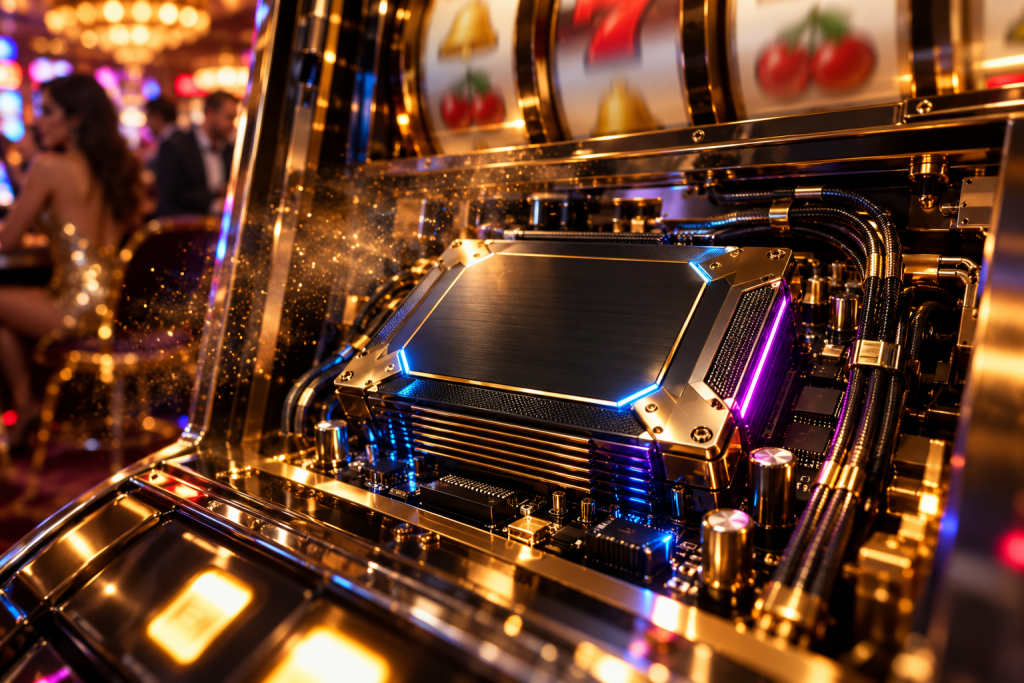
The Part of the Machine That Runs the Game
A slot machine controller is the internal computing unit inside a slot machine cabinet that executes the game program, reads the player's inputs, and drives the displays and sound. It is not a remote device that alters outcomes from outside the machine, and it is not something a player can interact with directly. The controller is the machine's own dedicated computer, sealed inside the cabinet.
Every modern slot machine has some form of controller. On older electromechanical machines, the equivalent function was spread across physical relays, stepper units, and cam switches. On current machines, the controller is typically a single board or a small set of boards mounted inside the locked main cabinet, connected to the button panel, the bill acceptor, the reels or video display, and the machine's accounting meters.
What the Controller Does
The controller's job is to run the game from one spin to the next. It holds the game program in memory, accepts the signal that a spin has been started, selects or receives the outcome for that spin, and then commands the display hardware to show that outcome. It also records the amounts wagered and paid so the machine's internal meters stay accurate.
The controller does not decide outcomes in the sense of making a human-like choice. The outcome selection is handled by a separate random number generator function, which may be built into the controller board or sit on a dedicated module. The controller's role is to execute the game logic around that selection: it reads the result, maps it to reel stops or screen symbols, checks the paytable, and issues the correct credit or payout signal.
| Controller function | What it handles | What it does not do |
|---|---|---|
| Input reading | Button presses, bill acceptor signals, touchscreen taps | Alter the odds after a bet is placed |
| Game execution | Running the game program, reel mapping, paytable lookup | Choose outcomes based on player behaviour |
| Output driving | Display, sound, hopper or ticket printer commands | Connect to a player's personal device |
| Metering | Credits in, credits out, games played | Set the house edge; that is fixed in the game program |
Where the Controller Sits Inside the Cabinet
Physically, the controller is mounted inside the main body of the slot machine, behind a locked door that only authorised technicians open. It is usually a printed circuit board, often with a processor, memory chips, and connectors for the peripheral devices. The board may be housed in a metal tray or a plastic enclosure to protect it from dust and tampering.
The controller is not the same thing as the bill validator, the coin comparator, the button deck, or the display panel. Those are peripheral devices that connect to the controller. The controller is the central unit that coordinates them. On many machines, the controller also stores the game's configuration settings, such as denomination and paytable version, though those settings can only be changed through a secure menu that requires physical access and often a key or password.
Controller Versus Random Number Generator
A common point of confusion is the relationship between the controller and the random number generator, or RNG. The RNG is the function that produces the number used to determine each spin's outcome. The controller is the hardware and software environment in which that function runs.
On some machines, the RNG is a separate chip or module that the controller queries. On others, the RNG is a routine inside the controller's own program. Either way, the controller is the executor, not the source of randomness. The distinction matters because it explains why no external device, timing pattern, or button sequence can tell the controller to produce a specific result. The controller runs the program it was given, and the program's outcome selection is governed by the RNG's output, not by anything the player does after the spin begins.
Why Players Sometimes Ask About the Controller
Players who ask about a slot machine controller are usually trying to understand whether the machine can be influenced, whether a casino can change the odds remotely, or whether a particular machine is "due" to pay. The controller is relevant to all three questions, but not in the way the question often assumes.
The controller runs fixed game software. Changing the odds means changing that software, which requires physical access to the machine, approval processes that vary by jurisdiction, and in many cases a complete shutdown and re-verification of the machine. The controller does not receive live instructions from a casino back room telling it to tighten or loosen. The game program, including its paytable and odds, is fixed at the time the machine is configured.
How the Controller Relates to the Machine's Overall Architecture
A slot machine is best understood as a set of connected subsystems. The controller is the hub. Around it sit the input devices, the display devices, the payment devices, and the metering and communication modules. Each subsystem has a specific job, and none of them can change the game's outcome on its own.
| Subsystem | Typical components | Relationship to the controller |
|---|---|---|
| Input | Buttons, touchscreen, arm switch | Sends signals to the controller |
| Payment | Bill validator, coin acceptor, ticket reader | Reports credits to the controller |
| Display | Video screen or mechanical reels, speakers | Receives commands from the controller |
| Metering | Electronic meters, event log | Records what the controller reports |
| Communication | Network interface for slot accounting | Exchanges data with casino systems, not outcome commands |
What the Controller Cannot Do
The controller cannot produce a guaranteed win, cannot remember a player's past spins in a way that changes future odds, and cannot be triggered by a pattern of button presses. It executes the game program exactly, and the game program's outcome for each spin is determined by the RNG at the moment the spin is initiated. The controller has no memory of whether the machine has been paying or not, beyond the accounting meters that record total amounts.
It also cannot be accessed by a player through the machine's normal controls. The service menus that allow configuration changes are protected by physical locks and access controls. The controller is a piece of game hardware, not a user-facing feature.
How to Confirm the Specifics for a Given Machine
The exact make and model of controller inside a particular slot machine varies by manufacturer and machine generation. The authoritative source for that information is the machine's own documentation, which is typically held by the casino's slot department or the machine manufacturer. A player cannot identify the controller from the outside of the cabinet in most cases.
If you need to know which controller a specific machine uses, the practical route is to ask the slot operations staff at the venue where the machine is located, or to consult the manufacturer's published technical documentation for that machine model. The machine's help screen or information menu may also show the game version, though it will not usually identify the controller board by part number.
What to Confirm Before You Go
If you are planning to visit a casino and want to understand the machines on the floor, there is nothing about the controller that you need to confirm in advance. The controller is an internal component and does not affect how you play or what you experience at the machine.
What you may want to confirm is the venue's current operating status, its machine count if that matters to you, and any entry or parking requirements. Those details are held by the venue's own published pages and guest services line, not by any general article. Machine availability changes as floors are reconfigured, and the number of machines on a floor is a figure the venue itself publishes and updates.
FAQ
Can a player access the slot machine controller?
No. The controller is mounted inside the locked main cabinet and is only accessible to authorised technicians. Player-facing controls connect to the controller but do not expose it. Service menus are protected by physical locks and access controls, so a player cannot reach the controller through normal use of the machine.
Does the controller decide when a machine pays?
The controller executes the game program, but it does not make a human-like decision about when to pay. Each spin's outcome is produced by the random number generator function, and the controller maps that outcome to the display and the paytable. The controller has no memory that makes a machine more or less likely to pay on the next spin.
Can a casino change the odds through the controller remotely?
No. Changing the odds means changing the game program, which requires physical access to the machine and a reconfiguration process. The controller does not receive live outcome instructions from a back-office system. The game program, including its paytable and odds, is fixed when the machine is configured for the floor.
Play responsibly
Gambling should be treated as paid entertainment, never as a way to earn income or recover losses. 1-800-MY-RESET (1-800-697-3738)
18+ or 21+ depending on where you are; follow the minimum age that applies to you.
This article is general information about how these mechanics work. It is not legal advice and not a recommendation to gamble or to use any particular operator. Availability and legality differ by jurisdiction — check the rules that apply where you are.