


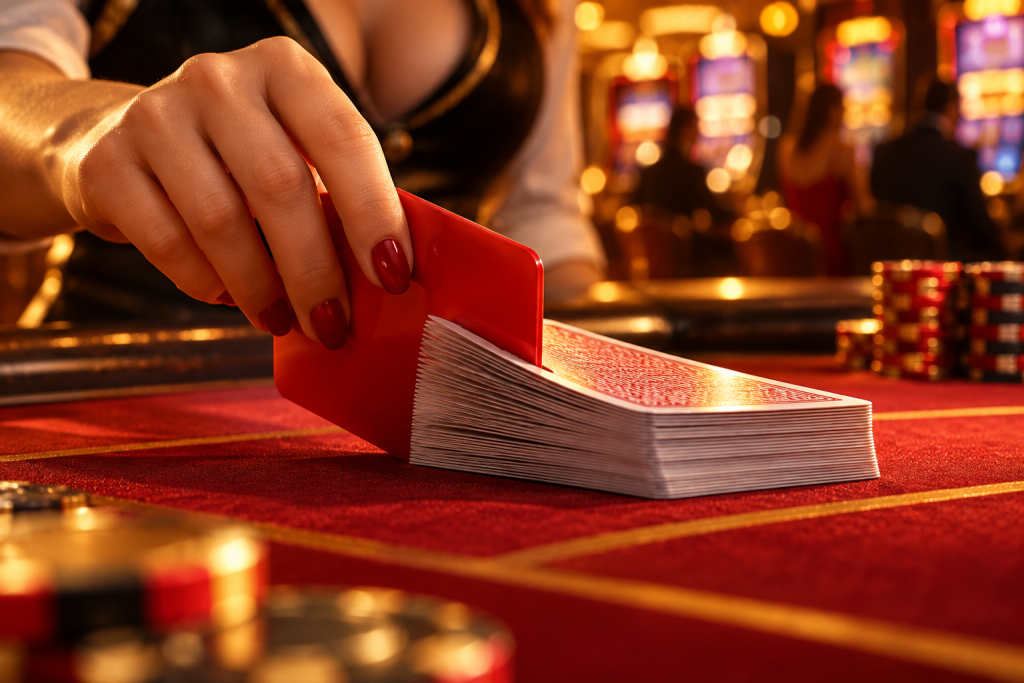
The plastic rectangle that ends every shoe
Sit at any blackjack table and you will see the dealer holding a solid plastic card, usually a single colour and slightly larger than a playing card. That is the cut card. It has no value, no suit and no role in any hand. Its only job is to mark a stopping point inside the stack of cards, and that one job shapes how every shoe is dealt.
The cut card matters because blackjack is normally dealt from a shoe holding multiple decks, and the casino does not want the dealer working through every last card. Dealing to the absolute bottom of the shoe would create two practical problems. First, the final cards would be predictable to anyone who has been counting what has already appeared. Second, a shoe that runs dry mid-round forces an awkward reshuffle while players sit waiting. The cut card solves both by saying, in effect: deal up to here, then stop.
Where the cut card sits and how it gets there
After the dealer shuffles the decks, the cards are placed in the shoe. The dealer then offers the cut card to a player, usually the one at first base or the player who won the previous round, and asks them to insert it somewhere into the stack. The player slides the card between two cards, and the dealer cuts the stack at that point, moving everything above the cut card to the back of the shoe.
From that moment, the cut card defines the end of the shoe. The dealer deals until the cut card appears, then finishes the round in progress and reshuffles. The portion of the shoe that is dealt before the reshuffle is called the penetration, and it is expressed as a percentage of the total cards in play. A shoe cut shallow might see only half the cards dealt; a deep cut can see most of the shoe.
Two related objects sit on the table and are easy to confuse. The blank or cover card is a solid card placed at the bottom of the shoe so the last playing card is never exposed. The cut card is the one inserted by a player and later drawn by the dealer. They look similar, but only the cut card triggers the reshuffle.
| Object | Where it sits | What it does |
|---|---|---|
| Cut card | Inserted by a player after the shuffle; later appears mid-shoe | Marks the point where dealing stops and the shoe is reshuffled |
| Cover card | Placed at the very bottom of the shoe by the dealer | Hides the last playing card so no one sees it |
| Playing card | Throughout the shoe | Has a rank and suit; builds hands |
What the cut card changes about a round
Nothing about the rules of a hand changes because of the cut card. A blackjack still pays its posted odds, a bust still loses, and the dealer still follows the fixed drawing procedure printed on the table felt. What changes is the rhythm of the shoe and the information available to anyone who tracks cards.
When the cut card appears, the dealer completes the current round. If the cut card shows up as the first card of a new round, the dealer announces that this is the final round of the shoe, deals it, settles all bets, then collects the cards and shuffles. Players cannot request extra rounds, and the dealer will not keep dealing past the cut card even if only a few cards remain behind it.
The cut card also interacts with card counting, though it does not prevent it. A counter estimates the composition of the remaining deck from the cards already seen. The deeper the cut, the more cards are dealt before the reshuffle, and the more valuable the remaining information becomes. A shallow cut reduces how far that information can carry. Casinos adjust cut depth as one of several table conditions, and the depth can vary by property, shift or even table.
Why the casino uses one at all
The cut card is a dealing-control device, not a game rule. It exists so that the house can guarantee a reshuffle happens before the shoe is exhausted. That serves three purposes at once: it keeps the game moving, it prevents the last cards from becoming a known quantity, and it gives the casino a simple lever for managing how much of the shoe is in play.
Some venues also use a second cut card or a different colour to mark a reshuffle point inside the discard tray, but the principle is the same. A solid, valueless card tells the dealer where the dealing stops.
How the cut card affects strategy
Basic strategy does not change because of the cut card. The correct play for any hand against any dealer upcard is derived from the specific rule set in use: the number of decks, whether the dealer stands or hits on soft 17, and which doubling and splitting options are allowed. The cut card does not alter any of those rules, so it does not alter the chart.
What the cut card does affect is the value of tracking what has been dealt. If you are counting, the depth of the cut determines how much of the shoe will be played and therefore how much usable information remains. A table with a shallow cut gives you fewer dealt cards per shuffle; a table with a deep cut gives you more. That is a table-condition observation, not a strategy change.
The cut card also creates a small practical point for players who size bets by the count. Because the shoe ends at a fixed physical point rather than after a set number of rounds, the number of hands per shoe varies slightly. The final round is always the one in which the cut card appears, and that round is played under the same rules as every other.
Common misunderstandings at the table
New players sometimes treat the cut card as if it were a wild card or a penalty card. It is neither. It never enters a hand, never counts toward any total, and never changes a result. If the cut card is drawn as the next card, the dealer simply stops dealing after the current round and reshuffles.
A second misunderstanding is that the player who cuts the shoe has some control over the outcome. The cut only determines where the reshuffle point falls. It does not change the order of the cards, and no player can predict what will be dealt from the position of a cut.
A third is that the cut card guarantees fairness. It does not. It is a physical marker; the fairness of the game rests on the shuffle procedure, the deck composition and the rules, not on where a plastic rectangle is inserted.
Reading the table before you sit down
Before joining a blackjack table, look at the shoe and the felt. The cut card tells you nothing about the rules, but the printed layout does. The dealer's drawing rule, the blackjack payout, and the doubling and splitting options are all stated on the table or available from the dealer. Those are the details that determine the house edge on your decisions.
If you want to know how deeply a given casino cuts, watch a shoe or two. You will see the cut card appear, the dealer finish the round, and the cards go back for a shuffle. The proportion of the shoe dealt before that moment is the penetration, and it is set by the house, not by the player who inserted the card.
FAQ
Can a player refuse to cut the cards?
Yes. If you are offered the cut card and do not want to cut, you can decline, and the dealer will either cut the shoe themselves or offer it to another player. Declining has no effect on the game.
Does the cut card ever count as a card in a hand?
No. The cut card has no rank and no suit. If it appears during dealing, the current round is completed and the shoe is reshuffled. It is never dealt to a player as part of a hand.
Why do some tables cut deeper than others?
Cut depth is a table condition set by the casino. Deeper cuts deal more cards per shoe, which changes the amount of information available to anyone tracking cards. The depth can vary by property, shift or table, and it is not fixed by any universal rule.
Play responsibly
Gambling should be treated as paid entertainment, never as a way to earn income or recover losses. 1-800-MY-RESET (1-800-697-3738)
18+ or 21+ depending on where you are; follow the minimum age that applies to you.
This article is general information about how these mechanics work. It is not legal advice and not a recommendation to gamble or to use any particular operator. Availability and legality differ by jurisdiction — check the rules that apply where you are.