


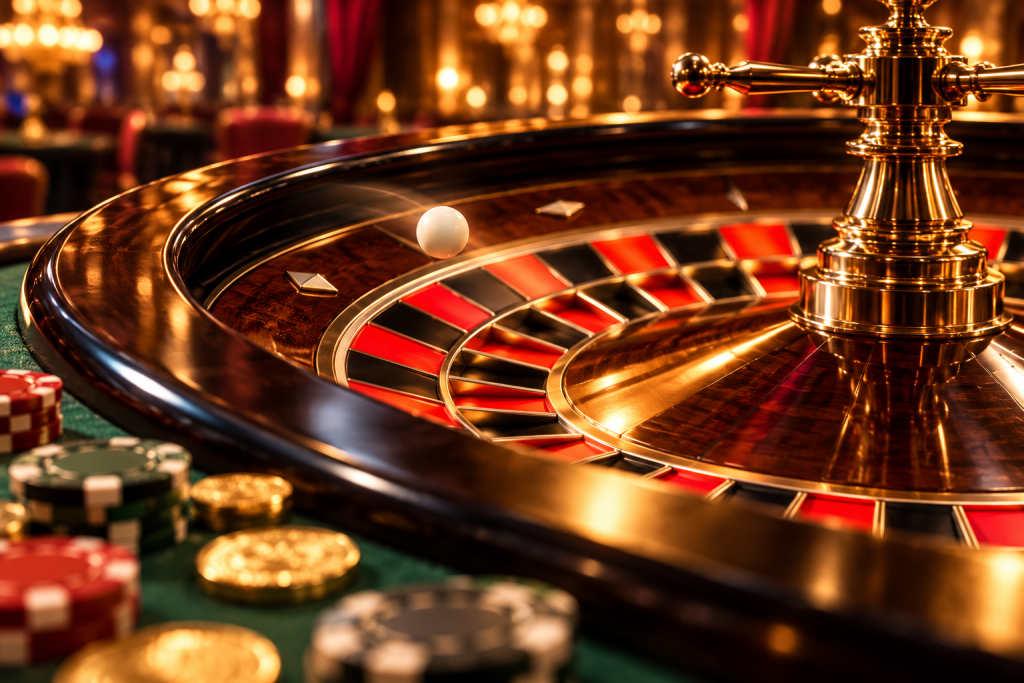
The wheel has no memory, and that is the whole answer
A player watching a roulette board for an hour will see some numbers hit twice, some hit three times, and a dozen others not hit at all. The temptation is to conclude that certain numbers are 'hot' or that the wheel favours a particular pocket. The mechanism says otherwise. A physical roulette wheel is balanced so that every numbered pocket has the same chance of capturing the ball on any independent spin. The ball does not remember where it landed last time, and the wheel does not develop preferences. What the player is watching is variance, not a pattern that can be exploited.
This matters because the question 'what numbers come up most often' is really a question about whether roulette outcomes can be predicted. They cannot. The game is built so that each spin is independent, and the only stable statistical facts are the ones built into the wheel's design: how many pockets it has, how many of them are zeros, and what each bet pays relative to the true odds of winning it.
What differs between wheels
Roulette is played on two main layouts, and the difference between them is the single most important thing to understand before placing any bet. The number of pockets changes the probability of every wager, which changes the rate at which a player can expect to lose over time.
| Feature | European wheel | American wheel |
|---|---|---|
| Pockets | 37 | 38 |
| Zero pockets | One (single zero) | Two (single and double zero) |
| Effect on any single-number bet | One winning pocket out of 37 | One winning pocket out of 38 |
| Effect on the house edge | Lower, because fewer losing pockets exist | Higher, because the extra zero adds a losing pocket without improving payouts |
The extra double-zero pocket on an American wheel does not change what a winning straight-up bet pays. It only adds another way to lose. That is the entire mechanism by which the American layout produces a higher house edge than the European layout. No number is more likely on either wheel; every pocket shares the same probability on its own layout.
How the house edge is built into each bet
Roulette does not hide its advantage in complicated rules. It is built into the gap between what a bet pays and what the true odds of winning that bet are. A straight-up bet on a single number pays 35 to 1. On a European wheel, the true odds against hitting that number are 36 to 1, because there are 36 other pockets. The operator keeps the difference. That difference, expressed as a percentage of each wager, is the house edge.
Every bet on the layout works the same way. A split bet covering two numbers pays less than the true odds of one of those two numbers appearing. A street bet covering three numbers pays less than the true odds of one of those three appearing. The payout is always slightly short of what the probability would justify if the game were fair. That shortfall is not a secret; it is printed in the payout table and it is the same on every spin, regardless of which numbers have appeared recently.
RTP and house edge are complements. For the same bet under the same rule set, the return to player and the house edge sum to 100%. If a bet returns a certain percentage to players over a very large number of spins, the operator retains the remainder. Neither figure predicts what will happen in the next ten spins. Both describe the long-run average.
Short sessions look nothing like long-run averages
A player who sits down for fifty spins is not experiencing the long run. The long run in roulette is an abstract idea: an enormous number of independent spins, enough that the observed frequency of each number settles close to its theoretical probability. Fifty spins is nowhere near that. In fifty spins, some numbers will appear more often than probability predicts and others will appear less often. That is not evidence of bias. It is what random sequences look like at small sample sizes.
Suppose a player watches a European wheel for one hundred spins. The theoretical expectation is that each number appears roughly the same number of times, but the actual distribution will be uneven. One number might appear six times, another not at all. If the player then bets on the number that appeared six times, they are not betting on a pattern. The wheel's next spin still gives every pocket the same probability. The previous six appearances have no influence on the seventh.
This is the core misunderstanding behind the search for 'most common' numbers. A number that has appeared often in a short session looks significant, but the sample is too small to distinguish signal from noise. The only way to observe the true long-run distribution would be to watch an impractically large number of spins, and even then the result would simply confirm what the wheel's design already tells us: every pocket is equally likely.
Decisions per hour change total exposure, not the edge
Roulette is a fast game. A busy table can produce a spin every minute or faster, which means a player placing a bet on every spin is putting money at risk dozens of times per hour. That pace matters, but not because it changes the house edge. The edge on each bet stays the same. What changes is the total amount wagered, and therefore the total expected loss over the session.
As an example, suppose a player wagers one unit on a single number on every spin of a European wheel. Each individual bet carries the same house edge. If the player makes sixty bets in an hour, they have wagered sixty units, and their expected loss is the per-bet edge multiplied by sixty. If the same player bets only once every five minutes, they wager twelve units in the hour, and their expected loss is the per-bet edge multiplied by twelve. The edge did not change. The exposure did.
This is why game speed is a real decision under the player's control, while number selection is not. A player cannot choose a number that reduces the house edge, because all numbers carry the same edge on the same wheel. A player can choose how many spins to play, how much to stake per spin, and when to stop. Those choices change the total amount put at risk. They do not change the mathematics of any individual bet.
Why progression systems redistribute outcomes instead of removing the edge
Betting systems that increase stakes after losses, or after wins, are popular because they seem to impose order on a random process. The most famous is the doubling system: after a loss, double the stake, so that a win recovers all previous losses plus one unit. The system feels safe because it produces many small wins. The problem is that it does not change the house edge on any bet, and it concentrates the risk of ruin into a small number of very large losing streaks.
A progression system changes the shape of the outcomes, not their average. Suppose a player uses a doubling progression on an even-money bet. Most sessions end with a small win, because most losing streaks are short. But occasionally a losing streak runs long enough that the required next stake exceeds the player's bankroll or the table's maximum. In that session, the player loses a large amount. The small wins and the rare large loss average out to the same expected loss as flat betting, minus the house edge on every unit wagered. The system has redistributed the losses, not removed them.
No betting pattern changes the built-in edge of a negative-expectation game. The wheel does not know what system is being used. Each spin is independent, and each bet carries the same shortfall between payout and true odds. A system can change how losses arrive, but it cannot change how much is lost on average per unit wagered.
What a player can control
The search for frequently appearing numbers is a search for control over a process that offers none. What roulette does offer is a small set of genuine decisions, and they are all about exposure, not prediction.
- Wheel type. A European wheel has fewer losing pockets than an American wheel, which means a lower house edge on every bet. This is the single largest structural difference a player can choose.
- Bet type. Different bets on the same layout carry different edges, though all are negative. The payout table states the odds for each, and comparing them against the true odds shows which bets are less costly.
- Stake and pace. The amount wagered per spin and the number of spins per hour determine total exposure. These are choices, not predictions.
- Session length and stopping rules. Deciding in advance how much to risk and when to stop controls the size of the possible loss. It does not change the edge, but it bounds the damage.
None of these choices makes a number more likely to appear. They are the only levers the game offers, and they are worth understanding precisely because the wheel itself offers no other information.
FAQ
Do some roulette numbers hit more often than others?
No. On a properly maintained wheel, every pocket has the same probability on every spin. Short-term streaks create the illusion of hot numbers, but they are random variation, not a property of the wheel.
Can a biased wheel make certain numbers come up more?
A physical defect could theoretically bias a wheel, but modern wheels are built and maintained to prevent this, and operators have strong incentives to detect and correct any bias. A player cannot rely on finding one, and the attempt is not a strategy.
Does betting on numbers that have not appeared recently improve my odds?
No. The wheel has no memory. A number that has not appeared for a hundred spins has exactly the same probability on the next spin as a number that just appeared. The absence of a number is not evidence that it is due.
Gamble responsibly. If you or someone you know has a gambling problem, call the helpline printed in the footer below. Help is available 24/7.
Play responsibly
Gambling should be treated as paid entertainment, never as a way to earn income or recover losses. 1-800-MY-RESET (1-800-697-3738)
18+ or 21+ depending on where you are; follow the minimum age that applies to you.
This article is general information about how these mechanics work. It is not legal advice and not a recommendation to gamble or to use any particular operator. Availability and legality differ by jurisdiction — check the rules that apply where you are.