


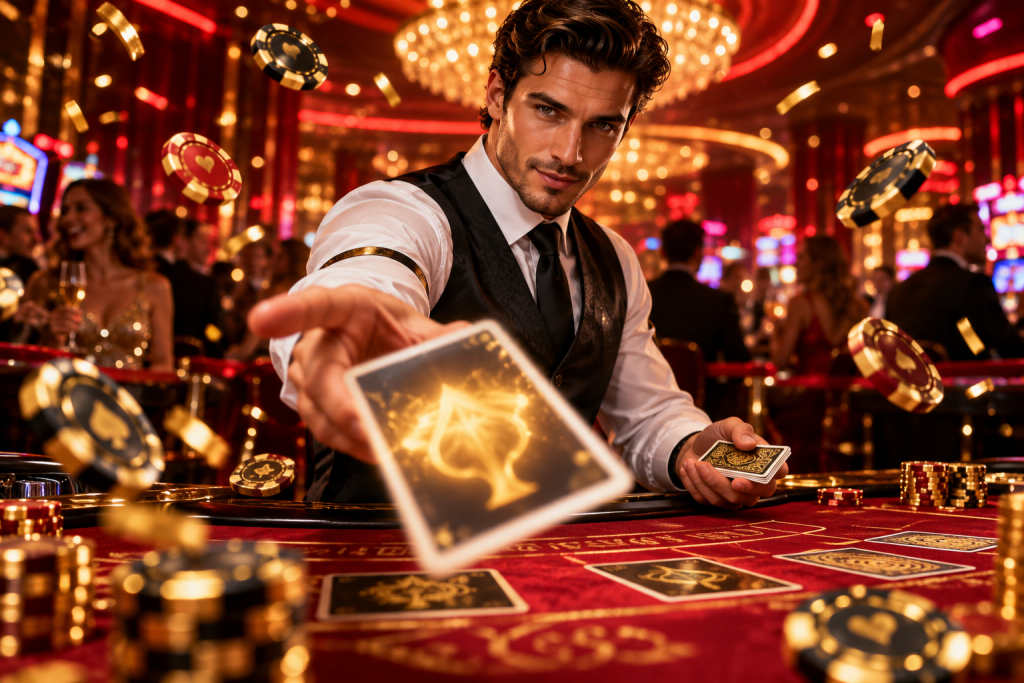
The sound you hear at a crowded table
Walk past a busy blackjack pit and you will sometimes hear a player calling for a “monkey” while the dealer reaches for the shoe. They are not asking for an animal. They are asking for a ten-value card: a ten, jack, queen, or king. The call is usually half joke, half superstition, and it is one of the oldest pieces of slang still alive on a casino floor.
The term is worth understanding because it sits at the intersection of blackjack's mechanics and its culture. A ten-value card is the most common card in the game, and it is the card that most often completes a strong hand. When a player has an eleven and wants a ten to make twenty-one, or holds a stiff hand and wants the dealer to draw a ten and bust, the word comes out. What matters for play is not the word itself but what it represents: four ranks out of thirteen, or sixteen cards in a fifty-two-card deck, all worth ten points.
What a monkey is at the table
In blackjack, every ten, jack, queen, and king counts as ten points. Aces are flexible, worth one or eleven, and every other card counts as its face value. Because four of the thirteen ranks are ten-value cards, just under a third of the deck can be described as a monkey. The term does not change any rule, and it does not affect the odds. It is a nickname, not a hand type.
The objective of a blackjack hand is mechanical and simple: finish with a total closer to twenty-one than the dealer's total, without exceeding twenty-one. A ten-value card is valuable to both sides of the table. For the player, it turns an ace into a natural blackjack, an eleven into twenty-one, or a soft hand into a stronger total. For the dealer, it turns a six into a sixteen, and a dealer who must draw to seventeen frequently busts when the next card is a ten.
| Card rank | Point value | Why it matters |
|---|---|---|
| Ten | 10 | Completes a total of twenty or twenty-one from many starting hands |
| Jack | 10 | Same value as a ten; face card with no separate rank in blackjack |
| Queen | 10 | Same value as a ten; face card with no separate rank in blackjack |
| King | 10 | Same value as a ten; face card with no separate rank in blackjack |
| Ace | 1 or 11 | The only flexible card; pairs with a ten-value card for a natural |
Where the word probably came from
No one can prove the origin of the term, and the casino industry has never issued an official etymology. The most widely repeated explanation is visual. A face card, particularly a jack or a king, shows a figure that some players thought looked like a monkey. The court cards in older decks were drawn with stylised faces, crowns, and poses, and in worn decks the artwork could look less regal and more simian. A player asking for a “monkey” was asking the dealer to turn up one of those face cards.
Another explanation points to the word's use as generic slang for anything unknown or unnamed. In some older English usage, a “monkey” could be a stand-in for an unspecified thing, the way a person might say “widget” or “whatsit”. Under this reading, calling for a monkey was a way of asking for whatever card would help, without naming it. That fits the way the term is used: the player rarely specifies a ten, a jack, a queen, or a king. They just want any ten-value card.
There is also a simpler possibility. The word is short, loud, and easy to say across a table. Blackjack slang tends toward one-syllable calls, and “monkey” carries better than “ten-value card, please.” Whatever the original source, the term has survived because it is useful in exactly that way.
How a round plays out, from buy-in to settlement
The monkey call happens inside a sequence that is the same at nearly every table, even though individual rules vary. A player buys in by placing cash on the felt, never directly into the dealer's hand. The dealer spreads the cash, calls out the amount, and gives the player chips. The player then places a wager in the betting circle before any cards are dealt.
The dealer gives each player two cards face up in most modern games, and takes two cards with one face up and one face down. If the dealer's upcard is an ace, the dealer may offer insurance, a side bet that pays if the dealer has a natural. If the dealer's upcard is a ten-value card, the dealer checks the hole card for a natural before players act. These checks are procedural and automatic; the player does not need to ask for them.
Each player then decides how to play the hand. Standing means taking no more cards. Hitting means asking for another. Doubling down means doubling the wager and taking exactly one more card. Splitting is available when the first two cards are a pair, and it creates two separate hands. Surrender, where offered, lets a player give up half the wager and end the hand before playing it. When all players have acted, the dealer reveals the hole card and draws according to a fixed rule, usually drawing to sixteen and standing on seventeen, though the exact rule is printed on the table.
Settlement follows the comparison of totals. A player with a higher total than the dealer wins even money on the wager. A natural blackjack typically pays three to two, though some tables pay six to five, which is a materially worse return for the player. A push returns the wager. The dealer collects losing bets and pays winners in order, and the next round begins.
Why the call is not a strategy
Calling for a monkey does not change what card comes next. The card is determined by the shuffle and the order of the shoe, not by what anyone says. A player can call for a monkey on every hand and will receive exactly the same distribution of cards over time as a player who says nothing. The call is entertainment, and most dealers treat it that way.
What does change the expected result is the decision the player makes with the cards they are dealt. Blackjack is a comparing game, and the player's choices—hit, stand, double, split, surrender—matter because they are made before the dealer acts. Published basic-strategy charts exist for this reason, but they derive from the specific rule set in use. The number of decks, whether the dealer stands or hits on soft seventeen, whether doubling after splitting is allowed, and whether surrender is offered all change the correct play on certain hands. A chart built for one rule set is not automatically correct for another.
The house edge in blackjack also depends on those rules. The game is not a single bet with a single edge; it is a family of rule sets, and the edge on the same hand can differ from one table to the next. The player's job is to read the felt, find the rule variations, and play the hand accordingly.
Where the term fits in table culture
Blackjack tables have their own vocabulary, and most of it is practical. A “pat hand” is a total of seventeen or higher that a player usually stands on. A “stiff hand” is a total of twelve through sixteen that can bust with a ten-value card. A “soft hand” contains an ace counted as eleven. “Paint” is another word for face cards, and “monkey” is part of the same family. None of these terms change the rules, but they are how regular players talk about the decisions in front of them.
New players sometimes mistake the call for a request to the dealer, as if the dealer could choose which card to pull. The dealer cannot. The shoe is dealt in order, and the dealer's job is to follow the draw rules and the table procedures, not to grant requests. Another common mistake is to think that a face card is somehow different from a ten. It is not. A jack, queen, and king are all worth ten points, and the only reason they look different is the artwork. A player who understands that can read any hand correctly, whether or not they ever use the word.
FAQ
Does saying monkey change the odds of getting a ten?
No. The card that comes next is determined by the shuffle and the order of the shoe. Saying the word, or any other word, has no effect on which card is dealt.
Is a monkey only a face card, or does it include a ten?
In table slang it usually means any ten-value card: a ten, jack, queen, or king. Some players use it only for face cards, but the practical meaning is any card worth ten points.
Why do players ask for a monkey when the dealer has a low card showing?
Because a ten-value card is the most likely single card to bust a dealer who must draw to seventeen. A dealer showing a five or six is in a weak position, and a ten is the card players most want to see appear.
Play responsibly
Gambling should be treated as paid entertainment, never as a way to earn income or recover losses. 1-800-MY-RESET (1-800-697-3738)
18+ or 21+ depending on where you are; follow the minimum age that applies to you.
This article is general information about how these mechanics work. It is not legal advice and not a recommendation to gamble or to use any particular operator. Availability and legality differ by jurisdiction — check the rules that apply where you are.