


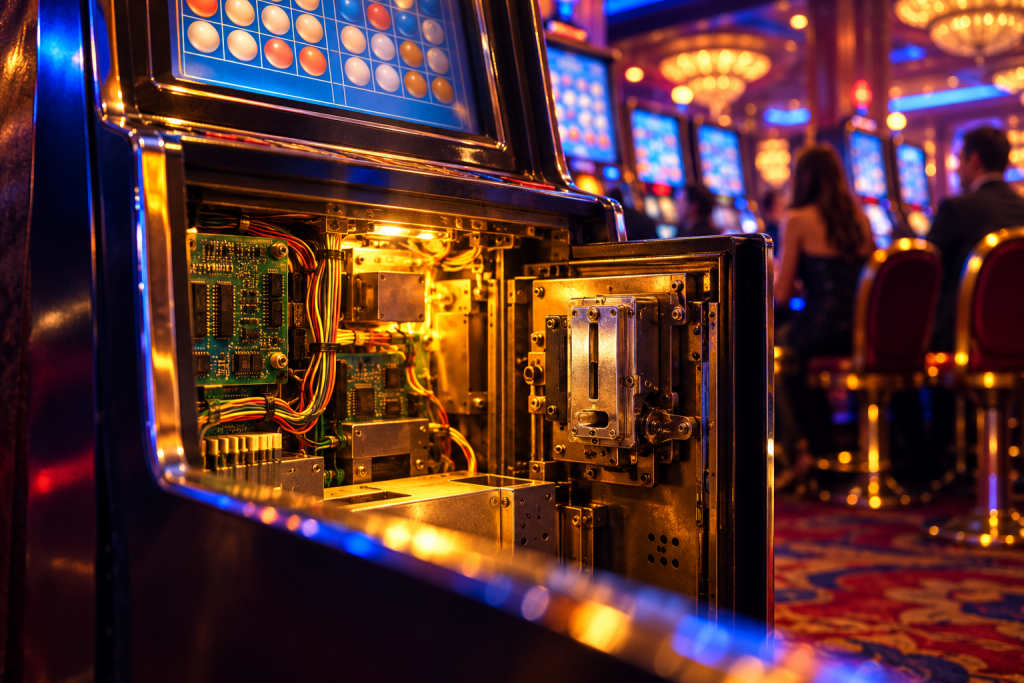
The switch you are looking for is not a player-facing control
On a Ballys keno machine, a pseudo coin switch is a service or diagnostic input, not something a player touches during normal play. It exists so a technician or operator can simulate a coin-in signal without inserting physical currency, usually during testing, meter checks, or configuration. Because it is a service component, its location is set by the cabinet design and the operator's configuration, not by any universal standard.
This article explains the structural reality of that switch: what it is, why its position varies, which categories of location to check, and where the authoritative answer lives. It does not give a specific mounting point for a specific cabinet, because no single documented position applies across Ballys keno machines.
What a pseudo coin switch does inside the machine
A coin switch in a gaming cabinet is the input that tells the game logic a coin has been accepted. A pseudo coin switch reproduces that signal through a manual or software-triggered pulse, bypassing the coin acceptor and its mechanical validation. The word "pseudo" signals that the input is simulated: the machine receives the same electrical or logical event it would get from a real coin, without a coin passing through the acceptor.
This kind of input appears in service menus, diagnostic routines, and sometimes in test modes used by route technicians. It is not a feature of the game of keno itself. Keno is a numbers game; the pseudo coin switch belongs to the cabinet hardware and the operator's service procedures. A player asking about it is usually either a technician, a collector working on a machine, or someone trying to understand a machine they have seen opened for service.
Why there is no single documented location
Ballys has produced keno machines across multiple cabinet generations. Each generation has its own internal layout: where the main board sits, where the coin acceptor mounts, where the service panel is placed, and how the wiring harness routes from the door to the logic board. A pseudo coin switch may be a physical toggle on a service bracket, a button on a diagnostic board, a jumper on the main logic board, or a software-selectable input in a service menu. The same function can therefore live in different physical places on different cabinets.
Operators also modify machines. A route operator may relocate a service switch to make it easier to reach during floor service, or may disable physical switches and rely on software inputs instead. Casino floors, arcade-style keno lounges, and private collectors can all have the same nominal machine with different service configurations. That is why any article that names one position as "the" location would be misleading.
Where to look first, by category
The search is best organised by the kind of access point the cabinet has, not by a single guess. Most service inputs on gaming cabinets cluster in a small number of places: the interior of the main door, the area around the coin acceptor, the main logic board, or a dedicated service panel behind a secondary lock. The table below separates these categories and what each one typically governs.
| Location category | What it usually contains | What to confirm before assuming |
|---|---|---|
| Main door interior | Test buttons, reset switches, meter access, sometimes a coin-in simulation toggle | Whether the switch is labelled, and whether it is wired to the coin input or to another function |
| Coin acceptor area | Mechanical coin switch, acceptor harness, sometimes a bypass or test point | Whether the pseudo coin input is a separate switch or a jumper on the acceptor harness |
| Main logic board | Jumpers, DIP switches, test points, sometimes a dedicated diagnostic button | Which board revision is installed, and which jumper position corresponds to coin-in simulation |
| Secondary service panel | Operator-only controls behind a separate lock or latch | Whether the operator has relocated or relabelled the switch during installation |
The authoritative answer is the machine's own documentation
For any specific Ballys keno cabinet, the definitive source is the service manual for that exact model and revision. The manual includes board layout diagrams, wiring schematics, and a parts list that identifies service inputs by their official names. A cabinet's model number and revision are usually printed on a plate inside the main door or on the rear panel. That identifier is what lets you match the machine to the correct manual.
If the machine is on a casino floor, the slot technician or keno supervisor is the person who works from that documentation. Asking the venue's technical staff is the fastest route to a correct answer for that specific cabinet. On a private machine, the seller or the previous owner may have the manual, or may have annotated the service panel with their own labels.
What to confirm before you open or adjust anything
A pseudo coin switch is a service input, which means the surrounding work is service work. Before opening a cabinet, confirm three things: whether you are authorised to access the interior, whether the machine is powered down or in a safe service state, and whether the switch you have found is the pseudo coin input rather than a reset, door, or meter switch. Misidentifying a service input can clear meters, reset configuration, or trigger a tilt condition.
The channel that holds the current answer is the machine's service manual, matched by model and revision. The venue's technical staff hold the same answer for floor machines. There is no public registry of switch positions across Ballys keno cabinets, and any single position stated without a model number is a guess.
How this differs from a player-facing coin switch
A player-facing coin switch sits in the coin path and fires when a coin passes through the acceptor. A pseudo coin switch sits outside that path and fires when a person or a test routine tells it to. The difference matters because the two are often physically close but electrically distinct. On some cabinets the pseudo coin input is a pair of test points on the logic board; on others it is a pushbutton wired in parallel with the coin switch. The service manual is the only document that distinguishes them reliably for a given model.
| Input type | Triggered by | Typical physical form | Who uses it |
|---|---|---|---|
| Coin switch | A physical coin passing the acceptor | Mechanical or optical sensor in the coin path | Players, during normal play |
| Pseudo coin switch | A manual press, jumper, or software command | Toggle, test point, DIP switch, or menu option | Technicians and operators, during service |
FAQ
Is the pseudo coin switch the same on every Ballys keno machine?
No. Ballys keno cabinets span multiple generations, and the switch's physical form and position vary by model and board revision. Some machines implement the function as a physical toggle, others as a jumper or a software menu option. The only reliable identifier is the machine's model and revision, matched to its service manual.
Can I find the switch by opening the main door?
You may find it there, but the main door interior also holds reset, meter, and door switches that look similar. Opening the door on a live floor machine is a service action and may be restricted to authorised staff. Confirm the switch's function against the service manual before pressing anything, because a wrong input can clear meters or trigger a tilt.
Who is the best person to ask about a specific machine?
For a machine on a casino floor, the venue's slot technician or keno supervisor works from the exact service documentation for that cabinet and is the fastest authoritative source. For a privately owned machine, the seller or previous owner may hold the manual. Match the cabinet's model and revision number to the correct manual before relying on any general description.
Play responsibly
Gambling should be treated as paid entertainment, never as a way to earn income or recover losses. 1-800-MY-RESET (1-800-697-3738)
18+ or 21+ depending on where you are; follow the minimum age that applies to you.
This article is general information about how these mechanics work. It is not legal advice and not a recommendation to gamble or to use any particular operator. Availability and legality differ by jurisdiction — check the rules that apply where you are.