


The Name Depends on Where You Sit Down
Walk up to a felt table in one part of the world and the dealer will welcome you to blackjack. Walk up to an identical table somewhere else and the sign above it simply says 21. The game is the same. The difference in naming is mostly a matter of region, venue tradition, and how the game has been marketed over the last century. In most of North America, the casino industry settled on blackjack as the standard term, while 21 survives as the everyday name, the name used in home games, and the name printed on many felt layouts. The two words are interchangeable, and a player who asks for a seat at a 21 table is asking for the same game as a player who asks for blackjack.
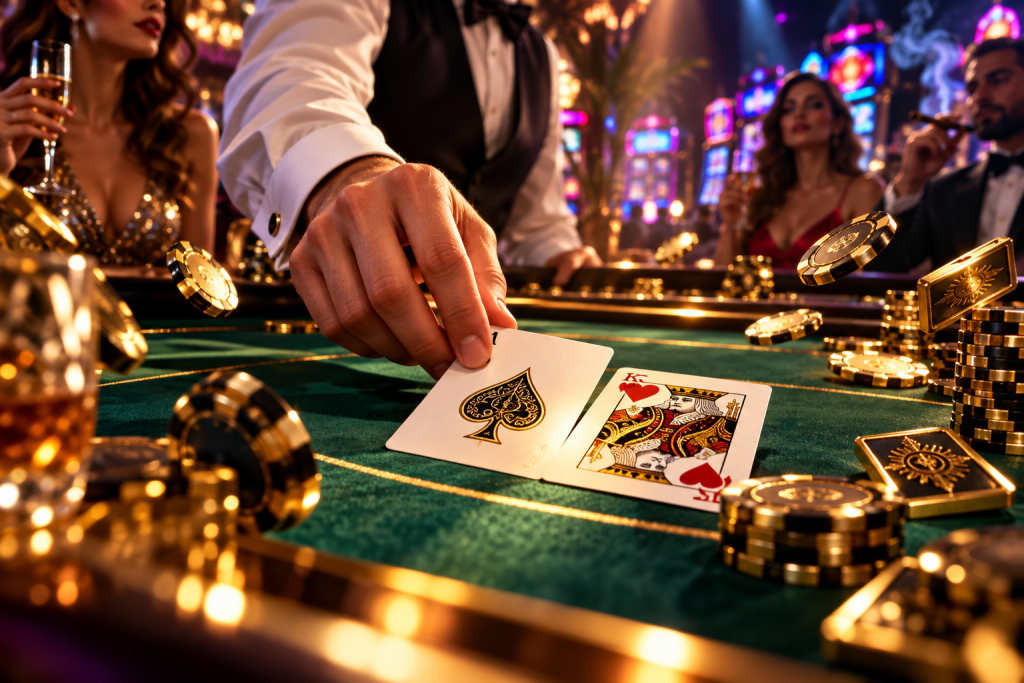
The name 21 is the older and more descriptive of the two. It states the target: a hand total closer to 21 than the dealer's, without going over. The name blackjack comes from a specific promotional payout that was once attached to a particular winning hand. Early American gambling houses wanted to attract players to a game that had not yet caught on, so some offered a bonus when a player's first two cards were the ace of spades and a black jack, meaning either the jack of spades or the jack of clubs. That exact two-card combination paid extra, and the bonus hand gave the whole game its lasting name. The special payout disappeared long ago, but the word stuck.
Today the term blackjack is used for the game itself and for any two-card hand that totals exactly 21, regardless of suit. A player holding an ace and a ten-value card of any suit has a blackjack. The old ace-of-spades-plus-black-jack condition is a piece of history, not a current rule.
What the Player Is Trying to Do
The objective is simple to state and easy to misread. You are not trying to get as close to 21 as possible on every hand. You are trying to finish with a hand total higher than the dealer's without exceeding 21. Those are different goals. A total of 12 can win the hand outright if the dealer draws cards that take the dealer's total past 21. A total of 20 can lose if the dealer finishes with 21. The game is a comparison between two hands, and the dealer's hand is the one you are measured against.
Card values are fixed. Numbered cards count as their face value. Face cards, meaning jacks, queens and kings, each count as 10. An ace counts as either 1 or 11, whichever gives the better hand without exceeding 21. A hand containing an ace counted as 11 is called a soft hand, because the ace can drop to 1 if a later card would otherwise bust the hand. A hand with no ace, or with an ace already forced to count as 1, is a hard hand. The distinction matters at every decision point, because a soft hand can absorb a high card that would destroy a hard hand of the same total.
A two-card total of exactly 21 is a blackjack, sometimes called a natural. It is the strongest starting hand in the game and is normally paid at a higher rate than a standard win, commonly 3 to 2 on the player's wager. The exact payout is printed on the table layout and varies between venues, so a player should read the felt before sitting down. Some tables pay a natural at a lower rate, and that single rule change has a large effect on the expected cost of playing.
The Sequence of a Round
A round of blackjack moves through a fixed sequence. The player buys in first, exchanging cash for chips at the table or presenting chips already purchased at the cage. The dealer places the chips in the player's betting area. The player then places a wager within the table's posted minimum and maximum before any cards are dealt. Once the first card leaves the shoe, the wager is committed and cannot be adjusted.
The dealer gives each player two cards face up and takes two cards as well, usually one face up and one face down. If the dealer's upcard is an ace, the dealer will normally offer insurance before proceeding. Insurance is a side bet that pays if the dealer's hidden card gives the dealer a blackjack. It is a separate wager with its own house edge, and it is generally a poor bet for a player who is not counting cards, because it is priced as if the dealer's hidden card is a ten-value card more often than it is.
Play then proceeds around the table. Each player decides in turn whether to stand with the current total, hit to take another card, double down to take exactly one more card while doubling the wager, or split a pair into two separate hands. Some tables also allow surrender, which lets a player forfeit half the wager and end the hand before playing it out. The options available at a given table are part of its rule set, and they change the mathematics of the game.
After all players have acted, the dealer reveals the hidden card and plays according to a fixed rule. The dealer must hit on totals of 16 or less and must stand on totals of 17 or more, with a variation on whether the dealer stands or hits on a soft 17. The dealer has no discretion. The dealer's hand is played the same way every time, and that predictability is what makes a published basic-strategy chart possible. When the dealer busts, every player who has not already busted wins. When the dealer does not bust, each player's hand is compared to the dealer's total, and the higher total wins. Ties push, meaning the wager is returned.
What the Main Decisions Change
Every decision in blackjack is a choice between outcomes that carry different expected losses. The player controls whether to hit, stand, double, split or surrender, and the correct choice depends on two pieces of information: the player's own total and the dealer's upcard. A basic-strategy chart is simply a table that lists the correct play for every combination of those two facts under a specific rule set. The chart says nothing about winning the next hand. It identifies the play that minimises the expected loss over a very large number of identical situations.
Because the chart derives from the exact rules in use, a chart written for one table is not necessarily correct for another. The number of decks, whether the dealer hits or stands on soft 17, whether doubling after splitting is allowed, whether surrender is offered, and the payout on a natural all shift the correct play in specific situations. A player who memorises a chart without checking which rule set it assumes has learned a set of answers to a slightly different game.
| Decision | What it does | What changes the correct choice |
|---|---|---|
| Stand | Keeps the current total and ends the player's action | Dealer's upcard, player's total, whether the hand is soft |
| Hit | Takes another card; may be repeated until the hand busts or the player stands | Risk of busting versus the dealer's chance of busting |
| Double down | Doubles the wager and takes exactly one more card | Whether the rule set allows doubling on any total or only certain totals |
| Split | Separates a pair into two hands, each with its own wager | Whether re-splitting and doubling after splitting are allowed |
| Surrender | Forfeits half the wager and ends the hand immediately | Whether the table offers early or late surrender at all |
Where the House Keeps Its Edge
Blackjack carries a house edge like every other casino game, but the edge is not a single fixed number printed on the table. It is the product of the rule set and the player's decisions. A player who follows a correct basic strategy for the table's rules faces a smaller expected loss than a player who plays by intuition, because intuition repeatedly chooses the play with the larger expected cost. The dealer's fixed drawing rule is what gives the house its structural advantage: the player acts first and can bust before the dealer ever has to draw. That single fact, not any hidden manipulation, is the core of the game's mathematics.
Different side bets carry different edges, and they are usually much higher than the edge on the main game. Insurance is the most common example. A side bet that the dealer has a ten-value card hidden under an ace is a separate wager with its own odds, and those odds are set so that the bet loses money at a faster expected rate than the main hand. Perfect pairs, 21+3 and other side bets work the same way. They are independent wagers attached to the same round, and their returns are calculated separately from the main bet.
Volatility in blackjack comes mostly from doubling and splitting, which put more money at risk on hands where the player has a mathematical advantage in that specific situation. Those plays increase the swing from session to session without changing the long-run expected loss. A player who doubles and splits correctly will see larger up-and-down movements than one who never does, but the larger swings are the cost of taking the better-priced opportunities.
Mistakes That Cost More Than They Look Like
The most expensive procedural mistake at a blackjack table is sitting down without reading the rule variations printed on the felt or displayed on the screen. The payout on a natural, the dealer's soft-17 rule, and the availability of surrender are all printed somewhere at the table, and each one changes the expected cost of every hand. A player who assumes every table uses the same rules is playing a different game than the one in front of them.
The second mistake is treating the dealer's upcard as irrelevant. New players often decide whether to hit or stand based only on their own total, as if the dealer's visible card were decoration. The dealer's upcard is the single most important piece of information in the game, because it determines how likely the dealer is to bust. Standing on a weak total against a dealer's 6 is often correct, while standing on the same total against a dealer's 10 is often a fast way to lose the hand without forcing the dealer to draw.
The third mistake is taking insurance or side bets as a routine part of the hand. These are separate wagers with their own, usually worse, odds. A player who takes insurance on every dealer ace, or who adds a 21+3 bet to every round, is paying a higher expected cost per hour than the main game requires. The side bets are optional for a reason, and the reason is that they are priced to favour the house more heavily than the hand itself.
FAQ
Is 21 exactly the same game as blackjack?
Yes. The two names refer to the same comparing card game. Some venues and home-game traditions prefer one name over the other, but the objective, the card values and the sequence of play are identical. A table labelled 21 is a blackjack table.
Why did the ace of spades and a black jack matter?
That specific two-card combination was the original hand that earned a bonus payout in early American gambling houses, and the bonus gave the game its lasting name. The suit-based bonus no longer exists. Today any ace with any ten-value card is a blackjack and pays the table's posted natural rate.
Does a basic-strategy chart work at every table?
Only if the chart was built for the same rule set as the table. The number of decks, the dealer's soft-17 rule, doubling and splitting restrictions, and the natural payout all change the correct play in specific situations. A player should check which rules a chart assumes before applying it to a given table.
Play responsibly
Gambling should be treated as paid entertainment, never as a way to earn income or recover losses. 1-800-MY-RESET (1-800-697-3738)
18+ or 21+ depending on where you are; follow the minimum age that applies to you.
This article is general information about how these mechanics work. It is not legal advice and not a recommendation to gamble or to use any particular operator. Availability and legality differ by jurisdiction — check the rules that apply where you are.