


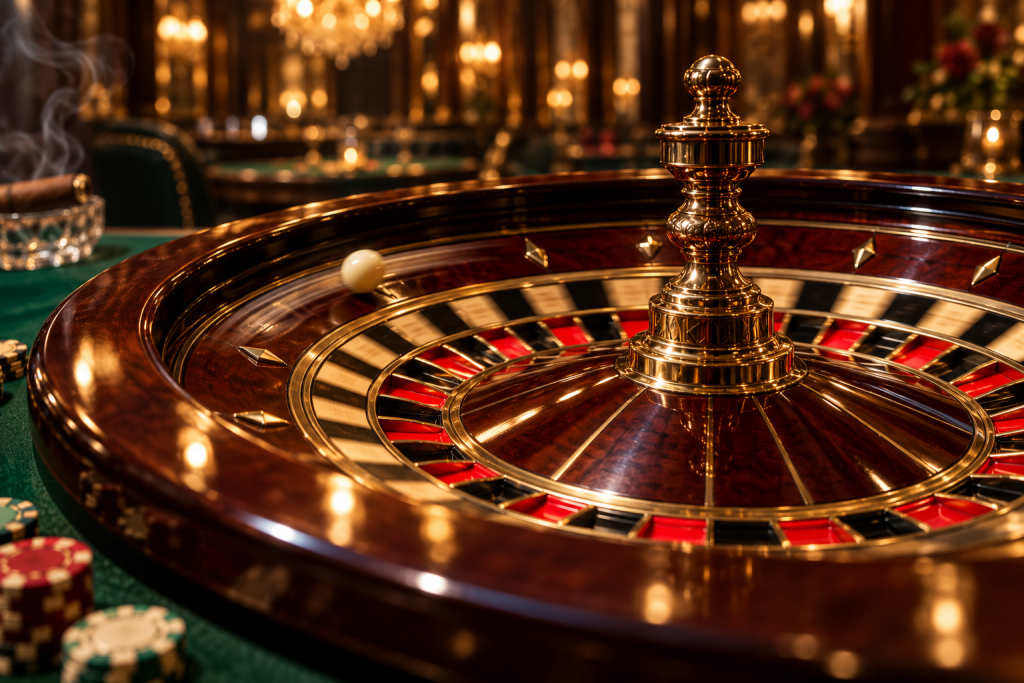
The wheel you see today is the end of a long chain, not the work of one person
Walk up to a roulette table and the equipment looks settled: a numbered wheel, a felt layout, a small ball spinning against the direction of the rotor. But that design was not drawn up in a single afternoon by a single inventor. The game assembled itself over roughly two centuries, with pieces contributed by mathematicians, monks, Parisian casino operators, and at least one pair of brothers who made a small but permanent change to the wheel itself.
The honest answer to who designed the roulette wheel is that no one person did. What exists today is a composite: a wheel concept borrowed from a seventeenth-century perpetual-motion experiment, a game structure built in eighteenth-century France, a zero added by a casino to create a house advantage, and a second zero added later in a different market. Each layer matters if you want to understand why the wheel looks the way it does.
The earliest piece of the story is probably not a gambling game at all
The name most often attached to roulette's origin is Blaise Pascal, the French mathematician and philosopher. The story runs that Pascal, working in the mid-1600s, was attempting to build a perpetual-motion machine, and that one of his experimental devices, a wheel that could spin freely on a bearing, later became the basis for the gambling wheel.
There is no solid documentary evidence that Pascal ever saw a roulette game, and no record that he designed one. The connection is plausible only in a limited sense: a spinning wheel was one of the mechanical ideas circulating in European scientific circles at the time. The step from a physicist's apparatus to a game with numbered pockets and a betting layout is a large one, and the historical record does not show Pascal taking it.
What the record does show is that wheel-based gambling games were already known in Europe. English games such as roly-poly and ace of hearts used a spinning wheel with marked sections, and Italian games of chance involving wheels appear in earlier accounts. These were not roulette, but they established the basic format: a wheel, a marker, and a bet on where the marker would stop.
The game itself took shape in late eighteenth-century Paris
The direct ancestor of modern roulette is generally placed in Paris in the 1790s or thereabouts. The game that emerged combined a wheel with numbered pockets and a table layout where players could bet on individual numbers, groups of numbers, colours, and odd or even outcomes. The structure was close enough to what a modern player would recognise that historians treat this as the point where roulette became roulette.
One detail from this period matters more than the inventor's name. The early French wheel contained both a single zero and a double zero. The zeros were the house's edge, built directly into the wheel rather than imposed as a separate fee. A player betting on a single number was paid as if the wheel had no zeros at all, while the zeros themselves sat outside the ordinary red-black and odd-even splits. That gap between the payout and the true odds is the entire commercial structure of the game, and it was present from the beginning.
Because the game was refined inside Parisian gambling houses rather than patented by a named designer, the specific person who standardised the layout is not reliably recorded. What survives is the game, not the signature.
Two brothers took the single zero to Germany, and that wheel became the European standard
The next change is better documented. In the 1840s, two Frenchmen, François and Louis Blanc, operated gambling houses in Germany, first in Bad Homburg and later in Monte Carlo. The Blanc brothers removed the double zero from the wheel, leaving a single zero. The result is what is now called the European wheel: 37 pockets, numbered 0 through 36.
The removal was not cosmetic. It changed the arithmetic for every bet on the table. A wheel with one zero gives the house a smaller built-in advantage than a wheel with two zeros, because the player's payouts are still calculated as if the zero pockets did not exist, but there is one fewer unpaying pocket to contend with. The single-zero wheel became the standard across continental Europe, and it remains the wheel most players outside the United States will encounter.
The American wheel kept the second zero, and that difference is permanent
Across the Atlantic, the double-zero wheel survived. The American layout uses 38 pockets, numbered 0, 00, and 1 through 36. The extra pocket is not a trivial detail; it is the single most important difference between the two main wheel types, and it affects every wager placed on the layout.
The comparison is worth holding side by side, because the two wheels look similar enough that a new player can easily miss what changed.
| Feature | European wheel | American wheel |
|---|---|---|
| Number of pockets | 37 | 38 |
| Zero pockets | Single zero | Single zero and double zero |
| Number range | 0-36 | 0, 00, and 1-36 |
| Effect on house edge | Lower, because one fewer unpaying pocket | Higher, because two unpaying pockets |
| Common where | Most casinos outside the United States | Common in the United States |
The difference in house edge follows directly from the number of pockets. On a single-number bet, a European wheel pays as if there were 36 pockets, but there are 37; an American wheel pays as if there were 36, but there are 38. The gap between the payout and the true odds is the house edge, and the American layout's gap is wider. This is not a matter of opinion or house policy; it is a property of the wheel itself.
Some American casinos also offer a single-zero wheel, often at higher minimum stakes or as a separate table. The wheel type is always printed or visible on the layout, and the difference between 37 and 38 pockets is the first thing to check before buying in.
What the designer question teaches you about the game
The search for a named inventor is less useful than the design history itself, because every major change to the wheel was a change to the odds. The zero was added to give the house an edge. The second zero was removed in Europe to make the game more attractive to players. It was kept in America, and the two markets have run on different wheels ever since.
That history also explains why strategy discussions about roulette are so limited. In a game like blackjack, the player's decisions change the outcome, and published strategy charts derive from the exact rule set in use. In roulette, the player chooses which bets to place, but no decision changes the number of pockets on the wheel. The wheel type fixes the house edge before the first chip is placed. The only real choice is which wheel to play and which bets to make on it.
The wheel itself is now a regulated piece of equipment
Modern roulette wheels are precision instruments, not the hand-turned wooden devices of the eighteenth century. The pockets are machined to consistent depth, the rotor is balanced, and the wheel is inspected for wear that could bias the ball's behaviour. Casinos and regulators treat the wheel as equipment whose integrity must be maintained, because any physical bias would change the odds in a way the layout does not disclose.
This is also why the designer question has no clean answer: the wheel is no longer designed by a single inventor at all. It is manufactured to a specification, tested, and maintained. The creative decisions happened centuries ago, and they were decisions about zeros, not about the basic idea of a spinning wheel with numbered stops.
FAQ
Did Blaise Pascal invent roulette?
There is no reliable evidence that Pascal designed a roulette game or a roulette wheel. The story connecting him to the game comes from his interest in perpetual-motion devices, one of which may have involved a spinning wheel. The gambling game we now call roulette appeared much later, in late eighteenth-century France.
Why does the American wheel have a double zero?
The double zero was present in the early French version of the game and was retained when roulette spread to the United States. The Blanc brothers removed it from the European version in the 1840s, leaving the single-zero wheel. The double zero increases the house edge because the wheel contains one more pocket that pays no winning bet.
Does the wheel design change the odds on every bet?
Yes. The number of zero pockets changes the gap between the payout and the true odds on every bet on the layout, from a single number to red or black. A single-zero wheel has 37 pockets and a double-zero wheel has 38, and that one-pocket difference is the main structural difference between the two main wheel types.
Gambling can be harmful. If it stops being a game, seek help. In the UK, call the National Gambling Helpline at 0808 8020 133 or visit GamCare. 18+.
Play responsibly
Gambling should be treated as paid entertainment, never as a way to earn income or recover losses. 1-800-MY-RESET (1-800-697-3738)
18+ or 21+ depending on where you are; follow the minimum age that applies to you.
This article is general information about how these mechanics work. It is not legal advice and not a recommendation to gamble or to use any particular operator. Availability and legality differ by jurisdiction — check the rules that apply where you are.