


The machine you are picturing probably exists, just not where you looked
Most casinos do have blackjack in a machine format. It is usually tucked near the slot banks or in a dedicated electronic table games area, and it rarely looks like the felt table you are imagining. The reason the question keeps coming up is that the machine version is not the default. On a busy floor, the live tables with a human dealer dominate, and the electronic versions sit off to the side as a quieter alternative.
So the honest answer to "why aren't there blackjack machines" is that there are, but they solve a different problem than a live table does. A live table needs a trained dealer, a pit boss watching the action, and enough players to justify the payroll. A machine needs none of that. The trade-off is that blackjack is a decision-heavy game, and automating those decisions changes the feel of the game enough that many players simply prefer the table.
What an electronic blackjack machine is
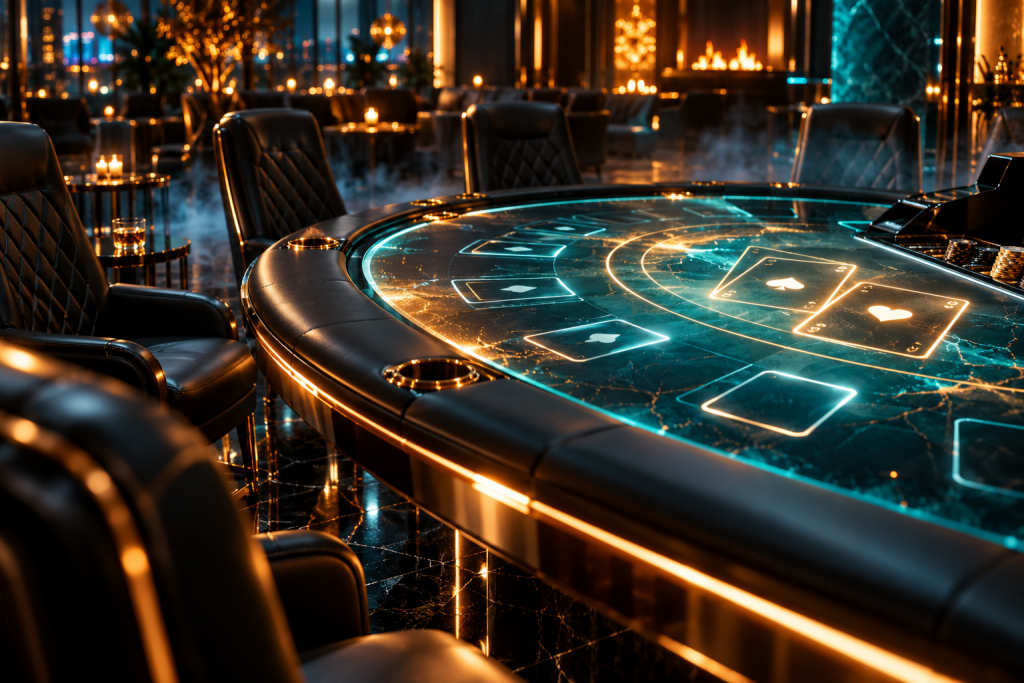
Electronic blackjack comes in several physical formats, and they are not all the same thing. A single-player video blackjack cabinet plays like a slot machine with a blackjack rule set on the screen. A multi-seat electronic table puts five or seven touchscreens around a shared virtual dealer. A stadium setup runs dozens of seats against one or two live dealers whose cards are shown on a big screen while players bet from terminals.
All of them use a random number generator to shuffle and deal, the same way an online blackjack game does. The rules are programmed into the software: deck count, dealer stand rule, doubling and splitting options, payout for a blackjack. What differs from machine to machine is which rule set was loaded in, and that matters more than the cabinet it sits in.
| Format | Dealer | Pace | Where it appears |
|---|---|---|---|
| Single-player video cabinet | Software only | Fast, player-driven | Slot floor, bar tops |
| Multi-seat electronic table | Virtual, on shared screen | Moderate, fixed timer per decision | Electronic table games area |
| Stadium blackjack | Live dealer on camera | Moderate to fast | Dedicated stadium pit |
| Live table with human dealer | Human | Slow, social | Main table games pit |
The dealer is a bigger part of the game than the cards
Blackjack is not a pure game of chance in the way a slot spin is. The player makes a decision on nearly every hand: hit, stand, double, split, sometimes surrender. A live dealer enforces those decisions at a human pace, reads the hand aloud, pays the winners, and gives the table a rhythm that machines have to simulate with timers and animations.
That rhythm matters to the casino's economics. A live table runs at maybe 60 to 80 hands per hour with a full table, slower with fewer players. An electronic table can run several times that pace because there is no physical card handling and no waiting for other players. Faster play means more decisions per hour, and more decisions per hour means more total wagers against the same house edge. The machine is not changing the edge; it is changing how often the edge is applied.
For the player, the same arithmetic applies in reverse. A session on a machine can compress two hours of table play into forty minutes. The expected loss per hand is identical under the same rule set, but the expected loss per hour is higher because the hour contains more hands. That is the single most important difference between the two formats, and it is rarely printed anywhere on the machine.
Why the floor still centres on live tables
A casino floor is a retail space, and table games are the showroom. Live blackjack tables sit in the middle of the pit because they draw a crowd, and a crowd draws more players. The felt, the chips, the dealer's patter, the other players groaning at a busted hand — none of that translates to a touchscreen. Casinos keep the live tables prominent because they sell the experience, not just the game.
Electronic blackjack exists because some players want the game without the table. Lower minimums are common on machines, since there is no dealer salary attached to each seat. A player who wants to bet small, play alone, or avoid the social pressure of a full table can do all three at a terminal. The machine is not a replacement for the table; it is a different product aimed at a different session style.
There is also a regulatory layer to this, though it varies by jurisdiction. Whether a given machine type may operate in a given venue turns on the rules set by the authority that oversees gaming there, and those rules change. This article does not decide the status of any named venue or device. The practical point is that the electronic formats you see on a floor are the ones the local rules permit, and the absence of a format in one place does not mean it is absent everywhere.
Rule sets matter more than the cabinet
Two blackjack machines sitting side by side can be different games. One may pay 3 to 2 on a blackjack, the other 6 to 5. One may let you double after splitting, the other may not. One may use six decks, the other eight. Each of those choices moves the house edge, and none of them is visible from across the room.
The only reliable way to know what you are playing is to open the game's information or help screen before you put money in. That screen lists the rule set, and from that rule set you can derive the correct basic strategy. Published strategy charts are not universal; they are built for a specific combination of deck count, dealer stand rule, and doubling and splitting permissions. A chart built for a game where the dealer stands on all 17s is slightly wrong for a game where the dealer hits soft 17, and the difference is real money over enough hands.
| Rule variant | What it changes | What to check on the machine |
|---|---|---|
| Blackjack payout | 3 to 2 pays more than 6 to 5 for the same hand | Paytable or info screen |
| Dealer soft 17 | Dealer hits or stands, shifting the edge | Rules screen, often abbreviated S17 or H17 |
| Double after split | Whether doubling is allowed on split hands | Rules screen |
| Number of decks | More decks generally raise the house edge slightly | Rules screen |
| Surrender | Late surrender lets you fold half your bet on bad hands | Rules screen; many machines omit it |
The sequence of a round on a machine
Playing electronic blackjack is mechanically simpler than a live table, but the decision points are the same. You load funds onto the terminal, choose your stake, and press deal. The software deals two cards to you and two to the dealer, one dealer card face up. You then work through your hand: hit to take another card, stand to keep your total, double to take exactly one more card and double your stake, or split a pair into two hands with a second stake.
The machine enforces the rules automatically. If you bust, the hand ends and the stake is collected. If you stand, the dealer's hidden card is revealed and the software draws dealer cards according to the programmed rule, typically standing on 17 or higher. The machine then compares totals and settles the bet. There is no misdeal, no dealer error, and no dispute about whether you signalled a hit. The trade-off is that the timer forces a decision pace, and there is no asking the dealer to slow down.
Procedural mistakes new players make
The first mistake is sitting down without reading the rule screen. On a live table, the felt prints the blackjack payout and the dealer will answer questions. On a machine, the rules are behind a button, and many players skip them. That is how someone plays an entire session on a 6 to 5 payout without noticing, or doubles on a hand the rules do not allow doubling on.
The second mistake is treating the machine's speed as harmless. Because the hands come quickly, a player who would never chase losses at a live table can find themselves pressing the rebet button through a long losing streak without pausing. The machine does not cause the losses, but it removes the natural pauses that a live table provides. Setting a session limit before the first hand, and sticking to it, matters more on a machine than on a felt table.
The third mistake is assuming every electronic blackjack game is the same game. A video blackjack cabinet with a side bet, a progressive jackpot, and a 6 to 5 payout is a very different proposition from a multi-seat table with a 3 to 2 payout and no side bets. The cabinet does not tell you which one you are playing; the rule screen does.
FAQ
Are electronic blackjack machines rigged differently from live tables?
The outcome of each hand on a machine comes from a random number generator, and the same mathematical house edge applies as on a live table with the same rules. What differs is pace and rule set, not the underlying fairness of the shuffle. Check the game's information screen for the exact rules before you play.
Why do blackjack machines often have lower minimum bets than tables?
A machine has no dealer salary, no pit supervision, and no physical chips to count, so the operator can offer a seat at a lower cost per hour. The lower minimum does not change the house edge; it changes how much you can wager per hand and how long a given bankroll lasts at the machine's faster pace.
Can I use a basic strategy card on an electronic blackjack machine?
Yes, and it is easier than at a live table because there is no social pressure and the timer gives you a fixed window to decide. The card must match the machine's exact rule set, especially the blackjack payout and the dealer soft 17 rule. A chart built for different rules will give you slightly wrong decisions.
Play responsibly
Gambling should be treated as paid entertainment, never as a way to earn income or recover losses. 1-800-MY-RESET (1-800-697-3738)
18+ or 21+ depending on where you are; follow the minimum age that applies to you.
This article is general information about how these mechanics work. It is not legal advice and not a recommendation to gamble or to use any particular operator. Availability and legality differ by jurisdiction — check the rules that apply where you are.