


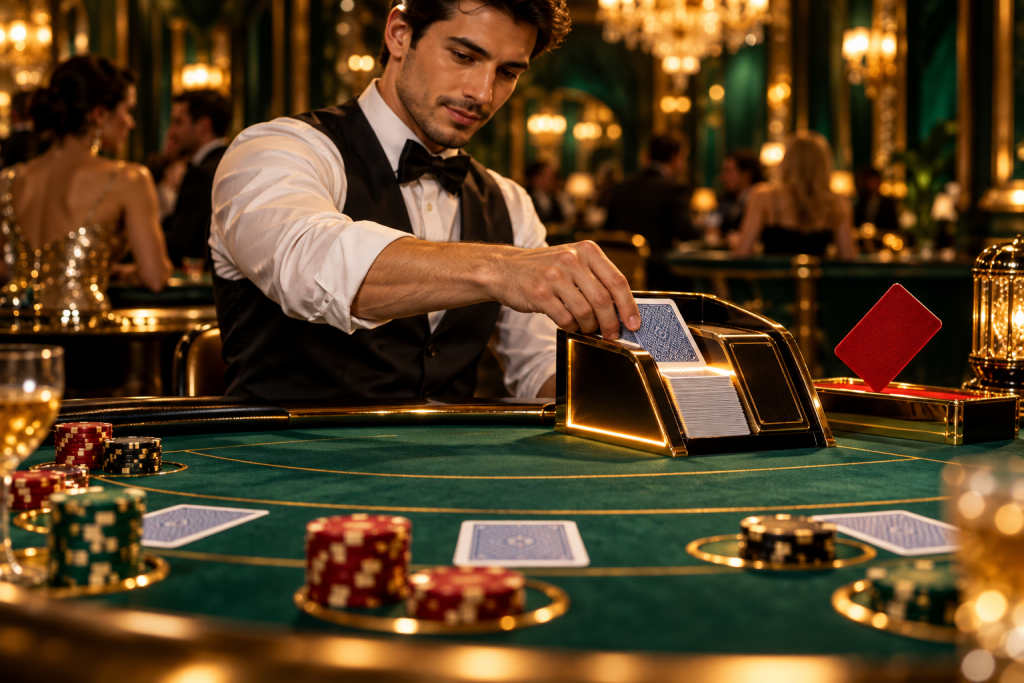
The Shoe Exists to Keep the Game Moving
A blackjack table with a multi-deck shoe is built around one idea: the dealer should spend as little time as possible not dealing cards. If the dealer stopped to shuffle after every single hand, a table would lose a large share of its hourly hands to shuffling. Players would sit through dead time, and the operator would take fewer wagers per hour on that table. The shoe is the answer. It holds several decks at once, lets the dealer pull cards continuously, and turns shuffling into an occasional event rather than a constant interruption.
The discard tray sits next to the shoe and does the other half of the work. Every card that has been played goes into the tray, face up in most venues, so that the order of discards is visible. The tray is not just storage. It is the physical record of how deep into the shoe the game has gone, and it is what tells the dealer when the next shuffle is coming.
How the Cut Card Sets the Shuffle Point
A plastic cut card is inserted into the stack of cards before play begins. The dealer places it somewhere in the shoe, usually after a shuffle, and then deals from the front of the shoe until that card appears. When the cut card comes out, the round in progress is finished, and then the dealer shuffles. The cut card is deliberately positioned so that a block of cards at the back of the shoe is never dealt. That block is called the penetration, and its size varies by venue and by table policy.
The cut card exists for two reasons. First, it makes the shuffle point predictable and consistent, so the dealer does not have to guess when the shoe is getting low. Second, it reduces the value of card counting as a practical matter. A player who tracks cards benefits from knowing which cards remain. The deeper the cut card sits, the more of the shoe gets dealt and the more information a tracker can accumulate. By cutting off the back portion of the shoe, the venue limits how much of the remaining deck composition is ever exposed to play.
What Changes When a Table Uses Fewer Decks
Not every blackjack table uses a large shoe. Some use a single deck or two decks, and on those tables the shuffle rhythm changes. A single-deck game is often shuffled after every round, or after very few rounds, because there are not enough cards to sustain a long dealing sequence. A double-deck game may be shuffled after roughly half the cards are gone, again depending on house procedure. The multi-deck shoe is the format where long stretches between shuffles are normal.
| Format | Typical shuffle rhythm | Why it differs |
|---|---|---|
| Single deck | After every round or after a very small number of rounds | Too few cards to sustain continuous dealing |
| Double deck | After a portion of the two decks is dealt, often around half | More cards than single deck, but still limited |
| Multi-deck shoe | When the cut card appears, leaving a block of undealt cards | Maximises hands dealt per hour and limits tracking |
The table above describes general practice, not a universal rule. Each venue sets its own shuffle procedure, and a player can always ask the dealer or read the table signage to see how the shoe is managed at that specific table.
The Discard Tray Is the Visible Half of the System
The discard tray matters because it lets anyone at the table see how much of the shoe has been played. The cards sit face up, stacked in the order they were discarded. A player who wants to know roughly how deep the shoe is can look at the tray and compare it with the remaining cards in the shoe. The dealer does the same thing when checking whether the cut card is near.
Some players misunderstand the discard tray as a sign that the casino is hiding something. It is the opposite. The tray is open and visible precisely because the game is dealt from a shoe in plain view. The shuffle is not delayed to conceal cards; it is delayed because the shoe is designed to deal many hands before a shuffle is needed. When the shuffle does happen, it is usually done in full view, often with a wash, a riffle, a strip and a cut, depending on house procedure.
Why the Shuffle Point Matters to a Player
The shuffle point changes nothing about the house edge on a single hand. Blackjack's return to player is a long-run statistical average, and it holds across the shoe as a whole. What the shuffle point changes is the amount of information available to a player who is tracking cards. The deeper the cut card sits, the more cards are dealt before the shuffle, and the more a tracker can refine an estimate of what remains. That is why venues set the cut card where they do, and why the placement can vary from one table to another even in the same building.
For a player who is not tracking cards, the shuffle point is mostly a question of rhythm. A shoe with a shallow cut means more shuffles per hour and slightly fewer hands. A shoe with a deep cut means longer dealing sequences and fewer interruptions. Neither is better in terms of expected value. The house edge on a given blackjack hand is determined by the rule set in use, not by how often the dealer shuffles.
Rule Set, Not Shuffle Timing, Sets the Edge
Blackjack is a comparing card game where the objective is a hand total closer to 21 than the dealer's without exceeding it. The decisions a player makes at the table matter, but only within the structure of the specific rules on that table. The number of decks, whether the dealer stands or hits on a soft 17, whether doubling after splitting is allowed, and whether surrender is offered all change the correct play in certain situations. Published basic-strategy charts derive from the exact rule set in use, not from a generic version of the game. A chart built for a six-deck shoe with the dealer standing on soft 17 will not be exactly right for a double-deck game where the dealer hits soft 17.
This is the connection between shuffling and strategy. The shuffle schedule determines how many cards are dealt from the shoe before the discards are gathered and reordered. The rule set determines what the correct decision is on any given hand. A player who wants to play correctly needs to know the rules at the table they are sitting at, and should treat any strategy chart as specific to those rules rather than universal.
Procedural Mistakes New Players Make Around the Shoe
The first mistake is touching the cards. In a shoe-dealt game, players do not touch the cards at all. The dealer pulls cards from the shoe and places them on the layout. A player who reaches for the cards will be corrected immediately, and repeated contact can get a player removed from the table. The cards are dealt face up in most shoe games, and the player signals decisions with hand gestures, not by handling the cards.
The second mistake is misunderstanding the cut card. Some new players think the cut card means the game is about to end, or that the appearance of the cut card is a signal to change their bet. It is neither. The cut card simply marks the point after which the current round will be the last before a shuffle. The cards dealt before the cut card appears are governed by the same rules as every other hand in the shoe.
The third mistake is assuming that a fresh shuffle resets something about the odds. It does not. A newly shuffled shoe has no memory, and the house edge on the next hand is the same as it was on the last hand of the previous shoe. The shuffle changes the order of the cards, not the mathematics of the game.
What the Dealer Does at the Shuffle
When the cut card appears, the dealer finishes the hand in progress, then collects the remaining cards from the shoe and the discards from the tray. The cards are then shuffled according to house procedure. Many venues use a multi-step process that includes spreading the cards on the table, riffling them, stripping them and then offering a cut. Some venues use automatic shufflers that do part or all of this mechanically. The shuffled cards go back into the shoe, the cut card is reinserted, and play resumes.
The shuffle is a procedural event, not a strategic one. It exists to reorder the cards so that no predictable sequence carries over from one shoe to the next. The reason it does not happen after every hand is simply that the shoe format makes frequent shuffling unnecessary, and the venue has no reason to stop dealing cards more often than it must.
FAQ
Does the casino shuffle less often to stop card counting?
The cut card placement is the main tool that limits card counting, because it keeps a block of cards at the back of the shoe out of play. The shuffle schedule itself is mostly about keeping the game moving. A venue can adjust the cut card depth to change how much of the shoe is dealt, and that adjustment changes how much information a tracker can accumulate.
Can I ask the dealer to shuffle early?
You can ask, but the dealer will almost always decline. The shuffle point is set by house procedure, and the dealer does not have discretion to shuffle on request. Some venues may shuffle early if a player leaves the table or if a new shoe is being opened, but that is a procedural decision, not a player-controlled option.
Does a fresh shuffle change my odds on the next hand?
No. The house edge on a blackjack hand is set by the rule structure of the table, not by the order of the cards in the shoe. A new shuffle reorders the cards, but the long-run mathematics of the game are unchanged. The next hand has the same expected value as any other hand under the same rules.
Play responsibly
Gambling should be treated as paid entertainment, never as a way to earn income or recover losses. 1-800-MY-RESET (1-800-697-3738)
18+ or 21+ depending on where you are; follow the minimum age that applies to you.
This article is general information about how these mechanics work. It is not legal advice and not a recommendation to gamble or to use any particular operator. Availability and legality differ by jurisdiction — check the rules that apply where you are.