


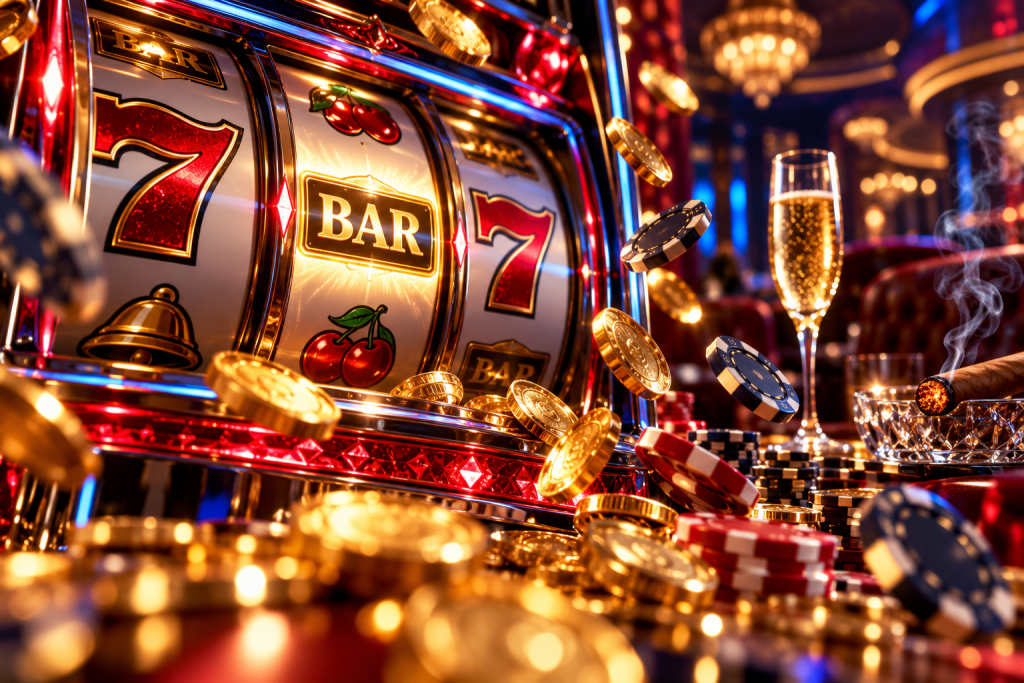
The bar symbol is older than the slot machine itself
Walk up to almost any slot machine, physical or digital, and you will see the same small cluster of symbols that has been there for over a century: cherries, lemons, bells, and the word BAR in block capitals. The fruit makes a kind of sense. The bar is the odd one out, and it is there because the earliest slot machines were not gambling devices in the modern sense at all. They were vending machines that paid out in chewing gum.
Before a machine could legally dispense coins as a prize, operators used a workaround. A spin that landed on a winning combination released a stick of fruit-flavoured gum, not money. The symbols on the reels showed what flavour you had won. A lemon paid a lemon gum. A cherry paid a cherry gum. And the BAR symbol stood for a bar of gum, or in some accounts a bar of chocolate, which was the highest-value prize the machine could hand over. When these machines were later adapted to pay cash, the reels kept their old pictures, and the bar stayed as the symbol for the top payout.
That is the short answer. The longer answer is that the bar has never stopped being a high-value symbol, and on a modern game it still carries a specific meaning you can read directly from the paytable.
What the bar meant on early machines
The first commercially successful slot machine appeared in the late nineteenth century and used playing-card symbols on its reels. The fruit and bar set came later, from a different line of machines designed to get around restrictions on cash payouts. These machines were built around the idea of a small automatic shop: you put in a coin, pulled the lever, and the machine gave you a product. The reels were the shop window.
The symbols worked as a simple hierarchy. A single cherry was the lowest prize, worth one stick of gum. Two cherries were worth more. The bar, usually rendered as a solid block with the letters BAR inside it, sat at the top of the payout scale, often alongside a bell. A line of three bars paid the machine's biggest prize, which is why the symbol still reads as premium to anyone who has spent time around slots.
When cash payouts replaced gum, the machines kept the same reel strips because players already recognised them. The bar did not need to mean anything new. It already meant the best result on the machine, and that association carried over into the first fully cash-based slots and then into the video slots that followed.
How the bar symbol works on a modern slot
On a current game, the bar is just one symbol among many, and its value is whatever the paytable says it is. There is no universal rule that a bar pays more than a cherry or less than a seven. The paytable is the only document that matters, and it is usually one tap or one button away on a digital machine, or printed on the glass of a physical cabinet.
What you will commonly see is a family of bar symbols rather than a single one. A game might have a single bar, a double bar, and a triple bar, each with a different payout. The triple bar is typically the most valuable of the three, and a full line of triple bars is often one of the highest-paying combinations on the reels. Some games also use stacked bars, where the symbol fills more than one position on a reel, or bars that act as part of a mixed combination with other classic symbols.
The table below shows how a paytable typically distinguishes bar variants, using placeholder values because every game sets its own numbers.
| Symbol | What it usually is | Where its value is stated |
|---|---|---|
| Single BAR | The lowest-value bar in a bar family | Paytable, usually as a multiple of the line bet |
| Double BAR | A mid-value bar, above single and below triple | Paytable, same format |
| Triple BAR | The highest-value bar; often near the top of the paytable | Paytable, same format |
| Stacked BAR | A bar symbol covering multiple reel positions | Paytable plus the game's information panel |
| BAR as a scatter | On some games, bars pay when they land anywhere, not only on a payline | Paytable rules section |
The point is not to memorise any of that. The point is that the bar symbol has kept its historical position as a high-value icon, but its actual payout is set per game and printed in the game's own documentation.
Symbols do not change how an outcome is decided
This is where a lot of confusion creeps in. A player sees three bars land and assumes the machine somehow chose to pay out, or that the bar symbol is what triggers a win. The symbols are only the display. The outcome of a spin is decided by a random number generator, the algorithm that determines game outcomes, before the reels stop. The symbols you see are the machine's way of showing you the result that the RNG already produced.
Each symbol is mapped to a range of numbers inside the RNG's output. When the RNG picks a number, the game looks up which reel position that number corresponds to and stops the reel there. The bar symbol is no more or less likely to appear than the mapping says it is, and the mapping is fixed in the game's programming. The player cannot influence it by timing the spin button, by stopping the reels manually, or by any pattern of play.
This is also why a machine that has not paid out for a while is not more likely to pay out on the next spin. The RNG has no memory of previous results. Each spin is an independent event, and the bar symbol's chance of landing is the same on every spin regardless of what happened before.
How to read the information panel and paytable
Every regulated slot game carries two pieces of documentation that answer almost every question a player could ask about it. The paytable lists every symbol, every winning combination, and the payout for each, usually expressed as a multiple of the line bet. The information panel, sometimes called the help or rules screen, carries the game's mechanical settings: how many paylines or ways-to-win it uses, what the bet range is, whether there are special features, and what the theoretical return is.
Return to Player, or RTP, is a theoretical percentage of total wagered money a game returns to players over a very large number of spins. It is a long-run statistical average, not a per-session guarantee. The house edge is the mathematical advantage the operator holds, and the two sum to 100% for the same game. If a game's information panel lists an RTP, that figure is the game's programmed long-run return. It does not tell you what your next session will do.
Volatility is a separate setting, and it is worth understanding because it explains what the bar symbol's presence does and does not mean. Volatility describes how payouts are distributed over time. High volatility means rarer but larger payouts; low volatility means more frequent but smaller ones. Volatility does not change a game's RTP. A high-volatility game with a big triple-bar payout has the same long-run return as a low-volatility game with the same RTP; it just delivers that return in a different rhythm.
Paylines and ways-to-win are the two main formats for deciding where a symbol has to land to count. A payline is a specific pattern across the reels that produces a paying combination. Fixed-payline games require betting all lines. Ways-to-win formats pay on adjacent-symbol combinations instead of fixed lines. The bar symbol's value is the same either way; only the position rules change.
Fixed and progressive jackpots change what a top symbol means
On a classic three-reel game, three bars might be the top prize, and that prize is fixed. On a modern video slot, the top prize might be a progressive jackpot that grows from a share of qualifying wagers and resets after a win. The bar symbol can sit anywhere in that hierarchy.
Fixed jackpots pay a set amount. Progressive jackpots grow from a share of qualifying wagers and reset after a win. Progressive contributions are typically taken out of the game's return, and some progressives require a maximum-stake bet to qualify. If a game has a progressive, the information panel will say so, and it will state whether the jackpot is available on every spin or only at certain stakes. The bar symbol's own payout is listed separately in the paytable, and it does not change just because a progressive sits above it.
What stake size and volatility do and do not change
A common question is whether betting more makes the bar symbol more likely to land, or whether a high-volatility game is more likely to pay out on the next spin. Neither is true. Stake size changes the amount you wager and therefore the amount a winning combination pays, because payouts are usually expressed as multiples of the line bet. It does not change the probability of any symbol landing. The RNG does not know how much you have bet.
Volatility changes the shape of the session, not the long-run return. A high-volatility game will tend to produce longer stretches without a win and then a larger payout when one comes. A low-volatility game will produce more frequent but smaller wins. If both games have the same RTP, the expected loss over a very large number of spins is the same. What differs is how much your balance swings in the short run.
No play pattern alters the programmed return. No betting progression, no stopping strategy, no timing of the spin button changes the RNG's mapping or the game's house edge. The bar symbol is a piece of history and a visual shorthand for a high-value result, but it is not a lever the player can pull in any sense beyond the physical one.
FAQ
Does the bar symbol pay more than other symbols?
Not automatically. On many classic-style games the triple bar is among the highest-paying symbols, but the paytable is the only source that states the actual value. A game can assign any payout to any symbol.
Why do fruit machines use bars and fruit instead of numbers?
The symbols come from early machines that dispensed flavoured gum instead of cash. The fruit showed the flavour, and the bar stood for a bar of gum or chocolate, which was the machine's top prize. The imagery stuck when machines switched to cash payouts.
Can I tell a slot's volatility from its symbols?
No. Volatility is a game setting, not something the symbols reveal. The information panel or the game's published documentation is where volatility and RTP are stated, and many games do not publish volatility at all.
Play responsibly
Gambling should be treated as paid entertainment, never as a way to earn income or recover losses. 1-800-MY-RESET (1-800-697-3738)
18+ or 21+ depending on where you are; follow the minimum age that applies to you.
This article is general information about how these mechanics work. It is not legal advice and not a recommendation to gamble or to use any particular operator. Availability and legality differ by jurisdiction — check the rules that apply where you are.