


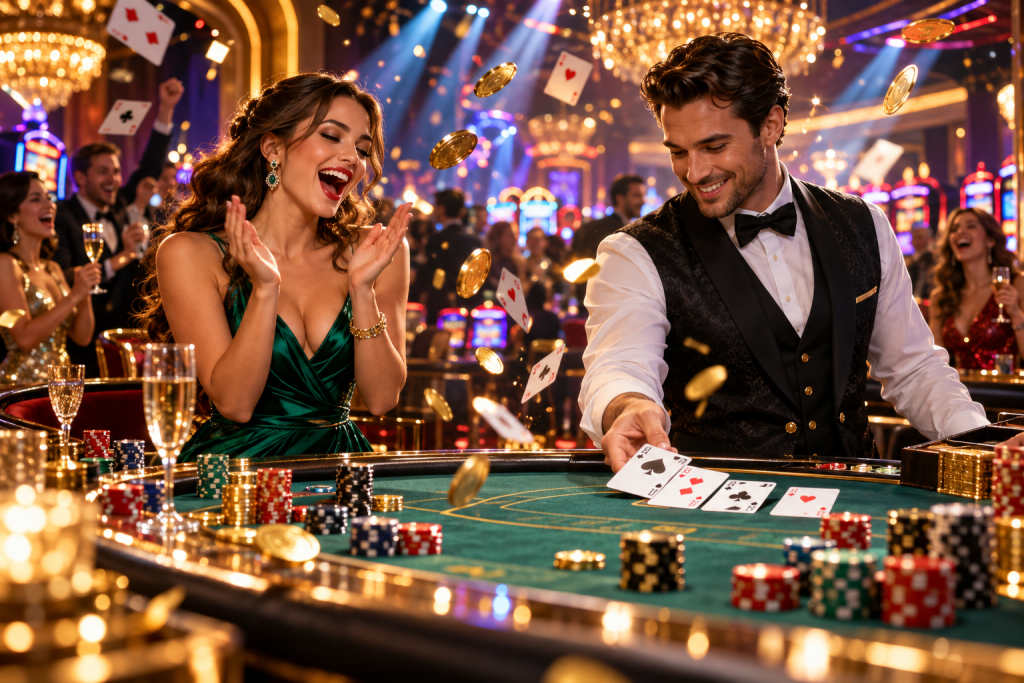
The Clap You Hear Is Not Part of the Game
Walk past a busy blackjack table or a packed sportsbook when a big result lands and you will hear it: a burst of clapping, sometimes scattered, sometimes rolling through the whole section. Nothing in the rules of blackjack or the mechanics of a sports bet requires applause. The clap is a human layer on top of the game, and it means different things depending on where it happens and who starts it.
At a blackjack table the clap usually follows a specific moment. A player who has been losing for an hour hits a double down and draws the exact card they needed. A dealer busts when the whole table has large bets out. Someone wins a side bet that pays a long shot. The table has been tense, and the clap releases that tension. It is a way for players to mark a shared result without saying anything, because at a live table the result belongs to everyone who had money on that hand.
At a sports betting counter or in a sportsbook bar, the clap works differently. A bettor who has been riding a parlay sees the final leg hit. A group of friends who pooled a futures ticket watches the last seconds of a game. The clap is a celebration of a win that has just become real, but it is also a performance. Other people in the room are watching, and the clap tells them something happened that mattered to someone.
What the Applause Signals
The clap is rarely about the house. It is about the players and the bettors. In a live casino, applause is one of the few ways players can communicate across tables without leaving their seats or shouting over the ambient noise of slots and announcements. It carries a few distinct meanings.
First, it marks a reversal. Blackjack is a game of streaks in the short run, even though the house edge stays fixed on every hand. A table that has been cold can turn, and when it does, the players who stayed through the cold streak often clap for each other. The clap says: we were here for this, and now it changed.
Second, it rewards a bold decision. Doubling down or splitting against a strong dealer card is a decision that can go badly. When it works, the table often claps because the player took a risk the others could see. The clap is not about the money alone; it is about the nerve.
Third, it is a social lubricant. A table full of strangers can stay silent for hours. A clap breaks that silence and gives people permission to talk, to high-five, to order another round. In a sportsbook, the same thing happens when a long-shot bet hits. The clap invites other bettors to ask what the ticket was, and the winner gets to tell the story.
Where the Clap Comes From
Casino applause is not a formal ritual with a rulebook. It grows out of the same impulse that makes people clap at a concert or a football match: a moment of collective attention that resolves in someone's favour. But casinos shape that impulse in specific ways.
Live table games are slow and visible. Everyone at the table sees the cards, the bets, and the dealer's upcard. There is no screen between the players and the outcome. That visibility makes a big win feel public, and public moments invite public reactions. A slot player who hits a jackpot is often alone in front of a machine; a blackjack player who wins a big hand is surrounded by people who watched it happen.
Sportsbooks amplify the same effect. A wall of screens shows dozens of games at once, and a group of bettors is often watching the same game. When the game ends, the result is simultaneous for everyone. The clap is a way of saying that one person's ticket just came in, and the rest of the room recognises the moment.
Dealers and floor staff usually tolerate the clap and sometimes join it lightly. It is good for the room's energy, and a lively table attracts more players. But the clap is never required, and no one is expected to clap for a hand they lost.
Blackjack Clapping vs Sports Betting Clapping
The same sound means slightly different things in the two settings, and the difference is worth understanding if you are new to either one.
| Setting | What triggers the clap | Who claps | What it communicates |
|---|---|---|---|
| Blackjack table | A big hand, a successful double or split, a dealer bust that saves the table | Players at the table, sometimes the dealer | Shared relief, respect for a bold play, a shift in table mood |
| Sportsbook or betting counter | A winning ticket, a parlay hitting, a long-shot result | The bettor and their group, sometimes nearby strangers | Celebration, a public claim on a win, an invitation to share the story |
| Casino floor generally | A jackpot announcement, a big roulette hit, a craps table on a roll | Anyone within earshot | Recognition that something notable just happened |
The blackjack clap is usually quieter and more localised. The sports betting clap is often louder and more performative, because the bettor has been waiting longer and the win is tied to a specific ticket rather than a single hand.
Why New Players Find It Confusing
If you have never played at a live table, the clap can feel like a code you do not understand. It is not. No one is clapping at you, and no one expects you to clap back. The applause is a spontaneous reaction, not a test of belonging.
What confuses new players is the timing. A hand can end with the dealer paying out several players at once, and the clap starts before anyone has collected their chips. That is because the players can already see the result: the dealer's bust card is on the felt, the payouts are being counted, and the tension has broken. The clap is the release, not the confirmation.
In a sportsbook, the confusion is different. A bettor may clap for a result that means nothing to anyone else in the room, because the bet was a player prop or a total that only matters to that ticket. The clap is not a signal that the game is over; it is a signal that one person's wager just resolved.
When the Clap Is Not What It Seems
Not every clap in a casino is genuine celebration. Some of it is performance, and some of it is noise.
A player who claps loudly after a modest win may be trying to draw attention to themselves, to mark themselves as a winner in front of other players or a companion. A group that claps in a sportsbook after a small cash may be performing for social media or for the room. None of this is against the rules, but it is worth reading the room before you join in.
There is also a practical side. A loud, prolonged clap at a table can slow the game down, and dealers are trained to keep the game moving. A brief clap is fine; a celebration that turns into a speech or a victory lap is not. The house wants the next hand dealt, and the other players want to keep their rhythm.
What the Clap Does Not Mean
It is important to be clear about what the applause does not signal. It does not mean the game is now hot, loose, due, or more likely to pay. A blackjack table that just paid out a big hand has the same house edge on the next hand as it did on the previous one. A sportsbook that just saw a long-shot winner has not become easier to beat. The clap is a social event, not a statistical one.
It also does not mean the casino is losing money in any meaningful sense. A single big payout at a table or a single winning ticket is one outcome in a long series. The operator's edge is built into the pricing of every hand and every bet, and it does not move because a room full of people clapped.
If you find yourself wanting to clap, go ahead. If you find yourself wanting to bet more because other people are clapping, that is a different impulse, and it is worth noticing it for what it is.
FAQ
Is clapping at a blackjack table considered rude?
No, a brief clap after a big hand is generally accepted and often welcomed. It becomes a problem only when it is loud enough to disrupt the game, when it goes on too long, or when it is aimed at another player's loss. A short, genuine reaction is part of the live table atmosphere.
Do dealers clap for players?
Sometimes, lightly. A dealer may tap the table or give a small clap after a player wins a dramatic hand, especially if the whole table was involved. It is a social gesture, not a statement about the game's odds or the house's position. Dealers are not rooting for or against the players; they are managing the game.
Why do people clap in a sportsbook when their bet is not even that big?
Because the clap is not about the amount. It is about the resolution. A bettor who has been waiting hours, or who hit a long-shot leg of a parlay, is marking the moment the uncertainty ended. The size of the win matters less than the fact that the ticket is now a winner, and the clap is a way of making that public.
Gambling involves risk. Please only gamble with funds you can comfortably afford to lose. While we do our best to provide good information, we cannot guarantee it is always correct or up to date. Gambling can be addictive; please play responsibly and only bet what you can afford. For help, advice and support, visit BeGambleAware.org, GamCare.org.uk or GamblersAnonymous.org.
Play responsibly
Gambling should be treated as paid entertainment, never as a way to earn income or recover losses. 1-800-MY-RESET (1-800-697-3738)
18+ or 21+ depending on where you are; follow the minimum age that applies to you.
This article is general information about how these mechanics work. It is not legal advice and not a recommendation to gamble or to use any particular operator. Availability and legality differ by jurisdiction — check the rules that apply where you are.