


The Shoe Is a Cost-Control Device, Not a Tradition
A blackjack table that reshuffled after every single hand would play far fewer hands per hour. The dealer would spend more time gathering, squaring, riffling, and cutting the cards than dealing them. A casino's revenue on a table game is a function of decisions per hour multiplied by the average edge on each decision. Slow the game down and the same table earns less, while still costing the operator the same floor space, the same dealer's wages, and the same supervision. The multi-deck shoe exists to keep the cards moving.
There is a second reason that has nothing to do with speed. A freshly shuffled shoe produces a known starting condition: every card is present exactly once. The fewer cards that have been dealt from that shoe, the more predictable the remaining composition is to anyone tracking it. A player who knows which cards have already appeared can estimate which cards remain, and that changes the mathematics of every subsequent hand. The shuffle point determines how much of that information is ever available.
What the Shuffle Point Controls
In a hand-shuffled game, the dealer does not deal all the way to the bottom of the shoe. A plastic cut card is inserted into the stack, and when the deal reaches that card, the round finishes and the dealer shuffles. The distance between the cut card and the end of the shoe is called the penetration. Deeper penetration means more cards are dealt before the shuffle, which gives a card tracker a longer window of usable information. Shallower penetration means the shoe is shuffled sooner, which shortens that window.
This is the real answer to the question. Casinos do not shuffle after every hand because the shuffle is not purely a fairness mechanism. It is also the reset point for the deck's composition. A casino that shuffled after every hand would eliminate card tracking entirely, but it would also destroy the game's throughput. Instead, operators choose a penetration depth that balances speed against information exposure. The cut card placement is one of the few table-game settings that a pit boss can adjust, and it is adjusted for exactly this reason.
| Shuffle timing | Hands per hour | Information available to a tracker | Where you see it |
|---|---|---|---|
| After every hand | Lowest | None beyond the current hand | Rare, mostly single-deck pitch games with very shallow dealing |
| At a cut card, shallow penetration | High | Short window, low value | Common on multi-deck shoes |
| At a cut card, deep penetration | High | Long window, higher value | Less common; watched more closely by floor staff |
| Continuous shuffling machine | Highest | Effectively none across rounds | Common on lower-limit tables and many online live-dealer games |
Continuous Shuffling Machines Solve the Same Problem Differently
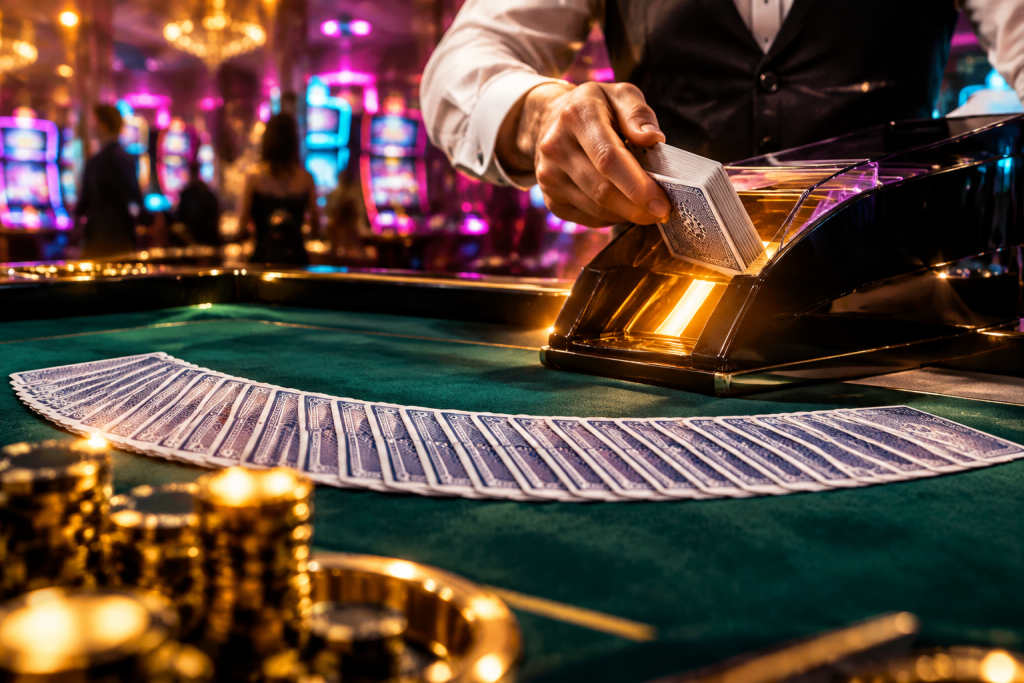
Some tables do effectively shuffle after every round, just not by hand. A continuous shuffling machine, or CSM, accepts the discards back into the mechanism after each hand and feeds them into the shoe in a way that keeps the deck in constant motion. The dealer never stops to perform a manual shuffle. The game runs at or near maximum speed, and because cards are reinserted continuously, tracking the remaining composition across rounds becomes impractical.
A CSM is not a rigged device. It is a throughput device with a side effect that the operator finds convenient. The same card-counting logic that makes deep penetration attractive to a skilled player makes continuous shuffling attractive to a house that wants to remove that variable from the table. The trade-off is player perception: some players simply prefer a hand-shuffled shoe, and operators know that. You will often find CSMs on lower-stakes tables where volume matters most, and hand-shuffled shoes on higher-limit tables where the clientele expects a traditional presentation.
The Shuffle Does Not Change the House Edge
It is worth being precise about what shuffling does and does not alter. The house edge on a blackjack hand is a function of the rules in force: how many decks are in the shoe, whether the dealer stands or hits on soft 17, whether doubling after splitting is allowed, whether surrender is offered, and what blackjack pays. The shuffle point does not change any of those rules. A hand dealt from a fresh shoe has the same built-in edge as a hand dealt from a shoe that is three-quarters spent, assuming the player is not varying their bets or decisions based on the remaining cards.
What the shuffle point changes is the information a player can act on. A card tracker who knows that the remaining shoe is rich in tens and aces can raise their bet and alter their strategy decisions, because the conditional expectation of the next hand has shifted. The shuffle resets that conditional expectation to the shoe's starting composition. The base game has not changed; the player's ability to exploit a temporary imbalance has been cut off. That is why penetration is discussed so carefully by people who study the game, and why it is monitored so carefully by the people who run it.
Why the Dealer Still Shuffles at All
If continuous shuffling removes the tracking concern and speeds up the game, a reasonable question is why any table still uses a manual shuffle. Part of the answer is equipment cost and maintenance. A CSM is an expensive electromechanical device that requires service, and not every pit wants that dependency. Part of it is tradition and atmosphere: the sound of a riffle and the visible cut are part of the ritual that many players expect from a table game. And part of it is commercial segmentation. A high-limit player who wants a hand-shuffled six-deck shoe with deep penetration is a customer the casino wants to keep comfortable, even if that comfort comes with a slightly longer information window for anyone skilled enough to use it.
For the ordinary player, none of this changes how a hand is played. The object of blackjack remains the same whether the cards come from a CSM, a six-deck shoe, or a single deck: finish with a hand total closer to 21 than the dealer's without exceeding it. The decisions are the same. What changes is the pace of the game and the amount of composition information that survives from one round to the next.
Reading the Table Before You Sit Down
If you want to know how a given table handles shuffling, the information is visible before you buy in. A CSM is a physical machine built into the table to the dealer's left or right, with the shoe feeding out of it. A hand-shuffled shoe is a wedge-shaped box from which the dealer pulls cards, with a separate discard tray. The cut card is a solid-coloured plastic card, usually red or yellow, that the dealer inserts into the stack after the shuffle. Where that card sits relative to the back of the shoe tells you the penetration at a glance.
The table's placard will state the number of decks in use, and the dealer will answer a direct question about shuffle procedure if you ask before the first hand. None of this requires any special knowledge. It is the same information a pit boss uses to manage the game, and it is posted or visible at every table.
FAQ
Does shuffling after every hand make blackjack fairer?
No. The fairness of the game comes from the rules and the random order of the cards, not from how often the order is reset. A hand dealt from a spent shoe is just as random as one dealt from a fresh shuffle, because the dealing order is still determined by the shuffle that created it. Shuffling more often removes information between rounds; it does not make any individual hand more or less fair.
Can a casino shuffle whenever it wants to disrupt a winning player?
The shuffle point is set by the cut card, and the dealer follows that point consistently. A pit boss can call for an early shuffle in some circumstances, such as when a card is exposed or a shoe is suspected of being miscounted, but a dealer does not reshuffle simply because a player is winning. The house edge does not depend on stopping a winning streak, and the shuffle is not a tool for that purpose.
Do online blackjack games shuffle after every hand?
Most online blackjack games use a random number generator that effectively reshuffles the virtual deck for every hand, because there is no physical shoe to exhaust. Live-dealer online games, by contrast, deal from a physical shoe or a CSM on camera, so the shuffle behaviour matches what you would see at a land-based table. The rules panel for each game states which format is in use.
If you or someone you know is experiencing problems with gambling, help is available. Contact local support services or visit responsible gambling resources in your jurisdiction. Play only with money you can afford to lose.
Play responsibly
Gambling should be treated as paid entertainment, never as a way to earn income or recover losses. 1-800-MY-RESET (1-800-697-3738)
18+ or 21+ depending on where you are; follow the minimum age that applies to you.
This article is general information about how these mechanics work. It is not legal advice and not a recommendation to gamble or to use any particular operator. Availability and legality differ by jurisdiction — check the rules that apply where you are.