


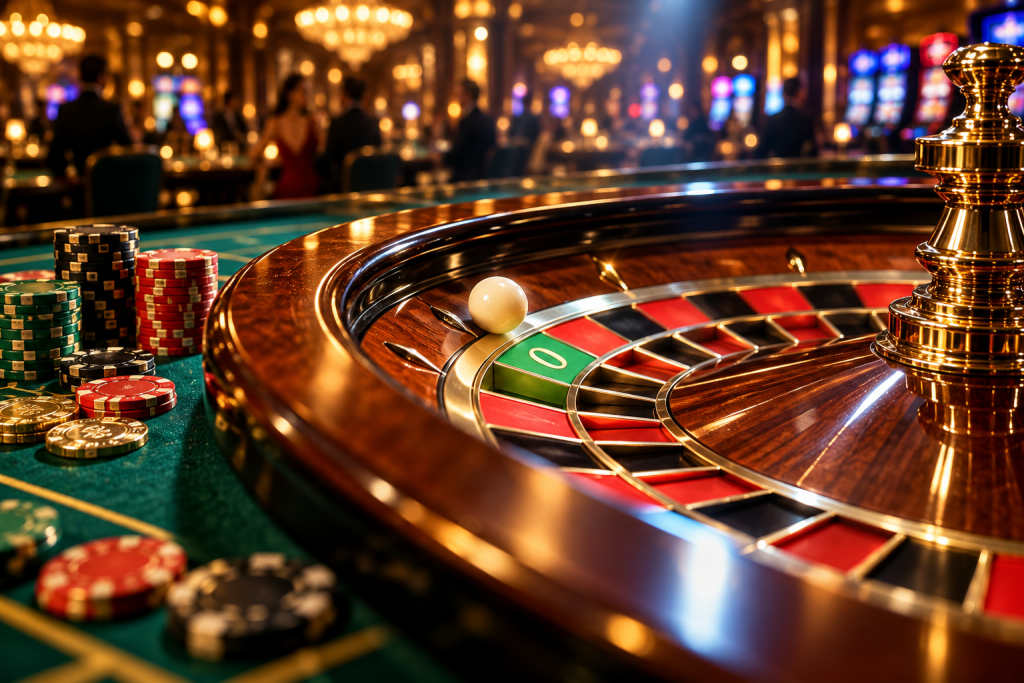
The pocket count is the whole argument
When a player says one roulette wheel has better odds than another, they are almost always comparing a wheel with a single zero against a wheel with a zero and a double zero. The difference is not the layout, the dealer, or the felt colour. It is the number of losing pockets on the wheel, and that number changes the arithmetic on every bet placed.
A European wheel has 37 pockets, numbered 0 through 36, with one zero. An American wheel has 38 pockets, with a 0 and a 00 added to the same 1 through 36 sequence. The extra pocket is not a neutral addition. It is a house pocket that sits outside every outside bet, every column, and every straight-up number, and it is the reason the two wheels carry different edges.
Roulette pays winning bets as if the zero pockets did not exist. A straight-up number pays 35 to 1, but on a European wheel there are 37 pockets, so the payout is short by one unit relative to the true odds. On an American wheel there are 38 pockets, so the same 35-to-1 payout is short by two units. That shortfall is the house edge, and it is larger wherever there are more zero pockets.
How the edge is built into each bet
The house edge is not a fee displayed at the table. It is the gap between the payout a bet offers and the payout that would make the bet fair given the number of pockets. A fair game would pay every winning bet at odds that exactly match the probability of winning. Roulette never does. It pays at odds calculated from 36 numbers while the wheel carries 37 or 38.
Suppose, as an example, a player places one unit on a straight-up number on a European wheel. The chance of winning is 1 in 37. The payout is 35 to 1. Over a very large number of identical bets, the player receives 35 units back for every 37 units wagered on average, while the house retains 2 units. That retained share is the edge, and the same logic applies to every bet on the layout.
On an American wheel the identical bet faces a 1 in 38 chance while still paying 35 to 1. The house now retains 3 units for every 38 wagered on average. The player has not changed anything about the bet. The wheel changed, and the expected loss per unit went up with it.
RTP and house edge under one rule set
Return to Player, or RTP, is the complement of the house edge for the same bet under the same rule set. If a game returns a certain percentage of wagers over a very large number of spins, the house keeps the remainder. The two figures always sum to 100% for the same bet on the same wheel.
A single-zero wheel returns more to players over the long run than a double-zero wheel because the house retains less on every spin. The exact percentage depends on the bet, but the relationship between the two wheels is consistent: removing the double-zero pocket reduces the house edge on every wager placed on that layout.
Volatility does not change this. A straight-up number is high volatility because it pays rarely and pays a large multiple when it hits. An even-money bet is lower volatility because it pays often and pays one unit. Both bets carry the same house edge on the same wheel, because the edge comes from the zero pockets, not from how often a particular bet wins.
| Wheel type | Pockets | Zero pockets | Effect on the edge |
|---|---|---|---|
| European | 37 | 1 | Lower house edge on every bet |
| American | 38 | 2 | Higher house edge on every bet |
Why short sessions look nothing like the long-run average
The edge is a long-run statistical average, not a per-session guarantee. A player can win on a double-zero wheel and lose on a single-zero wheel in any given hour. The edge does not promise a result on any particular spin, and it does not deliver a predictable outcome over twenty or fifty spins. It expresses what happens to the total amount wagered as the number of spins grows very large.
Variance is what a player feels in a short session. A straight-up number can miss for a hundred spins and then hit twice in ten, and neither streak changes the underlying edge. The wheel is not due, hot, or loose. The zero pockets sit on the wheel on every spin, and the payout stays short on every spin, regardless of what the last ten results looked like.
What a player can control is how much total money passes across the felt. Every spin is a separate wager, and the edge applies to each one. A slower game with fewer spins per hour exposes less total money to the edge in that hour. A faster game with larger bets exposes more. The edge itself is fixed by the wheel; the total exposure is set by the player's decisions.
What decisions per hour do to total exposure
Roulette is a game of repeated independent bets. The wheel has no memory, and the edge applies to every unit wagered. If a player places one unit per spin, the expected loss over a large number of spins is the edge multiplied by the number of units wagered. The number of spins per hour depends on the table, the dealer, and the player's own pace, and it is one of the few variables a player controls.
Suppose, as an example, a player wagers one unit per spin on a wheel with a house edge of 2.70%. Over 100 spins, the total wagered is 100 units, and the expected loss is 2.70 units. Over 200 spins at the same stake, the total wagered is 200 units, and the expected loss is 5.40 units. The player has not changed the odds. The player has doubled the amount of money exposed to the same edge.
Bet selection also matters, but not in the way a newcomer might expect. Different bets on the same wheel carry different payout structures, but on a standard single-zero layout the house edge is the same across most bet types. The difference between a straight-up number and an even-money bet is volatility, not edge. A player choosing a lower-volatility bet is choosing a different distribution of outcomes, not a better rate of loss.
Why progression systems redistribute outcomes instead of removing the edge
A progression system changes the size of each bet according to the previous result. The most familiar version doubles the stake after a loss, on the theory that a win will eventually recover all prior losses plus one unit. The system feels persuasive because it works often in the short run. It fails as a method for changing the odds because it does not alter the wheel.
The edge is charged on every unit wagered, not on every session. A progression increases the total amount wagered, and therefore increases the total expected loss, even though it also increases the chance of ending a short session ahead. What the system does is redistribute outcomes: many small wins and a small number of very large losses, instead of a steadier distribution. The average result over a very large number of sessions still reflects the edge on the total amount wagered.
No betting pattern changes the built-in edge of a negative-expectation game. A player can change the wheel they play, the bets they place, the speed of play, and the size of their stakes. Those choices change the total exposure and the shape of the variance. They do not remove the zero pockets from the wheel.
What to check before sitting down
The wheel type is printed on the layout or shown on the table sign, and online games display it in the information panel. A single-zero wheel is the better choice for a player who wants the lower house edge, all else equal. A double-zero wheel is the worse choice for the same player, because the extra pocket increases the expected loss on every bet without changing the payouts.
The table minimum and maximum also matter, because they set the range of stakes a player can place. A player who wants to slow the game down can choose a fuller table, place fewer bets per spin, or step away between spins. None of these change the edge, but they change how much money passes across the felt in an hour.
The honest answer to why a single-zero wheel offers better odds is that it removes one losing pocket from the wheel, and that single change lowers the house edge on every bet placed. The odds still favour the house on every spin. The question is only how much, and the single-zero wheel takes less.
FAQ
Does a single-zero wheel change the payout on a straight-up number?
No. A straight-up number pays 35 to 1 on both a single-zero and a double-zero wheel. The payout is identical. What changes is the chance of winning, because the single-zero wheel has one fewer pocket that can beat the bet.
Is every bet on a single-zero wheel better than the same bet on a double-zero wheel?
Yes, for the same bet under the same rule set. Removing the double-zero pocket reduces the house edge on every wager on the layout. The size of the improvement is the same in percentage terms across the standard bets, because the edge comes from the zero pockets rather than from the bet itself.
Can a player overcome the single-zero edge with a betting system?
No. A betting system changes the size and sequence of wagers, not the wheel. The edge is applied to every unit wagered, so a system that increases total wagers also increases total expected loss over the long run, even though it may produce more frequent small wins in the short run.
Gambling involves risk. Please only gamble with funds that you can comfortably afford to lose. While we do our best to provide good quality information, we cannot be held responsible for any loss you may incur from gambling. We do not bet on our own games, nor can we guarantee wins. All content is for informational purposes only. If you or someone you know needs help, contact a responsible gambling organisation in your area.
Play responsibly
Gambling should be treated as paid entertainment, never as a way to earn income or recover losses. 1-800-MY-RESET (1-800-697-3738)
18+ or 21+ depending on where you are; follow the minimum age that applies to you.
This article is general information about how these mechanics work. It is not legal advice and not a recommendation to gamble or to use any particular operator. Availability and legality differ by jurisdiction — check the rules that apply where you are.