
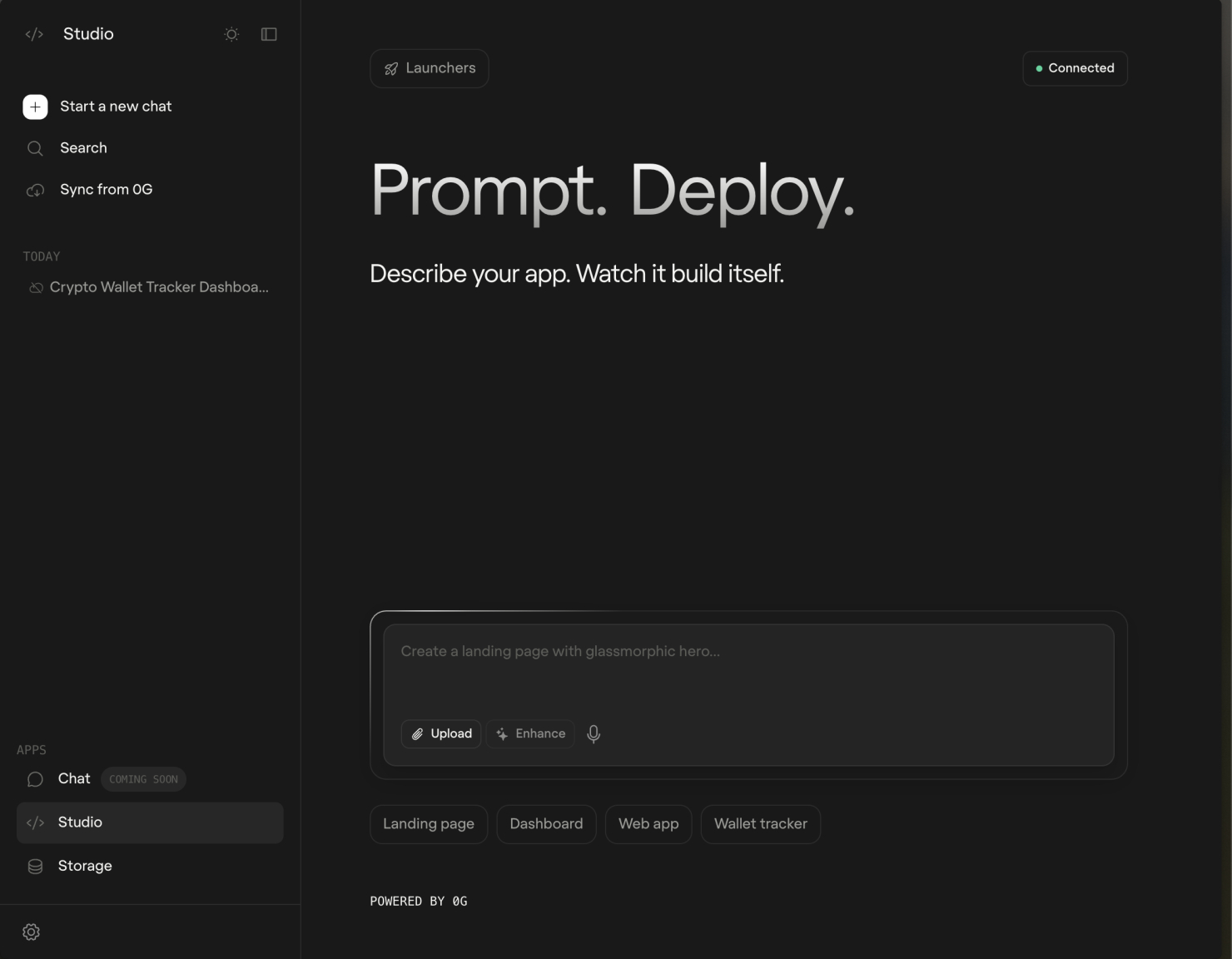
0G Labs has launched 0G App, a consumer-facing AI development platform designed to let users build applications with natural-language prompts instead of code. The product brings together decentralized compute, Trusted Execution Environment (TEE) verification, AI agent deployment, and token-based economics inside a single workflow for creating, editing, previewing, and deploying apps.
Targeting the gap between ease of use and decentralization
The company frames the launch around the rise of “vibe-coding” tools, which allow people to generate applications through plain-language instructions. Those products have lowered the barrier to software creation, but 0G Labs argues that heavy reliance on centralized cloud providers has raised concerns around data privacy, vendor lock-in, and model opacity. At the same time, crypto-native infrastructure still tends to require more technical skill and fragmented tooling.
0G App is positioned as an attempt to close that gap. Users can describe an application idea in simple language, watch the output take shape inside an integrated development environment, and iterate on the result. At launch, the platform supports templates for landing pages, dashboards, and full web applications. It also includes reference-file uploads, prompt refinement, and voice input.
TEE-backed AI execution sits at the center of the stack
On the infrastructure side, 0G App runs on decentralized compute and applies TEE verification to supported AI models. According to the company, inference workloads are handled inside secure hardware enclaves using Intel TDX and NVIDIA H100/H200 infrastructure. The point of that design is to make privacy and verifiability part of the hardware-backed system rather than relying only on platform policy.
At release, the platform will include GLM-5, a model developed by Zhipu AI. 0G Labs described it as an open-source model with 744 billion parameters operating inside a TEE-protected environment.
Launcher Hub expands the product beyond app generation
0G App also introduces a framework called Launcher Hub, which extends the platform across more stages of the development lifecycle. App Launcher is built around a prompt-to-app workflow with live preview and revision tools. Claw Launcher, available at launch, allows users to deploy dedicated AI agents backed by OpenClaw and the 0G compute layer in one click. Token Launcher is listed as a future feature that will guide users through token creation on 0G Chain.
With those modules in place, the company says users can build, launch, and expand projects without leaving the platform.
Web2-style deployment paired with onchain infrastructure
To keep the experience familiar, 0G App includes one-click deployment through Vercel. Project data is synced to 0G’s decentralized storage layer and can be restored through a root hash. Usage of compute resources is directly tied to the $0G token, and wallet connectivity is available at launch so users can access services and manage payments inside a native crypto framework.
Founder and CEO Michael Heinrich said the company’s goal is to make AI development more accessible while building privacy and decentralization into the platform from the start.
Funding, mainnet timeline, and exchange listings
In its company background, 0G Labs said it has secured $40 million in seed funding and $250 million in token purchase commitments. Named backers include Hack VC, Delphi Digital, OKX Ventures, Samsung Next, and Bankless Ventures. The broader stack under development includes an EVM-compatible Layer 1 blockchain, decentralized compute, distributed storage, and a data availability layer.
The company said its Aristotle mainnet is expected to launch in September 2025. Its partner network includes Chainlink, Google Cloud, and Alibaba Cloud, while the $0G token is already listed on Binance, OKX, Bybit, and Gate.io.