


From 'Improving the Map' to Robot Navigation Engine
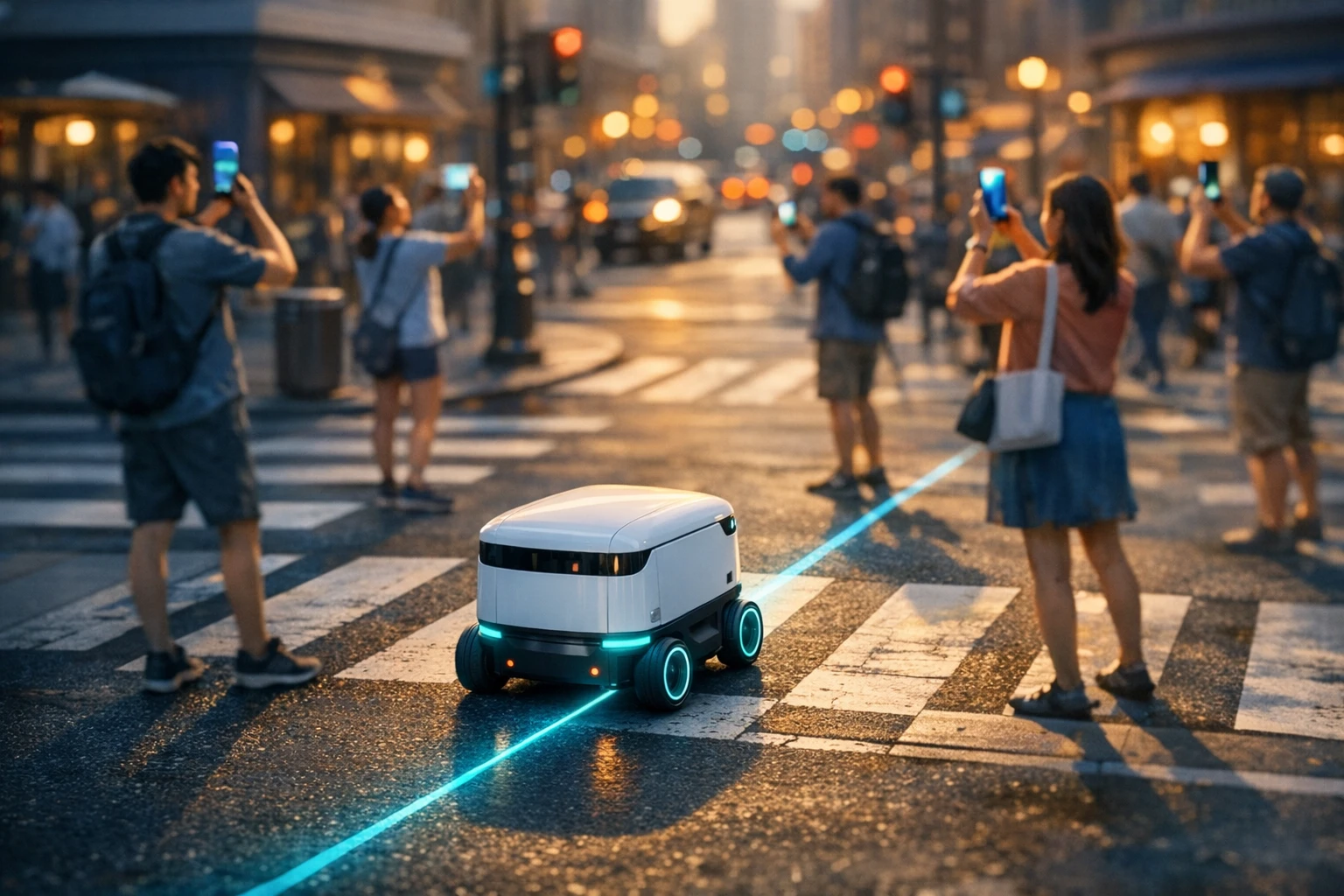
Since its 2016 launch, Pokémon Go quietly included a feature: players could voluntarily scan nearby public landmarks (statues, buildings, monuments) to "improve the game map." Over ten years, this system trained a Visual Positioning System (VPS) on over 30 billion images. In February, Niantic Spatial, the spatial tech subsidiary, partnered with Los Angeles-based Coco Robotics. Coco operates roughly 1,000 autonomous delivery robots across Los Angeles, Chicago, Miami, and Helsinki, each roughly suitcase-sized and capable of carrying 8 large pizzas or 4 grocery bags.
The pain point VPS solves: GPS signals degrade in dense urban canyons and fail in narrow alleys. By comparing live camera feeds against pre-built visual maps, VPS achieves centimeter-level precision — letting a robot stop exactly at a restaurant door instead of hitting a parking post.
Niantic's Pivot: Game Company Becomes Spatial Data Company
In May 2025, Niantic Spatial spun off from parent Niantic Inc. as an independent firm focused on spatial AI. The move was no surprise: in 2021, Niantic raised $300 million at a $9 billion valuation to build "the real-world metaverse." For Niantic, Pokémon Go was never just a game — it's a global ground-level sensor network. A Niantic Spatial spokesperson told Decrypt: "Our initial VPS was built using data voluntarily scanned by players... no single source defined the model. Our approach's uniqueness lies in the combination of scale and ground-level detail, and increasingly, customer-generated data is key to driving accuracy in the most critical environments."
Where Does 'Voluntary' End?
Criticism quickly followed. On X (formerly Twitter), one user posted: "143 million people thought they were catching Pokémon. They actually built one of the largest real-world visual datasets in AI history." Another user went deeper: "The killer app isn't the map — it's the incentive design. Pokémon Go turned millions of players into unpaid edge-case hunters, making data exhaust feel like gaming." This is gamification's central paradox: when something is wrapped as a game, people stop measuring it by work standards. Players scanned landmarks to "improve their game experience," yet a decade later, the biggest beneficiaries are delivery robots roaming city streets.
Niantic's official response emphasizes voluntariness: "Players can choose to submit anonymous scans of public places to help improve VPS. This scanning has always been and remains completely voluntary, and scan data is not linked to player accounts." But "voluntary" requires full knowledge of how data will be used. How many players scanning PokéStops years ago imagined their contributions would one day train robot navigation models?
A Metaphor for Gaming's Data Economy
Pokémon Go offers a textbook example: converting user behavior into a commercial data asset via game mechanics. This isn't unique to Niantic — countless games quietly harvest behavioral data from every tap, route, and decision. The difference: Pokémon Go's data collection extends from the digital world into physical space — players contribute not just in-game behavior but real-world perception and scanning. That's why its scale dwarfs any pure digital game dataset. 30 billion images — a number walked out by 143 million players' footsteps.