
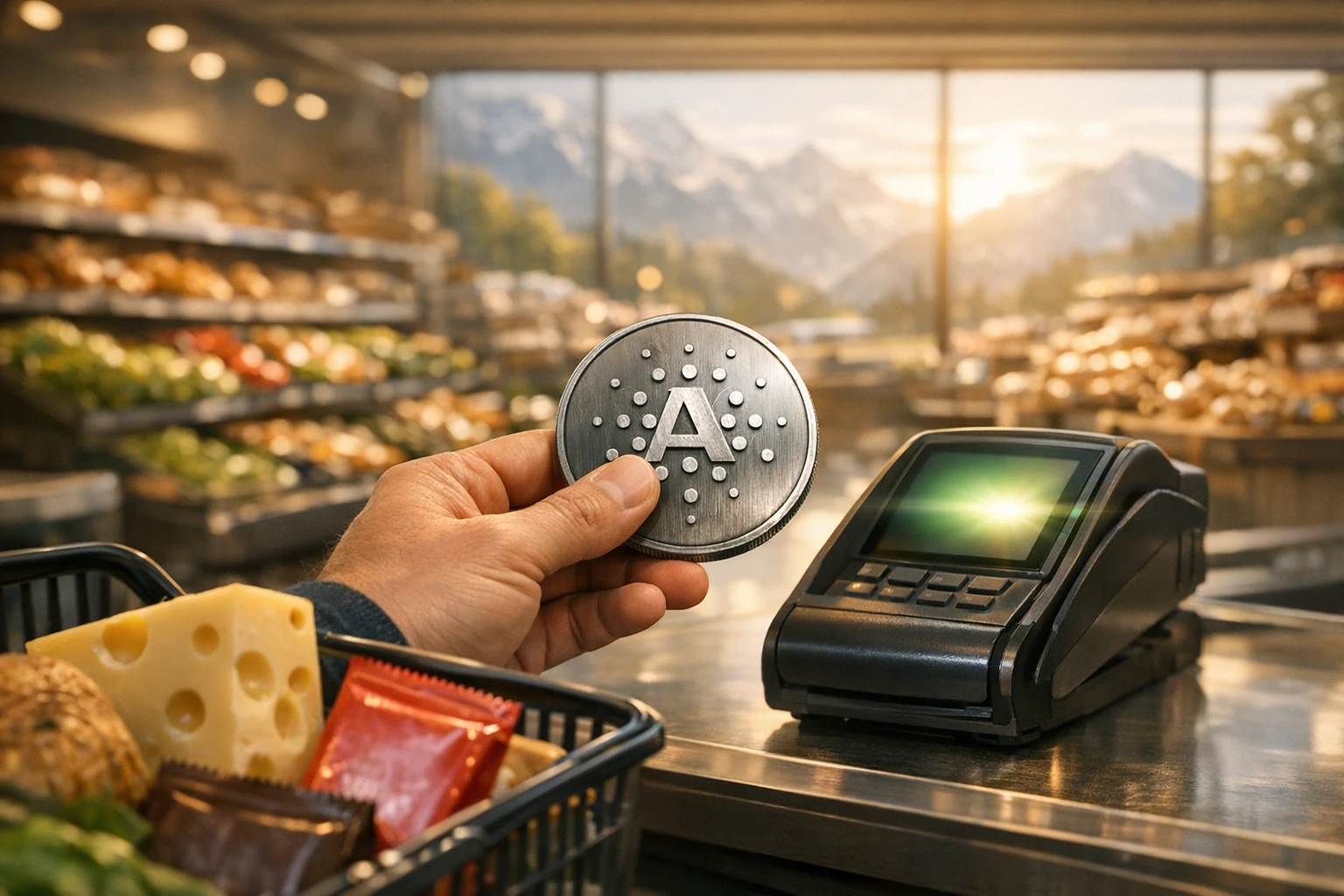
137 SPAR supermarkets in Switzerland are now able to accept ADA payments. The setup comes from Cardano Foundation’s integration with Swiss fiat on-and-off-ramp platform DFX.swiss, announced in March, allowing shoppers to pay from a Cardano native wallet while merchants receive settlement in Swiss francs (CHF).
This is already operating in stores, not a pilot framed as a future possibility. According to the source material, the integration went live on March 5. At checkout, the customer scans a QR code, confirms the ADA amount in a compatible wallet, signs the transaction, and the payment is processed on-chain. No centralized exchange is required in the flow, and no prior currency conversion is needed on the user side.
Open Crypto Pay connects ADA to an existing in-store payment rail
The system runs on Open Crypto Pay, a payment standard built by DFX.swiss. Before ADA was added, the same standard already supported Bitcoin, Ethereum, and stablecoins including USDC, USDT, and DAI at SPAR locations in Switzerland. ADA’s inclusion puts Cardano onto a retail payment rail that was already in use rather than creating a separate merchant stack from scratch.
For merchants, the key detail is the settlement design. DFX.swiss handles the crypto-to-fiat conversion in the background, so stores receive CHF instead of holding ADA on their balance sheet. That removes direct exposure to token price swings. Current store coverage spans Switzerland and nearby Liechtenstein, though the Open Crypto Pay map still shows some SPAR locations in Geneva, Bern, and Davos as not yet connected.
Fees are about two-thirds lower than card payments
The strongest commercial argument is cost. DFX.swiss says transactions made through Open Crypto Pay carry fees that are about two-thirds lower than those charged by traditional credit cards or payment service providers.
The source notes that conventional card acceptance fees usually fall in a 1.5% to 3% range. For supermarkets, where margins are typically tight, that difference matters. If a crypto payment option can reduce transaction costs while leaving the merchant settled in local currency, the pitch becomes operational rather than symbolic. Cardano Foundation CEO Frederik Gregaard described the integration as the beginning of a fundamental change in how social value moves, and said the partnership is laying the groundwork for an ecosystem where paying with ADA feels as natural as using a card.
Native-wallet payments avoid exchange account routing
One of the more consequential design choices is that users pay directly from a native wallet instead of spending from a balance held on a centralized exchange. That changes the custody model first: the ADA remains under the user’s private-key control until the payment is signed and broadcast on-chain.
It also changes the privacy structure. A centralized exchange as the routing layer can tie spending records closely to a KYC identity. Native-wallet payments are still visible on-chain, but they do not depend on an exchange account in the middle of the transaction path. The source also says Open Crypto Pay has not implemented a dedicated double-spend protection mechanism for physical-store scenarios, with the platform treating this as a theoretical issue in a setting where simpler forms of non-payment already exist.
Switzerland is the first proving ground, not the final market
Switzerland offers favorable conditions for this model. The source says Lugano already has more than 350 merchants accepting Bitcoin, and the country has clearer crypto rules than many markets. At the same time, Swiss National Bank Chairman Martin Schlegel said in April that Bitcoin should not be added to reserves, citing volatility and market liquidity concerns. The environment is open, but not without limits.
The next question is whether the same structure can move into Germany, Austria, or Italy, where SPAR also has a large store footprint. The source does not provide a launch schedule for those markets. It says expansion would depend on DFX.swiss obtaining local regulatory approval and completing integrations. For Cardano, 137 stores is still a small figure in global crypto payments, but the case is concrete: ADA is being used for everyday purchases in physical retail.