SPAR

Linkup Resear
2026-09-19 08:01:51

Linkup Research releases open-source sparse embedding model SPARSEUP with 149 million parameters

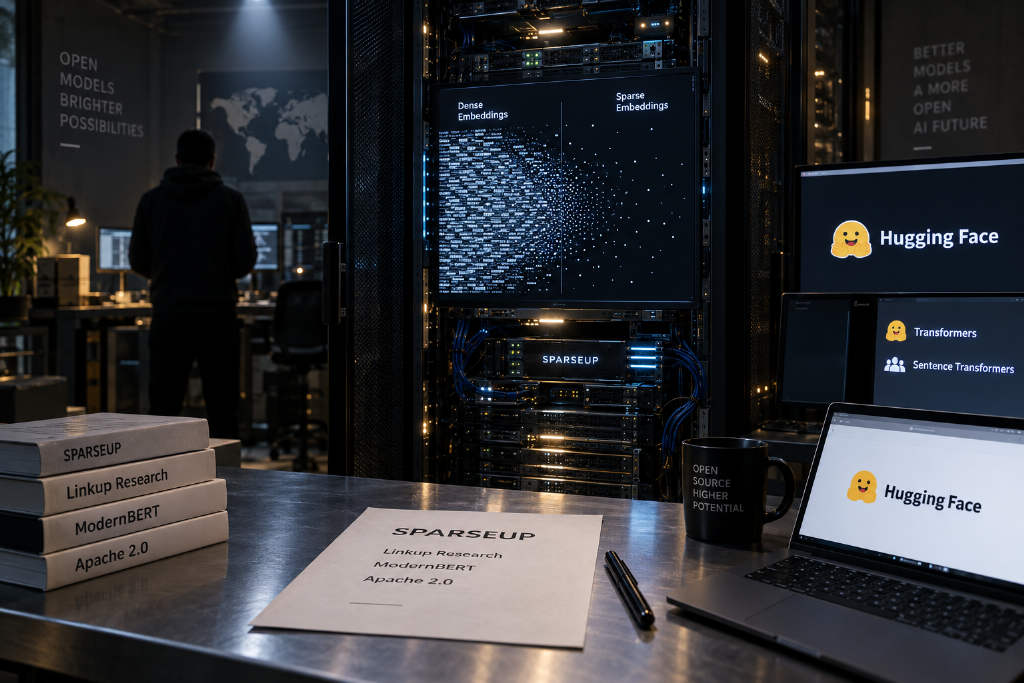
Linkup Research has released SPARSEUP, an open-source sparse embedding model built on a 149 million-parameter ModernBERT backbone and distributed under the Apache 2.0 license. According to the team, the model posted an average nDCG@10 score of 56.4 on the BEIR-13 benchmark. It also described SPARSEUP as the strongest known sparse encoder under 150 million parameters that uses a public vocabulary. The model weights are hosted on Hugging Face and can be loaded through either Transformers or Sentence Transformers. Linkup Research said the release is meant to fill the sparse retrieval gap left after LightOn recently introduced DenseOn and LateOn, while keeping the same backbone family and fine-tuning data so the three retrieval styles can be compared side by side. On MS MARCO, SPARSEUP averages 47 non-zero terms per query and 190 per document. Using the Seismic inverted index, it reaches more than 97% recall in about 380 microseconds per query on a single thread.

120
Linkup Research releases open-source sparse embedding model SPARSEUP with 149 million parameters
AMD
2026-09-15 11:33:18

Open-source package lets AMD GPUs run some CUDA workloads, with validation limited to one card

Developer Speedstu published CUDA-for-AMD-Windows on GitHub on Sept. 13, packaging ZLUDA and AMD’s Windows HIP SDK into a PowerShell-based installer aimed at running CUDA software built for NVIDIA GPUs on AMD Radeon hardware. The setup has only been validated on the AMD Radeon RX 9060 XT using ZLUDA v6-preview.69, HIP SDK 6.4, and LibTorch 2.3.0+cu118. In that environment, five CUDA-related components passed checks: nvcuda, cuBLAS, cuBLASLt, cuSPARSE, and cuFFT. The project documentation says a PPO reinforcement learning model with 2,216,347 parameters completed inference, learning updates, optimizer operations, and one run covering 65,536 timesteps. Benchmark notes from Sept. 13 show the official ZLUDA path reached a median 13,278 steps per second, compared with 12,876 for an earlier modified component set, a 3.03% gap. The project also spells out its limits. It does not offer full CUDA support, cuDNN-dependent programs may fail because the stable Windows HIP SDK lacks MIOpen, and NCCL, TensorRT, and some custom CUDA extensions may also break. NVIDIA’s CUDA license terms still include translation-related restrictions, and ZLUDA itself no longer has commercial funding, according to developer Andrzej Janik. So far, no public compatibility reports have been posted for cards beyond the RX 9060 XT.

620
Open-source package lets AMD GPUs run some CUDA workloads, with validation limited to one card
nuclear fusio
2026-08-30 10:08:43

Nuclear fusion may not arrive in time for the current climate fight, BlockTempo says

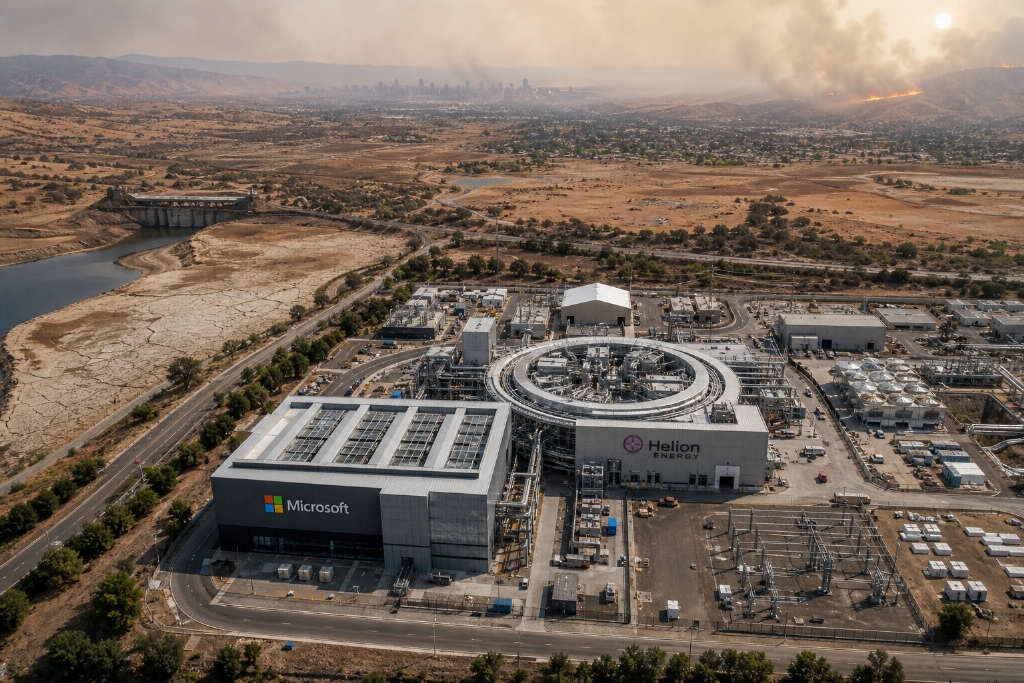
A BlockTempo article argues that nuclear fusion, despite a string of technical advances and growing investor backing, is unlikely to play a meaningful role in cutting global emissions during the most critical decades of climate action. The piece ties renewed interest in fusion to intensifying El Niño conditions, noting that NOAA assessed a more than 90% chance of the event developing into a “super El Niño” after the Niño 3.4 index reached +2.7°C in mid-August. Against that backdrop of heatwaves, drought and extreme rainfall, fusion is again being framed as a possible long-term clean energy answer. The article lays out why fusion attracts such optimism: no greenhouse gas emissions during the reaction, fuel sources centered on deuterium and tritium, no meltdown scenario comparable to Chernobyl or Fukushima, and a much lighter waste burden than fission. It also points to more than $7 billion invested in private fusion companies over the past decade, along with Microsoft’s 2023 power purchase agreement with Helion for electricity starting in 2028. Still, the report says climate deadlines come much sooner than fusion deployment. It places engineering net gain in the late 2020s or early 2030s, first demonstration plants in the mid-to-late 2030s, and large-scale commercial buildout much later. With ITER’s first plasma pushed beyond 2034 and major hurdles still unresolved, BlockTempo concludes fusion is more likely to matter after 2050 than before it.

440
Nuclear fusion may not arrive in time for the current climate fight, BlockTempo says
RWA
2026-08-26 09:02:46

Wall Street’s Next Crypto Bet May Be the Onchain Product Layer Behind RWA

A TechFlowPost market analysis argues that Wall Street’s most valuable skill over the past five decades has not been stock picking, but product manufacturing. In that framework, the next major crypto opportunity may not sit at the asset-tokenization layer itself, but one level above it: the onchain infrastructure that turns tokenized assets into standardized investment products. The article points to several data points to support that view. Global ETF assets reached a record $23.09 trillion by the end of June 2026, with $1.33 trillion in net inflows during the first half of the year. In tokenized markets, stablecoin supply has climbed above $300 billion, while tokenized real-world assets, or RWA, expanded from $11.8 billion to $33.5 billion in one year. The piece also notes that the GENIUS Act took effect in July 2025, while market structure legislation has moved into the U.S. Senate process. Against that backdrop, the author says the asset side, demand side, and regulatory side have matured at the same time for the first time in the past 18 months. The analysis highlights activity from BlackRock, JPMorgan, MGX, Nasdaq, DBS, BNY Mellon, and Goldman Sachs as signs that not only assets, but products themselves, are moving onchain. It argues that the most obvious gap in current crypto-financial infrastructure is an issuance and operations layer for structured products, and names City Protocol as one project attempting to fill that opening.

1370
Wall Street’s Next Crypto Bet May Be the Onchain Product Layer Behind RWA