
Nuclear fusion is posting real technical progress, but that does not mean it can arrive in time to address the climate pressures facing this generation.
In a recent article, BlockTempo argues that the timeline for fusion commercialization still falls well behind the timeline laid out by climate science. The piece places the question in the context of a strengthening El Niño event and rising concern over heatwaves, drought and extreme rainfall.
Climate pressure is intensifying as El Niño strengthens
The article says the Pacific has heated up sharply this summer. By mid-August, the Niño 3.4 index in a key monitoring region had climbed to +2.7°C. The U.S. National Oceanic and Atmospheric Administration, or NOAA, assessed the event as having a more than 90% chance of developing into a “super El Niño.”
According to the piece, the ocean is bringing stored heat back to the surface at a time when the planet is already warming, adding to the risk of global heatwaves, drought and heavy rainfall. That has revived interest in whether fusion could serve as the long-promised source of clean energy.
Why fusion continues to attract so much attention
BlockTempo describes fusion as the same process that powers the sun: hydrogen isotopes deuterium and tritium are heated to more than 100 million degrees so their nuclei can overcome repulsion, collide and fuse, releasing large amounts of energy.
If commercialized on Earth, the article says, fusion offers a combination of advantages that is hard to match.
- Zero carbon emissions: the reaction product is helium, and the process does not generate greenhouse gases.
- Fuel that is close to inexhaustible: deuterium can be extracted from seawater. The article says the deuterium contained in 1 liter of seawater could release energy roughly equal to 300 liters of gasoline after fusion.
- No meltdown risk: fusion reactions are difficult to sustain, so abnormalities tend to extinguish the reaction rather than trigger a runaway event like Chernobyl or Fukushima.
- A lighter waste problem: fusion does not create long-lived high-level nuclear waste, and activated materials could be handled on a scale of about 100 years rather than 100,000 years.
In the article’s framing, that means fusion avoids the carbon emissions of fossil fuels, the intermittency of renewable generation, and the waste and safety disputes linked to fission.
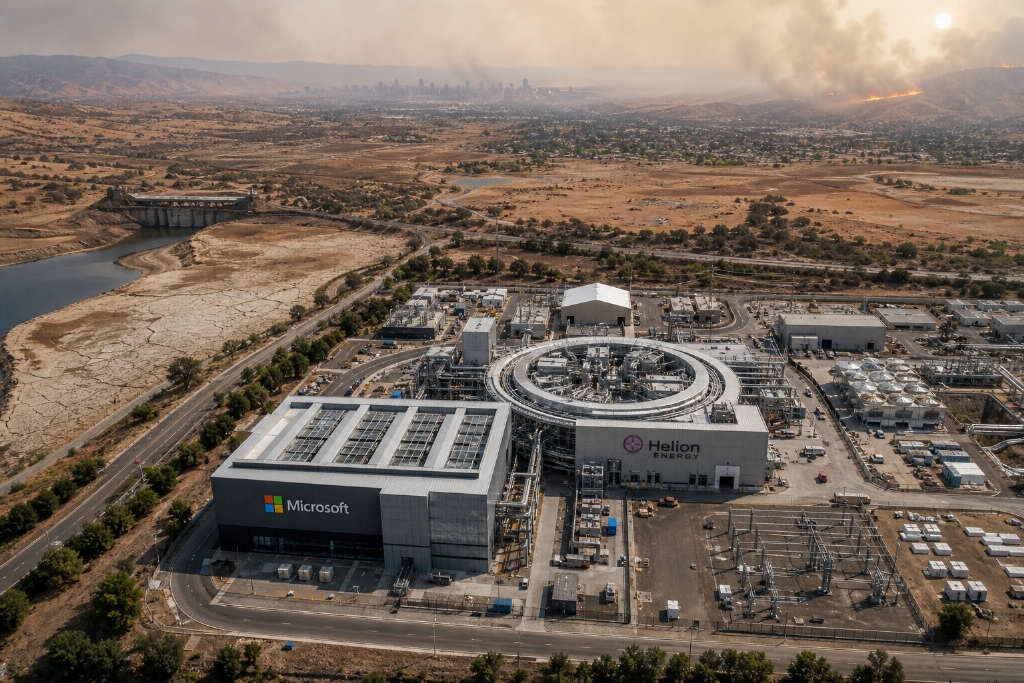
It also notes that private fusion companies have attracted more than $7 billion in investment over the past decade. Microsoft, for its part, signed a power purchase agreement with startup Helion in 2023 for electricity beginning in 2028.
Progress is real, and it is speeding up
The article does not dismiss recent momentum. It points to several examples.
Commonwealth Fusion Systems, or CFS, has used high-temperature superconducting magnets to cut down the size of tokamak systems. Its SPARC device is targeting net energy gain within the next few years, and the company has already started planning a commercial plant called ARC.
China’s EAST device has continued to extend the duration of high-temperature plasma confinement, with long-pulse operation records moving into the thousand-second range.
Governments are also bringing fusion into national energy strategies. The article says the United States, the United Kingdom, Japan and China have all set demonstration plant goals for the 2030s and 2040s.
For BlockTempo, that marks a concrete shift. Fusion is no longer just the old joke that it is always fifty years away. It now has roadmaps, capital and engineering schedules behind it.
The climate timetable and the fusion timetable do not line up
This is where the article draws its main distinction. Climate science, it says, sets a much earlier deadline. To keep warming between 1.5°C and 2°C, global emissions need to fall sharply in the 2030s and reach net zero around 2050.
Fusion’s most optimistic path comes later.
- Demonstration of engineering net gain, rather than a laboratory-only result, is placed in the late 2020s to early 2030s.
- First demonstration plants connecting to the grid are placed in the mid-to-late 2030s, which the article describes as the most optimistic private-sector schedule.
- Commercial scale-up comes after that. To give fusion a meaningful share of global electricity generation, such as 10%, hundreds of plants would need to be built.
The article also notes that the international ITER project has pushed its first plasma experiment back to a point after 2034. Drawing on the historical pace of fission plant construction and renewable deployment, it says a buildout at that scale would likely need another 20 to 30 years.
Add those steps together, and BlockTempo argues that fusion would only begin to take a large bite out of global carbon emissions after 2050 at the earliest. In its wording, fusion is largely absent during the decisive thirty years that will determine whether the planet warms by 1.5 degrees or 3 degrees.
Several major obstacles are still unresolved
The article says the marketing language around fusion can hide problems that remain very much in front of the industry.
One is the gap between scientific gain and engineering gain. From a power-grid perspective, a facility can still be a large net consumer of electricity even if an experiment achieves energy-positive performance in a narrow sense. A commercial plant needs total output to exceed total input across the whole system, and the article says that still requires multiple orders of magnitude of engineering improvement.
Another issue is tritium supply. Tritium barely exists in nature, and the article says current supplies mainly come from a small number of heavy-water reactors, with global inventory measured in kilograms. Commercial fusion plants would need to breed their own tritium, but that has not yet been validated at plant scale.
Materials are another open question. High-energy neutrons produced by fusion bombard reactor walls, and the article says it remains unclear whether current materials can withstand decades of irradiation.
Then there is cost. Fusion plants are expected to be highly capital-intensive, while solar plus storage keeps getting cheaper. Even if fusion works technically, the article says it would still have to win a market price battle.
BlockTempo’s conclusion: important, but not the main tool before 2050
The article does not argue that fusion should be abandoned. It argues for a narrower and later role.
For emissions cuts before 2050, it says the world has to rely on tools that already exist and can be deployed now: solar, wind, storage, grid upgrades, fission, electrification and energy efficiency. Those technologies are available today, and the article says their costs can already compete with fossil fuels.
Fusion may become far more valuable in the deeper decarbonization phase after 2050. The article points to the final 10% to 20% of emissions that are hardest to remove, including high-temperature industrial processes, regions that need stable baseload power, and densely populated areas where land and resources are limited. In those settings, a compact carbon-free power source that is not weather-dependent and does not face fuel scarcity could carry major value.
It also says fusion could support energy-intensive climate solutions such as hydrogen production, desalination and carbon capture.
BlockTempo ultimately frames fusion not as the starter in the climate game, but as a relay baton for the second half. Investing now, in that view, is about having options thirty years from now. The immediate job of slowing warming still rests on technologies that can be deployed before that chapter begins.