


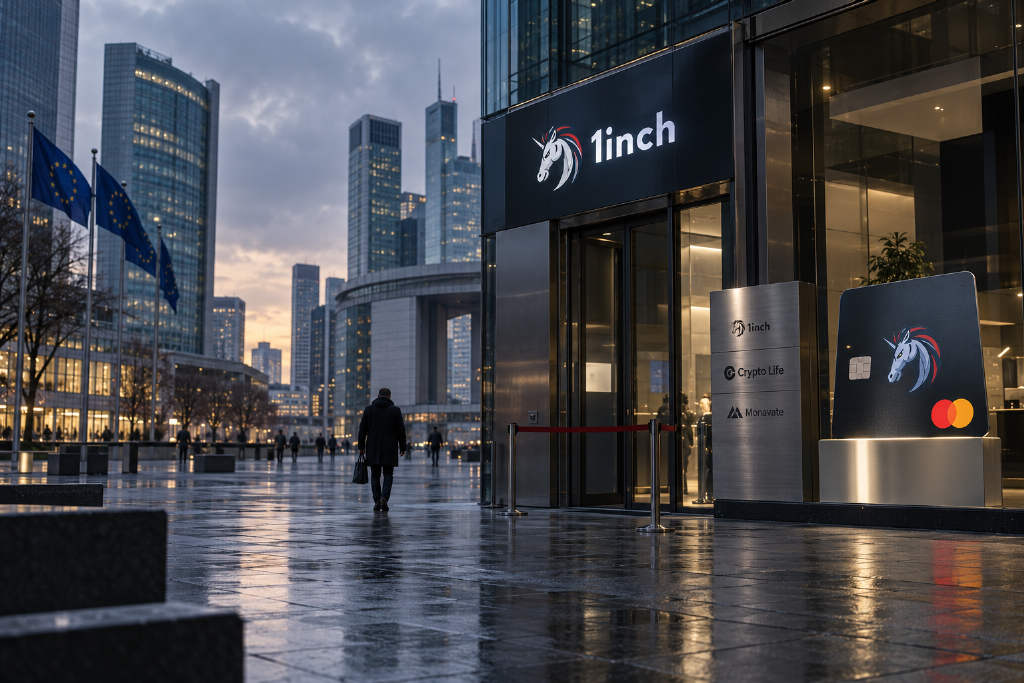
1inch is shutting down its crypto card business.
In an FAQ update published in mid-October under the title "1inch Card FAQ," the company said new user registration has been closed. Existing cardholders have until Dec. 18 to spend or withdraw their balances. After that date, there is theoretically a six-year redemption window, but 1inch said the exact timeline depends on the issuer and service providers and cannot be guaranteed.
The move ends a product that had been running for more than two years.
A product launched in April 2024 is now being wound down
1inch Card went live in April 2024. Its partners included Mastercard and Crypto Life, a company under Baanx, while Monavate served as the electronic money issuer. The card allowed users to spend crypto directly from the 1inch wallet, with funds converted into fiat at the point of payment. It also supported Apple Pay and Google Pay for both online and in-store purchases.
At launch, 1inch co-founder Sergej Kunz described the product as "another big step toward bringing mainstream users into DeFi." Two and a half years later, that step is being reversed.
The broader crypto card market is still expanding
1inch's exit stands in contrast to the direction of the wider market.
According to Artemis, monthly crypto card transaction volume climbed from about $100 million in early 2023 to more than $1.5 billion by the end of 2025, a 1,400% increase over two years. On an annualized basis, that works out to roughly $18 billion, nearly matching stablecoin peer-to-peer transfer volume.
The pace picked up again in 2026. Data cited from Kobeissi Letter showed monthly crypto card volume up another 230% year over year, with cumulative volume surpassing $7.8 billion. Visa processed about 90% of crypto card transactions, while Mastercard was also moving quickly to expand.
The spending mix has changed as well. Early crypto card users mainly spent BTC and ETH. Stablecoins have now become the main payment asset. The article points to Argentina, where users treat USDC as a digital dollar for saving and spending; India, where crypto cards are used to get around a 30% crypto tax; and OKX users in Europe, who are using cards at grocery stores and restaurants, with groceries accounting for 26% of transaction volume.
In the article's framing, crypto cards are no longer just a niche product for crypto-native users. In some emerging markets, they are starting to function as payment infrastructure.
Major crypto companies are still pushing in
Several large players are still building card products.
MetaMask launched its own crypto card in 2025 with Mastercard and Baanx, using Ethereum layer-2 network Linea and emphasizing self-custody. In March 2026, the card expanded into the U.S. market. Payment processing time was reduced to under five seconds, and payment volume rose 435% year over year.
Coinbase took a different route. It partnered with American Express on a credit card available to Coinbase One members, whose subscription costs range from $5 to $30 per month. The card offers 2% to 4% back in BTC. The article describes it as a traditional credit card in structure, using BTC rewards to pull users deeper into crypto.
Visa and Bridge, a Stripe-owned company, are also planning stablecoin cards in more than 100 countries. The first batch already covers 18 markets including Argentina, Mexico and Chile.
Bybit, Bitget, Crypto.com, OKX and Gate were also listed among the companies adding products in the category.
Crypto cards are a scale business first
The article highlights one detail in particular: 1inch Card used issuance infrastructure from Baanx and its subsidiary Crypto Life. MetaMask's card also runs on Baanx. At the infrastructure level, the two products were built on almost the same stack.
Yet the outcomes diverged. MetaMask expanded into the U.S. in 2026 and saw payment volume rise quickly. 1inch announced a shutdown in the same year. The article argues that the problem was not primarily the infrastructure. It was 1inch itself.
The core revenue source for crypto cards is interchange, the fee paid by a merchant's acquiring bank to the card issuer. But that revenue is split across several parties: the card network, such as Visa or Mastercard; the BIN sponsor, which holds the banking license; the payment processor; and only then the program manager.
Industry estimates cited in the article say the program manager earns about $0.006 in profit for every $1 of card spending. Put differently, if a user spends $100, the program manager makes about $0.60.
That margin still has to cover node operations, gas costs for moving funds across chains, KYC compliance, customer support, card manufacturing and shipping, plus fraud and chargeback losses. The article gives one example: running a full Ethereum node costs about $1,279 per month.
It also provides a break-even model. If fixed costs are $60,000 per month, each active card spends $500 per month, and each active card contributes $3 in profit, then 20,000 active cards are needed to break even.
Issuance volume is not the same as active usage. The article says fintech activation rates average about 5%, while first-year inactivity runs at about 34%. A program that issues 100,000 cards may end up with only 5,000 cards in real use.
Why 1inch was structurally weaker in this business
The article traces 1inch's problem back to its core business model.
1inch is a DEX aggregator. Its main product helps users find better prices across decentralized exchanges. The article calls that a strong product, but says its user base is made up of DeFi traders rather than everyday consumers. People come to 1inch to trade, not to buy groceries.
MetaMask, by contrast, can support a card business because it operates one of the world's largest self-custody wallets, with monthly active users in the tens of millions. In that setup, a card can serve as part of a broader push from wallet to super app, making cross-subsidy easier to justify.
Coinbase has a different set of advantages: more than 100 million registered users, a full compliance team, custody infrastructure, and a credit card model with American Express that can lean on interest economics.
Crypto.com can support cards by tying CRO staking to card tiers, locking in a group of high-spending users and using the card as a retention tool.
1inch did not have those advantages. Card issuance requires licenses, compliance teams, customer support systems and deep banking relationships. None of those are core strengths for a DEX aggregator. Once those functions are outsourced to Crypto Life and Monavate, the article argues, 1inch ends up in an awkward position in the value chain: it does not control the infrastructure, it does not have enough user scale to spread costs, and it still carries the brand risk.
This is not the first washout in crypto cards
The article places 1inch in a longer pattern.
In 2023, Binance lost its partnerships with Visa and Mastercard and stopped crypto card services in Latin America and the Middle East. In 2020, after Wirecard collapsed, many crypto cards that depended on it for issuance effectively stopped working overnight.
By that reading, the history of crypto cards is also a history of elimination. Each bull cycle brings a new batch of cards. Each downturn removes some of them. The survivors tend to have one of three things: exchange-level user pools and compliance capacity, as seen at Coinbase and Crypto.com; wallet-level daily activity and ecosystem ambitions, as seen at MetaMask and Phantom; or backing from traditional finance heavyweights, as in the Visa and Bridge partnership.
Platforms caught in the middle eventually have to choose. 1inch chose to leave.
The article closes on a simple calculation. In a business where every $100 of spending yields about $0.60 in profit and 20,000 active cards are needed just to break even, a DEX aggregator does not have much room for error. If MetaMask can scale a card on the same Baanx infrastructure, then the question for 1inch is whether the card was ever a strategic asset at all, or just an operating burden.