

A guide written by Maciej Zerelik and translated by AididiaoJP frames the 2026 altcoin season question around one issue: whether a durable rotation away from Bitcoin is actually taking shape, or whether traders are only seeing brief bursts of speculation.
In the article, altcoin season is not treated as a vague mood. It uses a defined benchmark: over a rolling 90-day period, at least 75% of the top 50 cryptocurrencies must outperform Bitcoin. Analysts use that threshold to judge whether capital is moving out of BTC and into the broader digital asset market.
How the guide defines altcoin season
The piece says many newer investors ask what altcoin season actually means and why it draws so much attention. Its answer is straightforward. If most major altcoins generate better returns than Bitcoin across the same 90-day window, the market is usually considered to have entered an altcoin season.
The article uses a simple example. If Bitcoin rises 25% over 90 days and Solana climbs 80% in the same period, Solana has clearly outperformed BTC. When that kind of relative strength appears across a large share of leading crypto assets, the market tends to classify the period as an altcoin season.
The concept became widely recognized during the 2017-2018 bull market. At that time, many investors rotated profits from Bitcoin into Ether and smaller tokens, and a large number of altcoins posted returns that far exceeded BTC within a matter of months. Historically, the guide says, a full altcoin season has often lasted from 2 to 6 months, though timing has differed from one cycle to the next.
The Bitcoin-versus-altcoin dynamic and the ETF wall
The article argues that this cycle differs from earlier ones because of what it calls the “ETF wall.” Bitcoin dominance, the share of Bitcoin in total crypto market capitalization, has long been one of the main gauges traders use to see whether money is rotating into altcoins. When that metric starts to fall, many market participants read it as a sign that capital is broadening beyond BTC.
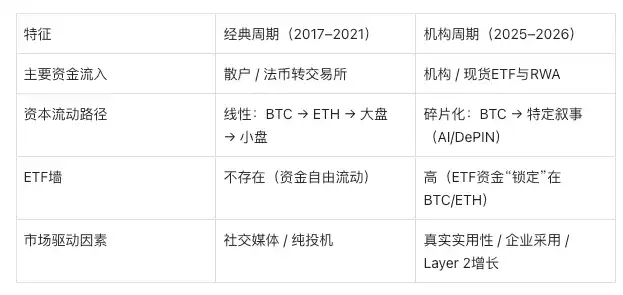
This time, though, spot Bitcoin ETFs launched by asset managers including BlackRock and Fidelity have already attracted billions of dollars from institutions. According to the guide, those investors usually gain Bitcoin exposure only through regulated products, which means a meaningful portion of capital remains effectively locked inside the BTC ecosystem.
That creates a market structure different from 2017, when retail money could move more freely into thousands of altcoins. For a broad altcoin season to emerge in 2026, the article says the market may need not only profit-taking in Bitcoin but also a fresh wave of retail participation and on-chain liquidity so capital can spread beyond BTC.
How to identify a real rotation
The guide says early recognition matters. Entering after the biggest move has already happened usually means taking more risk for less upside.
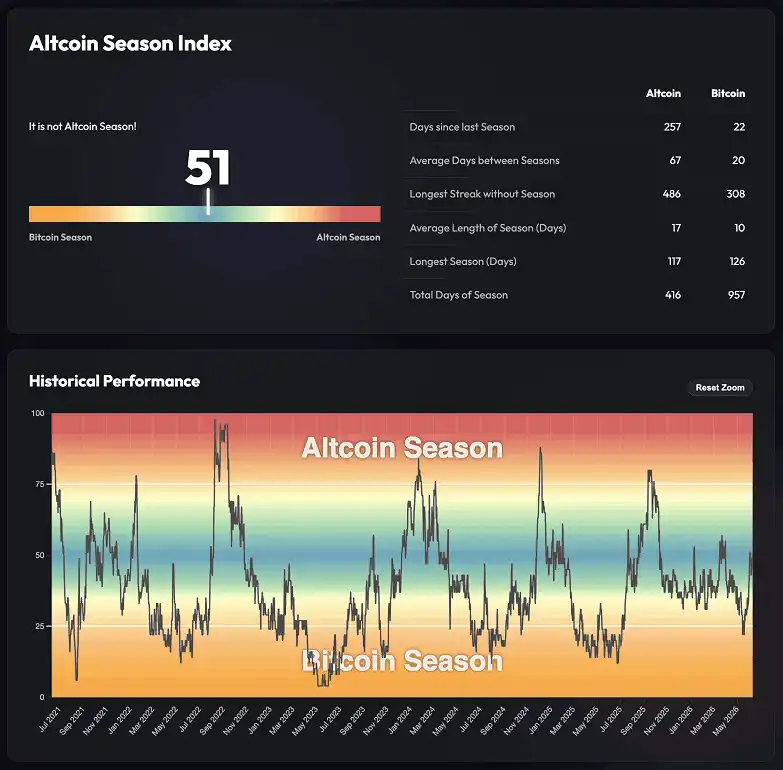
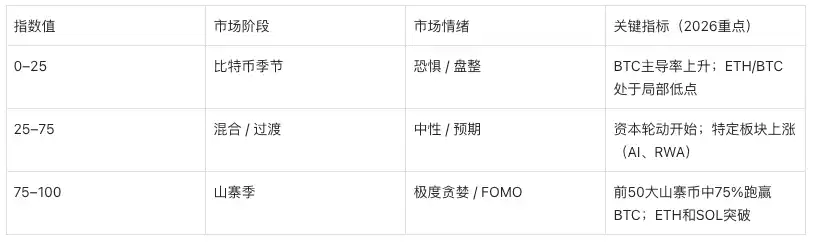
One of the best-known tools is the Altseason Index from Blockchaincenter. It scores market rotation on a 0-100 scale based on how major cryptocurrencies have performed against Bitcoin during the past 90 days. A reading below 25 points to Bitcoin season, 25 to 75 suggests a mixed market, and anything above 75 is usually treated as altcoin season because most leading altcoins are outperforming BTC.
Still, the article says 2026 requires extra confirmation. Many analysts now also watch the ETH/BTC and SOL/BTC pairs. If Ether and Solana are not strengthening against Bitcoin, even an index reading above 75 may reflect a short-lived speculative burst rather than a sustainable market rotation. Strong action in those benchmark pairs tends to confirm that liquidity is moving beyond Bitcoin and into a broader part of the ecosystem.
Key indicators the guide highlights
The article stresses that no single metric can perfectly predict a market turn. More experienced investors usually look for several signals lining up at once.
- Bitcoin dominance: a drop from above 50% toward 40% or lower often signals that capital is leaving BTC for altcoins.
- Altcoin market cap growth: the guide says it should ideally be expanding 2x to 3x faster than Bitcoin.
- Trading activity: weekly growth of more than 50% in altcoin/BTC volume often points to rising investor interest.
- Search and social signals: social media engagement and Google Trends can add confirmation, especially if terms such as “best altcoins” or “altcoin season” rise 30% to 50% over a span of weeks.
When several of those readings move together, the article says the odds of a genuine altcoin season are much higher than if traders rely on the Altseason Index alone.
What past cycles looked like
The piece revisits the 2017-2018 and 2020-2021 bull markets and says both delivered exceptional gains, but for very different reasons.
The 2017-2018 altcoin run was driven by the ICO boom. Hundreds of new blockchain projects raised money directly from retail investors, and speculation often mattered more than fundamentals. Once Bitcoin hit new highs and began to slow, capital rapidly moved into smaller coins, and many tokens surged by several hundred percentage points within months.
The 2020-2021 cycle took a different route. Market attention shifted to DeFi protocols, NFT platforms, Layer 1 blockchains, and later meme coins. Institutions also entered the crypto market through companies, funds, and regulated products, bringing far more capital than in prior cycles.
Retail speculation still played an important part, especially around NFTs and meme coins, but institutional participation made the market larger and more mature. The guide says that change also altered the way capital rotates. Ether and leadership from key sectors became more important than broad, indiscriminate speculation. As a result, future altcoin seasons may be increasingly selective instead of lifting every project at once.
The stages of an altcoin cycle
The guide argues that modern altcoin cycles no longer involve every token moving higher at the same time. Capital rotates through narratives, rewarding sectors with stronger adoption and momentum.
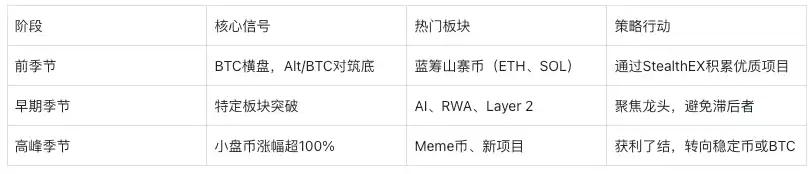
Pre-season: the accumulation phase
This stage often begins when Bitcoin moves sideways or pulls back by 10% to 20%. During that period, many altcoins fall another 20% to 40% from local highs, retail interest fades, volumes stay weak, and social discussion turns negative.
Behind the scenes, however, more experienced investors may begin accumulating fundamentally stronger projects at lower prices. The article says this phase often ends when Bitcoin stabilizes, Ether starts outperforming BTC, and trading activity gradually returns. For long-term investors, that is the period to study projects, build watchlists, and start positions before broader market attention comes back.
Early season: narrative-led breakouts
One of the guide’s key points is that altcoin season now tends to start through narratives rather than through market-cap rankings alone. Not every top-10 crypto asset rises together. Capital usually moves first into the sectors drawing the most attention.
The article points to AI agents, real-world assets, or RWA, and DePIN as examples of that pattern. It says the old strategy of buying the largest altcoins simply because they rank near the top has become less effective. Early winners are now more likely to be projects with clear use cases, growing ecosystems, and the ability to pull in fresh liquidity.
Peak season: maximum activity
When mid-cap and small-cap tokens jump 100% to 500% in a matter of weeks, traders often assume the market has entered a familiar altcoin peak. At that stage, optimism becomes extreme and the Fear & Greed Index is often above 80.
Retail traders may aggressively buy every dip, while more seasoned market participants start trimming positions and taking profits. New token issuance picks up, leverage expands, and social media fills with unrealistic price targets.
The guide treats those conditions as warning signs rather than fresh entry points. Rising volatility, excess leverage, and parabolic price moves often suggest the market is nearing exhaustion. Historically, the peak stage has tended to last 2 to 6 weeks before a sharp correction or a broader market rotation follows.
Trading strategy: allocation, rotation, and risk controls
The article says successful altcoin investing depends on having a clear structure. Portfolio allocation should reflect both an investor’s risk tolerance and prevailing market conditions.
More conservative investors, it says, tend to keep a larger share of capital in Bitcoin, Ether, and stablecoins. More aggressive traders may increase exposure to high-growth sectors during stronger parts of the cycle.
Sector rotation matters as well. Capital rarely stays in one narrative for an entire cycle. Profits made in AI-related projects, for example, may later rotate into RWA, DePIN, gaming, or other emerging themes. Following liquidity instead of chasing last cycle’s winners can produce better long-term results, according to the guide.
Risk management and stop-loss discipline
Even the strongest altcoin season ends eventually, so the article describes risk management as one of the most important parts of any strategy.
Many experienced investors, it says, limit a single position to 5% to 10% of the portfolio in order to reduce the damage from one failed trade. Spreading funds across 8 to 12 carefully selected projects can lower overall risk while keeping exposure to multiple narratives.
Keeping part of a portfolio in stablecoins also provides flexibility. Stablecoin reserves can be deployed when corrections create opportunities, and they can help preserve profits when the market overheats. Combined with preset stop-loss levels and take-profit targets, that kind of discipline often produces more consistent outcomes than trying to maximize every single trade.
Altcoin season versus Bitcoin season
The guide says the difference between Bitcoin season and altcoin season comes down to where capital is going.
In Bitcoin season, BTC dominance usually rises above 50% to 60%, showing that investors prefer the largest and most established crypto asset. During those periods, many altcoins may hold roughly steady in dollar terms yet still weaken against Bitcoin.
Altcoin season tells the opposite story. Bitcoin dominance usually drops toward 40% or lower, while Ether and other major crypto assets begin attracting more liquidity. That move can then spread into mid-cap and small-cap projects, producing some of the strongest gains of the cycle.
The investor mix changes too. Bitcoin season tends to attract more conservative investors and institutions seeking lower volatility and longer-term exposure. Altcoin season brings in more speculative capital, with traders willing to accept greater risk in pursuit of much larger returns.
Duration matters. The guide notes that Bitcoin-dominant phases often last for months, while an intense altcoin season may last only 2 to 6 weeks before momentum fades. If BTC dominance starts climbing again, stablecoin inflows rise, and leading altcoins begin weakening against Bitcoin, those are often early signs that capital is moving back into BTC or other defensive positions.
What the article says about the next cycle
The guide is careful on forecasts. It says no indicator can offer an exact start date for the next altcoin season, and any prediction depends on a mix of macro conditions, Bitcoin cycle structure, and capital rotation.
Historically, some of the strongest altcoin advances have come 18 to 30 months after a Bitcoin market bottom and often after a halving event. Since the most recent Bitcoin halving took place in April 2024, many analysts cited in the article believe 2026 to 2027 could still offer supportive conditions if liquidity continues to improve.
Macro conditions are central to that view. Lower interest rates, an expansion in global liquidity, and stronger investor risk appetite could encourage flows into higher-risk digital assets. Institutional adoption may also support the market, though a large share of institutional capital remains concentrated in Bitcoin ETFs rather than altcoins.
Technology themes are another part of the picture. The article lists AI infrastructure, tokenized real-world assets, DePIN, next-generation DeFi, and blockchain gaming as narratives that could attract fresh capital in the next cycle. At the same time, it argues investors should not expect every crypto asset to rise together. The focus, instead, should be on sectors that show real users, active developers, and institutional interest.
Has 2026 officially entered altcoin season?
The guide’s answer is no. It says an officially confirmed altcoin season has not started in 2026 because Bitcoin still accounts for roughly 56% to 60% of the total crypto market cap. Analysts cited in the piece expect a more durable shift into altcoins only if Bitcoin dominance falls below 50% to 55% and the Altseason Index reaches the 75 threshold.
How to prepare for the next altcoin season
The final section focuses on preparation rather than chasing momentum after prices have already surged. The article says opportunities are often better when the work is done during quiet market periods.
Building a watchlist
A strong watchlist should prioritize quality over quantity. Before adding a project, the guide says investors should check whether it has a real product, active users, an experienced and public development team, a reasonable valuation, and a community that can support longer-term growth.
Its research checklist includes token utility, ecosystem activity, developer updates, partnerships, liquidity, tokenomics, and competitive advantages. Reviewing those points regularly can make it easier to separate longer-lasting projects from short-term hype.
Questions the guide addresses
What is the current Altcoin Season Index reading?
The article says investors can check the Altcoin Season Index in real time on Blockchaincenter. A reading from 0 to 25 signals Bitcoin season, 25 to 75 suggests a mixed market, and 75 to 100 points to altcoin season. Although the index updates daily, the guide says checking it weekly often gives a clearer signal and reduces the chance of overtrading on short-term noise.
When does altcoin season arrive?
The guide does not give a fixed date. Historically, major altcoin advances have often happened 12 to 18 months after a Bitcoin halving, but the article says market conditions, Bitcoin dominance, liquidity, and ETH/BTC strength matter more than the calendar alone.
Can altcoin season happen if Bitcoin crashes?
The answer in the guide is no. A broad altcoin season usually requires Bitcoin to stay stable or rise moderately. If Bitcoin falls more than 20% in a short period, capital typically leaves the crypto market altogether rather than rotating into altcoins. Historically, major altcoin runs have tended to happen during Bitcoin consolidation or moderate BTC gains, with only limited exceptions during smaller pullbacks.
When do altcoins usually make their biggest move?
The article says the answer usually comes back to rotation. Altcoins often accelerate once Bitcoin dominance peaks above 50% to 55% and begins to decline while ETH/BTC strengthens. It adds that a 15% to 30% gain in ETH/BTC often comes before a broader advance, with capital first concentrating in Ether and then moving into large-cap, mid-cap, and eventually small-cap altcoins.