
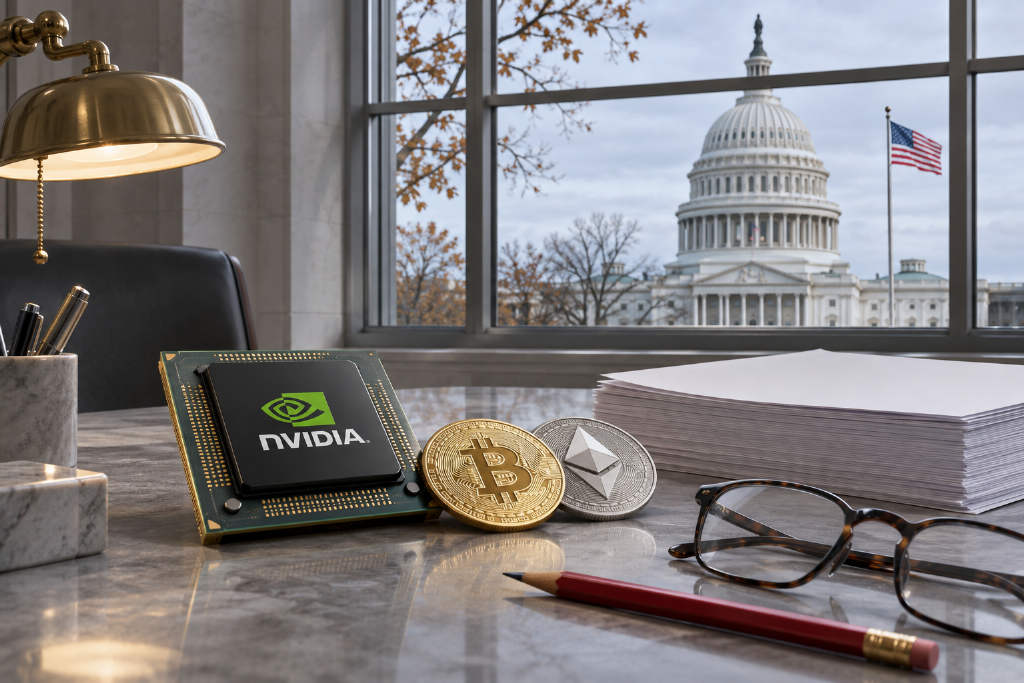
Markets enter year-end with several risks being repriced
The final stretch of 2026 is no longer just a question of a typical year-end rally. Politics, artificial intelligence valuations, monetary policy and crypto liquidity are all shifting at once, forcing investors to reassess the assumptions that shaped expectations for the fourth quarter.
Democrats have regained control of both the U.S. Senate and House of Representatives, leaving the Trump administration to face a Congress led by the opposition party. Nvidia CEO Jensen Huang has become part of an investigation involving personal relationships, chip exports and national security. The Nasdaq Composite fell 5.56% in a single session after the election before rebounding quickly. At the same time, U.S. inflation has started to heat up again, putting another Federal Reserve rate increase back into the market’s range of possibilities.
As of Nov. 11, Bitcoin was trading at about $73,800 and Ether at about $2,057. The S&P 500 was still up roughly 11.3% for the year. Risk assets have not entered a broad collapse, but the period in which one dominant narrative could carry markets higher is coming to an end.
Republicans lose both chambers ahead of a divided government
Strictly speaking, Trump did not personally “lose both chambers.” Republicans lost control of the Senate and House in the 2026 midterm elections. The Associated Press called the Senate for Democrats on the evening of Nov. 3 and the House in the early hours of Nov. 4. Reuters data showed Democrats gaining at least 39 House seats and flipping seven Senate seats.
Beginning in 2027, the United States will have a divided government: a Republican president and a Democratic Congress. Democrats cannot freely rewrite policy over a presidential veto, but they can control congressional committees, investigations, budget negotiations and the legislative agenda.
The market’s focus is on how the result changes the policy path:
- AI data centers, electricity consumption and technology-company regulation could face closer scrutiny.
- Tax policy, government spending, the debt ceiling and annual budget negotiations could become more difficult.
- The Trump administration may have less room to pursue another round of fiscal policy.
- Policy expectations for health care, clean energy and consumer protection could be repriced.
- Congressional investigations could increase compliance and political risks for large technology companies.
The first market response was sharp. On Nov. 5, the Nasdaq Composite fell 5.56%, its largest one-day decline in 19 months. Investors were concerned that Democrats could tighten oversight of AI infrastructure and data centers, putting pressure on the capital-spending cycle that had helped lift technology stocks.
That move did not establish that U.S. stocks would keep falling simply because Democrats control Congress. Oil prices later declined, easing inflation concerns. On Nov. 9, the S&P 500 rose 2.35% and the Nasdaq gained 2.74%. The market was trading policy uncertainty, not a confirmed recession.
Huang investigation puts pressure on AI’s trust premium
Reports that Huang could step down as Nvidia CEO remain unconfirmed. What has been established is that Huang acknowledged an extramarital relationship. Related reports connected the matter to Nvidia’s China chip business and possible foreign intelligence activity. Nvidia’s board has formed an investigation committee supervised by independent directors and outside legal counsel.
The board said there was currently no reason to believe national security or company secrets had been compromised. It also continued to support Huang and his management team. Huang said he would cooperate with the investigation and continue to lead the company.
Three questions matter for the rest of the year:
- Will the independent investigation find problems involving company secrets, export approvals or national security?
- Will the U.S. government place further restrictions on Nvidia’s exports of advanced chips to China?
- Will Nvidia customers change procurement or data-center investment plans because of political risk?
The potential impact extends beyond Nvidia. The company sits at the center of the AI capital-spending chain. If investors begin to question its governance stability, export access or customer demand, stocks tied to semiconductors, servers, power equipment, cloud computing and data centers could also be repriced.
Nvidia shares were at $173.73 on Nov. 11, up 2.94% on the day. The move suggests that the market has not formed a consensus that Huang will inevitably resign, though volatility and event risk have increased.
The Fed may be the biggest year-end variable
On Oct. 28, the Federal Reserve left its federal funds target range at 3.75%-4.00%. Two officials voted for a 25-basis-point increase, showing that a rate hike is no longer only a market rumor.
U.S. October CPI rose 0.4% month over month, while core CPI increased 0.3%. Nonfarm payrolls rose by 165,000 and the unemployment rate was 4.1%. A government shutdown in October 2025 caused gaps in some price data, leaving the Bureau of Labor Statistics unable to publish reliable year-over-year figures for most categories. A single October year-over-year inflation rate should not be assembled from incomplete data.
The combination is uncomfortable for risk assets. The economy and labor market are not weak enough to force the Fed into a rate cut, while inflation is high enough to keep another hike possible. Higher rates could continue to weigh on expensive technology stocks and crypto assets. A renewed rise in energy prices could add to inflation pressure.
The final Fed meeting of the year is scheduled for Dec. 8-9, while November CPI is due on Dec. 10. The central bank may have to make its rate decision before receiving the next complete CPI report. That puts additional weight on the December statement, economic projections and press conference.
U.S. stocks: valuation dispersion matters more than a simple bullish or bearish call
The central year-end question for U.S. equities is not simply whether prices will rise. It is whether earnings can continue to support current valuations.
AI and semiconductors
AI demand has not disappeared because of one political event. Nvidia recently reported quarterly revenue of $96.2 billion, up 106% year over year. Data-center revenue reached $89 billion, an increase of 117%. The operating picture remains strong, but political investigations, export limits, power costs and valuation concentration are raising the risk premium.
A more useful distinction is between companies with real orders, cash flow and pricing power; companies whose valuations depend mainly on long-term narratives; businesses directly exposed to chip-export restrictions; and companies that can benefit from demand for electricity, cooling, networking and infrastructure.
Defensive and value sectors
When technology regulation, interest rates and policy uncertainty rise together, sectors with stable cash flow, controlled debt and lower valuations may gain relative support. Health care, utilities, consumer staples and some financial assets could help reduce concentration in technology.
Defensive does not mean immune to declines. Highly indebted utilities remain sensitive to rates, and the health-care industry could face price regulation from a Democratic Congress. The asset itself matters more than the sector label.
Crypto liquidity is again a macro variable
Bitcoin did not show a fully independent safe-haven profile after the midterm election and the technology-stock selloff. During the risk-asset decline on Nov. 5, U.S. spot Bitcoin and Ether ETFs recorded combined net outflows of more than $500 million. Crypto leveraged positions worth more than $1 billion were liquidated over 24 hours.
The episode shows that during short-term stress, Bitcoin can still move with the Nasdaq, high-beta technology stocks and global liquidity. It does not automatically move in the opposite direction.
Optimistic case
If energy prices decline, month-over-month inflation slows, the Fed leaves rates unchanged and ETF flows return to net inflows, Bitcoin could retest the prior resistance area. If risk appetite returns, ETH and liquid major tokens would be more likely to attract follow-on capital.
Neutral case
If the Fed maintains a hawkish stance without actually raising rates, while political and AI risks do not worsen, Bitcoin could remain in a wide range. Position control, staggered execution and range-based strategies would fit that environment better than chasing every rebound.
Bearish case
If the Fed hikes again in December, the AI sector enters a second selling wave, ETF outflows continue, or the Nvidia investigation becomes a substantive national-security and export matter, Bitcoin could retest lower support. Smaller tokens with weaker liquidity would typically face larger drawdowns than BTC and ETH.
Year-end positioning should avoid a single-direction bet
A major mistake at year-end would be placing all assets behind one direction immediately after a major headline. Election results, corporate investigations and monetary policy are not priced in through a single event.
- Keep long-term holdings, trading capital and emergency funds separate.
- Do not raise leverage simply because of a “year-end rally.”
- Reduce excessive concentration ahead of the Fed meeting, inflation data and the investigation result.
- For U.S. equities, focus on earnings, cash flow and policy sensitivity rather than only popular themes.
- For crypto, track ETF flows, dollar liquidity and the U.S. technology sector together.
- Keep smaller-token exposure below allocations to liquid assets such as BTC and ETH.
- Set an invalidation condition for each position instead of only setting a profit target.
- Keep some cash or stablecoins available for opportunities during periods of high volatility.
Markets are moving into a risk-repricing phase
The central tension has changed since the start of 2026. Earlier in the year, investors focused on how quickly AI could grow and whether crypto assets would keep attracting institutional money. The market now has to answer harder questions: How will a Democratic Congress regulate technology and AI? Can the Nvidia investigation move from a personal matter to a corporate-governance or national-security risk? Could firm inflation force the Fed to hike again? Can Bitcoin develop a more independent source of capital when technology stocks are under pressure?
The final months of 2026 look more like a risk repricing than a bull-or-bear contest with a predetermined direction. Political developments, corporate events and monetary policy are entering asset prices one by one, leaving market participants to preserve room to adjust, exit and reallocate as conditions change.



