
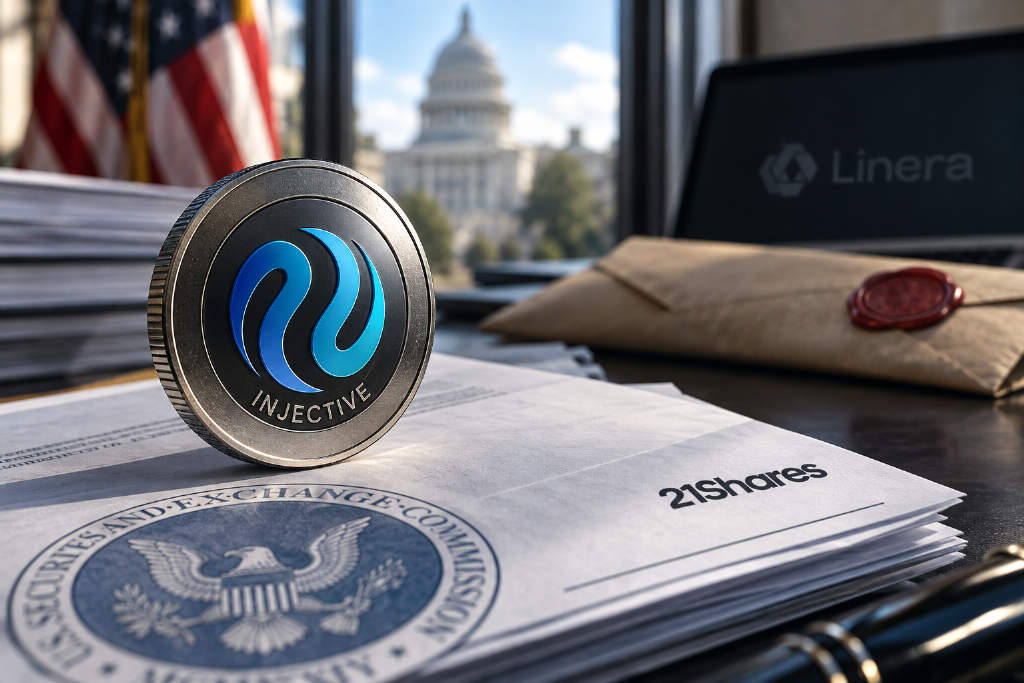
PANews’ Sept. 19 daily roundup put two developments at the top of the day’s crypto news flow: 21Shares has filed an amended registration statement with the U.S. Securities and Exchange Commission for a proposed spot Injective ETF, and Linera has shut down after failing to meet the minimum threshold in its public sale, with all subscription funds refunded.
Regulation and macro
According to Bitcoin.com News, Vietnam plans to issue its first licenses for crypto-asset service providers in 2026 under a pilot legal framework, allowing the first batch of digital asset platforms to begin operating. Vu Thi Chan Phuong, chair of Vietnam’s State Securities Commission, said the framework draws on Financial Action Task Force recommendations and European Union models, with a focus on risk management, investor asset protection, and anti-money laundering.
Federal Reserve Governor Michelle Bowman said the Fed will complete a reform package in the “coming weeks” to improve the transparency and accountability of bank stress tests, make the tests more reliable, and reduce volatility in bank capital requirements. Under the planned approach, the Fed would use the average of a bank’s two most recent stress-test results when setting its stress capital buffer.
NewsNation reported that U.S. President Donald Trump said Iran wants an agreement with the United States and that he is weighing whether to take further military action against Tehran. Asked whether he was considering “destroying” Iran, Trump said, “You’ll see,” adding that Iran is “losing on every front” economically and militarily and that “if it’s not the right deal, I wouldn’t even consider it.”
Bloomberg reported that after the U.S. Senate failed this week to advance the CLARITY Act, the Commodity Futures Trading Commission is moving faster on crypto market rules. A new proposal aimed at regulating crypto trading and markets has been submitted to the White House for review, according to a filing released Friday by the Office of Management and Budget, which said it received the proposal on Thursday. Bloomberg noted that if the CLARITY Act had passed, the CFTC would have become the main regulator of digital asset markets.
Project developments
Cronos proposal would use revenue to buy back and burn CRO
The Cronos community has published a governance proposal that would direct all revenue generated by Ult and Cronos Launch to monthly market purchases of CRO for burning. The proposal says each transaction would be executed on-chain and its hash disclosed. Operating, infrastructure, and growth costs would be covered by existing funds, while strategic reserves would support future staking rewards on Cronos POS. The proposal is still in the proposal stage, and voting runs through Oct. 3.
21Shares files amended S-1 for spot Injective ETF
The SEC has received an amended S-1/A registration statement for the 21Shares Injective ETF, updating the original filing submitted in October 2025. If approved, the fund would list on Nasdaq under the ticker TINJ, passively track the performance of the INJ token through the FTSE Injective Index, and may stake part of its holdings at its discretion to enhance yield. PANews noted that 21Shares has previously launched an Injective staking ETP in Europe, and this filing extends that push into the U.S. market.
Switchboard to cease operations
Oracle project Switchboard said it is shutting down. Its core development contributor, Switchboard Technology Labs, will gradually wind down remaining business lines. All Switchboard implementations will stop being maintained immediately, and remaining support will end on Sept. 25. Protocols using its oracle services were told to migrate at once to alternatives such as Pyth and RedStone.
Switchboard said several factors drove the decision: AI has lowered the cost of building in-house oracle systems; the crypto bear market has reduced the number of new chains and project budgets; and direct data-provider partnerships, such as Hyperliquid’s work with S&P and others, suggest more protocols may source data directly, reducing the value of third-party oracle networks.
Linera shuts down after sale misses minimum target
Linera founder Mathieu Baudet said the project is ceasing operations immediately because its fundraising effort fell short. The token sale on Sonar drew about $900,000 in subscription commitments, below the minimum amount required to complete the sale, and all subscription funds have been returned in full. The team had tried to raise emergency funding to keep operating until mainnet launch, but failed to secure the amount it needed, leading to the closure.
PANews added that the earlier LNRA community round had received commitments of 848,300 USDC, below the 1.5 million USDC minimum target.
Binance to list USDBRLUSDT perpetual contract
According to an official Binance announcement, Binance Futures will list the USDBRLUSDT USDT-margined perpetual contract at 22:00 Beijing time on Sept. 21.
Yahoo Finance ends Polymarket partnership
Bloomberg reported that Yahoo Finance has ended its partnership with Polymarket. Yahoo Finance had previously used Polymarket data to build a prediction-market section after the two sides reached a deal in November last year. Polymarket had described itself at the time as Yahoo Finance’s exclusive prediction-market partner. The agreement included a dedicated section showing probability data tied to “key economic, government and market outcomes.”
Coinbase seeks to launch single-stock perpetuals in the U.S.
Coinbase said it has filed an application to launch the first single-stock perpetual futures products in the United States.
ZCode apologizes over code upload controversy
ZCode issued a statement after community discussion around what it described as a “secret code upload” issue, saying it had completed an internal review and apologized to affected users. The company said the issue stemmed from its “repository indexing” feature. Its Repo Wiki function could trigger repository data uploads while generating wiki pages, but the uploaded data was destroyed immediately after cloud-side page generation and was not stored. The feature had been enabled by default in its early rollout, affecting some users. ZCode said the issue has now been fixed.
The company also said it will open-source the codebase soon and invite third-party reviewers to examine it. As compensation, all ZCode users will receive one additional weekly quota reset, to be distributed the same day. The controversy followed community discussion that Zcode, developed by Zhipu, was uploading user code to the cloud.
Funding and deals
Bloomberg reported that SoftBank Group is finalizing nearly $21 billion in potential new borrowing this week to expand its financing capacity for AI investments. SoftBank has increased a margin loan backed by Arm Holdings shares by $5 billion to $25 billion and added $450 million to an existing credit line, bringing that facility to $6.5 billion. It also plans to raise another $10 billion to $20 billion next week through another jumbo bond sale.
Bloomberg also reported that Nscale, an AI data center developer backed by Nvidia and working with Microsoft, has publicly filed for an IPO with the SEC to raise money for equipment purchases tied to AI computing demand. In the six months ended June 30, Nscale posted revenue of $140.6 million and a net loss of $1.02 billion, versus revenue of just $10.4 million and a net loss of $368.9 million a year earlier.
Nscale was spun out of crypto mining company Arkon Energy as an AI infrastructure business. In July this year, it announced the roughly $1.65 billion acquisition of distributed AI software company Anyscale.
Views and analysis
Coinbase CEO Brian Armstrong said in a post that The Wall Street Journal is preparing a story that would blame Coinbase and him personally for the failure of the CLARITY Act to pass. Armstrong said he opposed the version sent to committee in January because it had major problems involving DeFi, tokenization, CFTC authority, and stablecoin rewards. After about four months of revisions, he said those issues had been resolved and that he strongly supports the final draft.
Armstrong also criticized the Journal for what he described as repeated hostility toward the CLARITY Act, saying the coverage reads more like a repetition of bank lobbying positions.
Crypto commentator Ansem said the market has rebounded after what he called one of the worst cross-asset stretches in history. In his view, veteran traders waiting for a “four-year cycle” bottom will have to chase the move higher, while traditional finance investors looking for diversification may find crypto increasingly attractive both as a momentum trade and as a long-term hedge against what he described as irresponsible U.S. fiscal behavior.
Glassnode said on X that Bitcoin is approaching an increasingly dense liquidation zone, with concentrated short liquidations in the $83,000 to $86,000 range. If BTC reaches that area, forced short covering could push price quickly through the zone. The firm said those short positions have been building for weeks.
A whale account known as “Set 10 Big Goals First” reposted its early-September message saying “Bitcoin holds above $80,000 and heads for $100,000! Last chance to get on board,” adding, “I told you.”
Bitmine chairman Tom Lee said in an interview that the crypto market could keep rising even if the CLARITY Act fails, because demand matters more than any single bill. He added that the SEC and CFTC would still remain the main federal regulators for crypto even without the legislation, and pointed to prediction markets and sports markets as examples of sectors that have continued to grow despite regulatory uncertainty.
Galaxy research head Alex Thorn said on X that a break above the 50-week moving average has historically been an important signal that a bear-market bottom is in place. If BTC closes above that level on Sunday, he said, the move would gain more confirmation. Thorn added that Bitcoin’s action looks strong, that price is already above the 50-week average, and that the current rally appears “real.”
Key data and whale activity
Garrett Jin-linked whale entity once held more than 100,000 BTC
On-chain analyst EmberCN said a “Garrett Jin whale entity” accumulated more than 100,000 BTC in May and June 2018 at an average price of about $7,242. Starting in August 2025, the entity gradually sold about 89,000 BTC and bought roughly 900,000 ETH at an average cost above $3,500. Those ETH were gradually transferred to Binance in the first half of 2026.
EmberCN said the entity’s 213,000 ETH long position on Hyperliquid, opened at $3,150 in February 2026, was liquidated, costing about $230 million in margin. The same entity also accumulated about 289.6 million “Binance Life” tokens, equal to 28.9% of supply, and lost about $50.39 million to slippage in a March 2026 swap. More recently, its ZEC short on Hyperliquid has shown an unrealized loss of about $34 million.
Spot Bitcoin ETFs record $433 million in daily net inflows
SoSoValue data showed that U.S. spot Bitcoin ETFs posted total net inflows of $433 million on Sept. 18, Eastern Time. Fidelity’s FBTC led with $311 million in net inflows, bringing its historical cumulative net inflows to $10.362 billion. BlackRock’s IBIT added $108 million, with cumulative historical net inflows reaching $64.125 billion.
As of publication, total net assets across spot Bitcoin ETFs stood at $102.532 billion, with a net asset ratio of 6.29% and cumulative historical net inflows of $55.161 billion.
Bitcoin returns to top 15 global assets by market value
According to 8MarketCap, Bitcoin has overtaken Tesla and returned to the top 15 global assets by market capitalization. Bitcoin’s market value reached about $1.63 trillion, up 5.05% over 24 hours. Tesla shares closed Friday in U.S. trading at $364.27, down 0.53%.
Dormant wallets send 33,180 ETH to Bitfinex
Lookonchain said two wallets, likely belonging to the same whale investor, deposited 33,180 ETH worth $86.93 million to Bitfinex after more than two years of dormancy. If sold, the position would realize a profit of $20.48 million.
Spot Ether ETFs post $144 million in daily net inflows
SoSoValue data showed that U.S. spot Ether ETFs recorded total net inflows of $144 million on Sept. 18, Eastern Time. BlackRock’s ETHA led with $114 million in net inflows and cumulative historical net inflows of $12.957 billion. Fidelity’s FETH added $26.2449 million, bringing its cumulative historical net inflows to $2.247 billion.
As of publication, total net assets across spot Ether ETFs stood at $16.719 billion, with a net asset ratio of 5.2% and cumulative historical net inflows of $13.250 billion.
Market prices and listed equities
- According to Binance market data, Coinbase stock (COIN) rose as much as 10.00% intraday to $191.02.
- OKX market data showed BTC breaking above $81,000 and trading at $81,009.20, up 5.51% on the day.
- OKX market data showed ZEC briefly topping $1,584 to set a record high, later trading at $1,553.95, up 5.79% over 24 hours.
- According to Cailian Press, the U.S. 2-year Treasury yield rose to 4.743%, its highest level since July 2024.
- According to Binance market data, Strategy (MSTR) rose as much as 10.10% intraday to $145.50.
Additional on-chain movements
EmberCN also said an ETH whale or institution that had held coins for three years took partial profits on the day, with cumulative gains of $66.45 million and a return of 29%. The address had withdrawn and accumulated 112,100 ETH from Bitfinex three years ago when the holdings were worth $227 million and ETH traded at about $2,030. After ETH moved above $2,600, the holder transferred 21,200 ETH worth $55.93 million from one address back to Bitfinex two hours earlier.
In another alert from EmberCN, a TRUMP team address moved 11.25 million TRUMP tokens worth $26 million 12 days ago, and 3.25 million of those tokens, worth about $6.9 million, were transferred to OKX seven hours ago.
EmberCN also tracked a whale that had held a ZEC short for half a month and was forced to close a $24.43 million position at $1,548, taking a loss of $10.68 million. The trader had previously posted a 79% win rate and cumulative profits of $9.11 million since June.
TRM Labs said it tracked attacks tied to fake AI trading bot tutorials on YouTube that stole 274.60 ETH from 224 victims. The videos claimed to teach viewers how to build an AI-driven arbitrage bot with Claude, guiding them through wallet creation, code copying, smart contract deployment, and funding, but the code contained malicious scripts. TRM identified nine nearly identical tutorials, suggesting centralized production. The incidents between February and August 2026 led to losses of 274.60 ETH across 224 victims. TRM’s 2026 AI Crime Adoption Index also said criminal use of AI rose 40% year over year.
On-chain analyst Ai Yi said Loracle, the largest PONS short on Hyperliquid, took profit 22 hours ago on a short position held for more than half a month, booking $1.352 million in gains. A CASHCAT short closed at the same time generated another $1.026 million in profit. Loracle has since reopened a PONS short worth nearly $330,000 and is still adding to the position.