
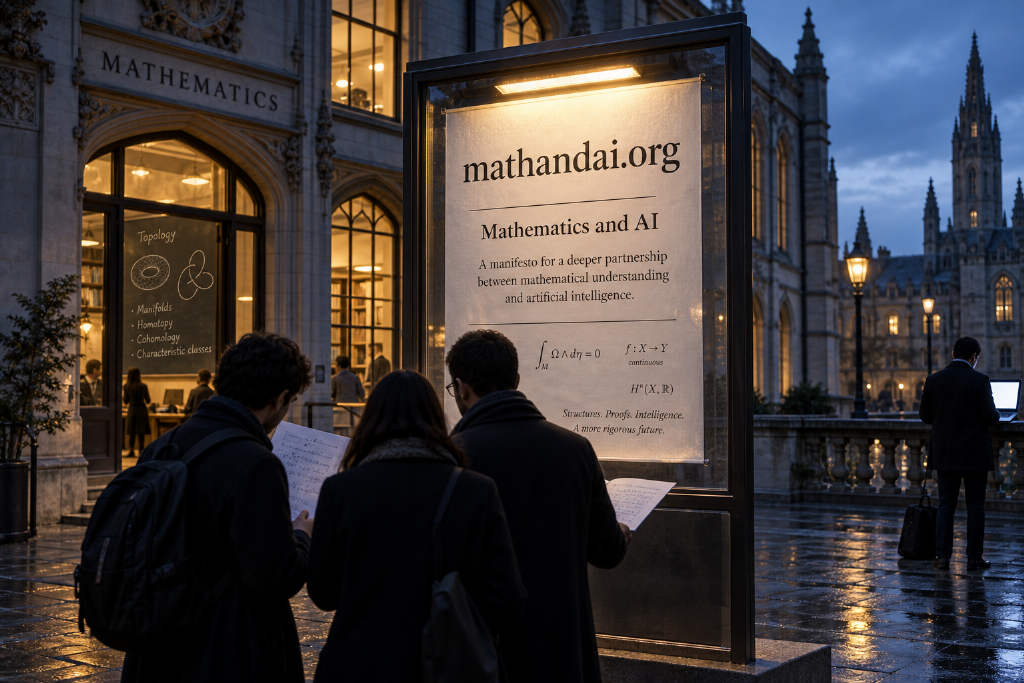
Twenty-five Fields Medalists have jointly released a declaration titled Mathematics and AI on mathandai.org, arguing that the way AI companies frame mathematical problem-solving does not align with the discipline's central goal of conceptual understanding.
The signatories include Terence Tao, Peter Scholze, Maryna Viazovska, June Huh, Pierre Deligne, and this year's winner Yu Deng. Their award years span from 1978 to 2026.
Problem-solving is a tool, not the destination
The declaration acknowledges that large language models have improved "substantially" in mathematics over the past few months and says they are now able to solve major open problems in many fields. But it argues that treating solved problems as the main benchmark of capability misses what mathematics is actually trying to do.
Its core claim is that solving problems is only a tool, and at best a proxy, for the primary objective: achieving conceptual understanding and insight. The signatories write that mathematical practice has been built across generations, and that famous unsolved problems matter because they serve as milestones of progress rather than endpoints.
The statement also says mathematical knowledge is shaped through community processes, including talks, discussions, and simplification. Turning a breakthrough into knowledge that students can understand takes time.
Speed is the central criticism
The declaration singles out speed as a major problem. It says AI-generated solutions are "often announced in haste, without time for proper writing, distilling new methods and ideas, and citing others' relevant prior work." In the signatories' view, that leaves credit unclear and makes it harder to fold the results into the mathematical canon.
The text does not name any company or specific case.
The concern extends beyond mathematics
The signatories broaden the argument beyond mathematics itself. In creative professions, the declaration says, years of training have traditionally not been only about producing a final answer or product, but also about cultivating understanding. When AI provides the output directly, those two goals begin to split apart.
The declaration describes the mathematics community as, in many ways, a "microcosm of humanity" and says its most valuable resources are "students and ideas."
The statement does not reject AI
The closing section does not dismiss AI as such. Instead, it says AI "offers the potential to enhance and accelerate genuine mathematical research." Whether it ultimately helps or harms mathematics, the declaration says, depends on the decisions made by the people who control the technology, and calls for action involving mathematicians, AI companies, and society as a whole.
No company was named, but an OpenAI dispute surfaced this month
While the declaration avoids naming companies or examples, Chain News reported on Sept. 9 that OpenAI said GPT-6 Astra had achieved a breakthrough on the Navier-Stokes equations. Some mathematicians then questioned whether OpenAI had published ahead of researchers who were using Codex in their work, raising disputes over research ethics and attribution.
Full list of signatories
The full list of signatories is: Artur Avila, Manjul Bhargava, Caucher Birkar, Pierre Deligne, Yu Deng, Simon Donaldson, Hugo Duminil-Copin, Alessio Figalli, Martin Hairer, June Huh, Maxim Kontsevich, Elon Lindenstrauss, Pierre-Louis Lions, James Maynard, Curtis McMullen, Shigefumi Mori, Bao Châu Ngô, Andrei Okounkov, Peter Scholze, Stanislav Smirnov, Terence Tao, Maryna Viazovska, Cédric Villani, Wendelin Werner, and Efim Zelmanov.